Cell Reproduction part 2 Concept Review 2
star
star
star
star
star
Last updated about 8 years ago
13 Nsɛmmisa
Hyɛ no nsow a efi ɔkyerɛwfo no hɔ:
A review assignment looking at Mitosis controlee mechanisms
1
1
1
1
1
1
1
1
1
1
1
1
1
A review assignment looking at Mitosis controlee mechanisms
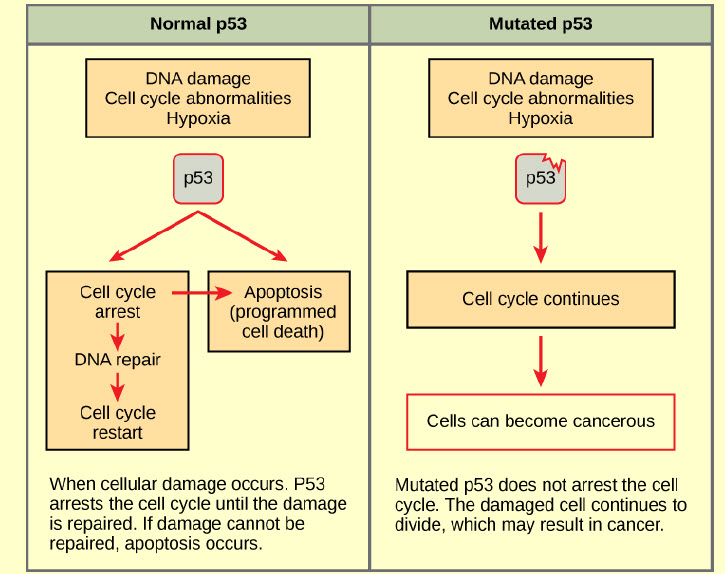
Figure 10.14 The role of normal p53 is to monitor DNA and the supply of oxygen (hypoxia is a condition of reduced
oxygen supply). If damage is detected, p53 triggers repair mechanisms. If repairs are unsuccessful, p53 signals
apoptosis. A cell with an abnormal p53 protein cannot repair damaged DNA and thus cannot signal apoptosis.
Cells with abnormal p53 can become cancerous. (credit: modification of work by Thierry Soussi)
16. At which of the cell cycle checkpoints do external
forces have the greatest influence?
What is the main prerequisite for clearance at the G2
checkpoint?
If the M checkpoint is not cleared, what stage of
mitosis will be blocked?
Which protein is a positive regulator that
phosphorylates other proteins when activated?
Many of the negative regulator proteins of the cell
cycle were discovered in what type of cells?
___________ are changes to the order of nucleotides
in a segment of DNA that codes for a protein.
A mutated gene that codes for an altered version of
Cdk that is active in the absence of cyclin is a(n) _____.