Evolution Final
star
star
star
star
star
Last updated almost 4 years ago
24 Nsɛmmisa
1
1
1
1
1
1
1
1
1
1
1
1
1
1
1
1
1
1
1
1
1
1
1
1
Which of the following statements is TRUE?
“Diversity of species” refers to the idea that:
Which of the following could cause the extinction of a species?
Which of the following statement is FALSE?
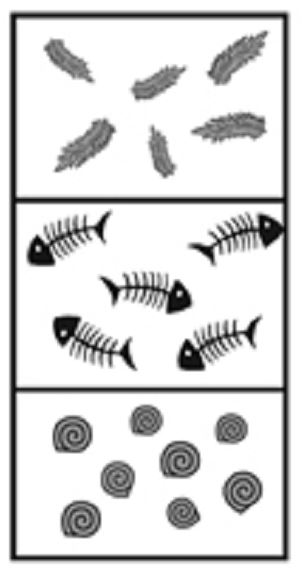
Which of the following is NOT likely to become a fossil?
Based on evidence in the diagram above, the organism that lived most recently:
A paleontologist is most likely to study:
Which of the following statements is an observation based on the image above?
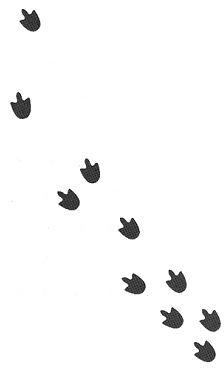
Based on these footprints, you decide that the organism started to run. Your idea is known as:
What kind of information can you collect from these footprints?
According to geological evidence, the earth is:
A population of birds eats the green moths that live in a pine forest. Every so often, the green moths have a brown offspring. The brown moths are usually seen more quickly by the birds and eaten sooner. The fact that the brown moths are easier to see and are less likely to survive as a result is known as:
A population of birds eats the green moths that live in a pine forest. Every so often, the green moths have a brown offspring. The brown moths are usually seen more quickly by the birds and eaten sooner. Which of the following statements is TRUE?
A population of birds eats the green moths that live in a pine forest. Every so often, the green moths have a brown offspring. The brown moths are usually seen more quickly by the birds and eaten sooner. The green moths survive in the forest because:
A population of birds eats the green moths that live in a pine forest. Every so often, the green moths have a brown offspring. The brown moths are usually seen more quickly by the birds and eaten sooner. Imagine that increased pollution caused the pine trees in the forest to be heavily covered with brown particles. What is most likely to happen?
Mutations are:
A man lifts weights and exercises until he is very muscular. He works out with the hope that his children will also be very strong. A problem with this idea is that:
A man lifts weights and exercises until he is very muscular. He works out with the hope that his children will also be very strong. To insure that his children are strong, which of the following should the man do?
Which of the following could describe a mutation in the population?
A female giraffe with a short neck is having a difficult time reaching the leaves in the taller trees. According to the theory of natural selection, which of the following is possible?
A scientist goes to an undisturbed field and begins digging. She finds a leg bone of Dinosaur A about 12 feet below the surface. She keeps digging and then finds a jaw bone of Dinosaur B about 27 feet below the surface. Based on this information, which is the MOST likely:
For many generations, a fish population had a lot of color variation. About half of the fish population was white and the other half gray. A species of large fish that eats the smaller fish enters the area. This large fish can see white fish easier than gray fish. What is likely to happen to the color of the fish population? Explain. (full sentences)
Bringing an extinct species back to life is not yet possible, but someday it will be. Should we bring back extinct species? Discuss the tradeoffs of your decision. (full sentences)
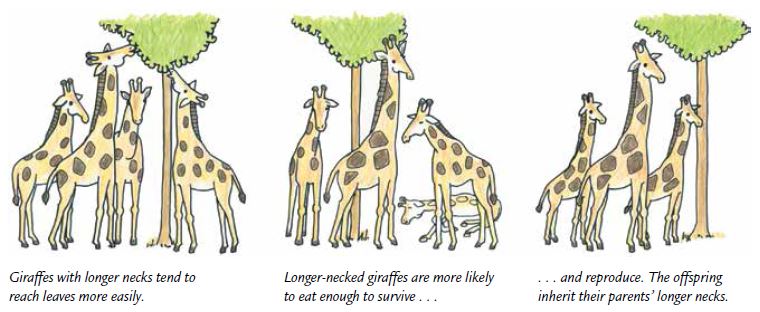
Would Lamarck or Darwin agree with this comic strip about the evolution of giraffes? How would this person describe how the change occurs from generation to generation? (full sentences)