7th Grade Life Science EOC

Last updated over 7 years ago
50 questions
Note from the author:
EOC
1

Researchers grew some bacteria in a lab and tested them in several trials. The results are shown in the table.
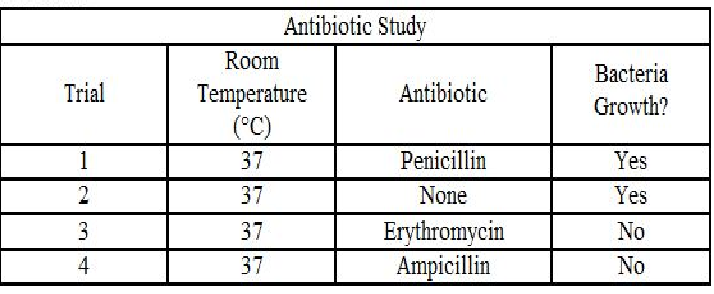
In this experiment, which trial served as the control?
1

Scientists conduct many types of scientific investigations. Their efforts often include fieldwork, surveys, models, and experiments. Which statement about scientific investigations is not true?

1

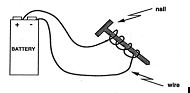
Students made an electromagnet by wrapping a wire in loops around an iron nail and attaching the wire to a battery, as shown below.
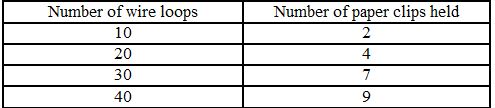
The students conducted a test to learn how the number of wire loops affected the number of paper clips held by the electromagnet. The table below shows the results of the test.
Based on the information from the table, which of the following is the test (independent) variable in this experiment?

1

Ginger hypothesized that she could use a screen to separate a mixture of sugar and sand. When she tried this method, she was not able to separate the mixture. Although her hypothesis was not correct, why was it still valuable?

1

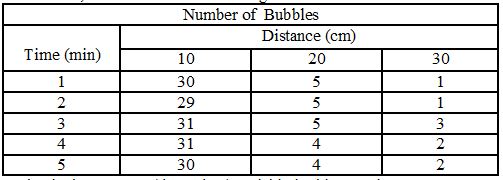
Shawna did an experiment to study the rate of photosynthesis in the water plant Elodea. She placed a piece of Elodea in a beaker of water and set the beaker 10 centimeters from a light source. Shawna counted the bubbles released from the plant every minute for five minutes. She repeated the process two more times. First, she moved the light to 20 centimeters from the beaker, and then she moved the light to 30 centimeters from the beaker. Shawna’s setup and data are shown below.
What is the outcome (dependent) variable in this experiment?

1

Cathy designs an experiment to investigate how well cups made of different materials maintain the temperature of a cold drink. Which step will increase the accuracy and validity of Cathy’s results?

1

Dan uses a thermometer to measure the temperature of alcohol in a beaker. He heats the beaker for 1 minute and measures the temperature again. The temperature increases by 10 degrees. Which of the following experiments replicates Dan’s experiment?

1

If a scientist does an experiment but no one else can get the same results when they replicate the scientist’s experiment, what does that mean?

1

A biologist is studying the migratory behavior of a species of sharks. Which is the best method the biologist could use in the study?

1

Janine is learning about how waves in the ocean form and move. For a class assignment, she builds a wave machine using a glass jar, water, mineral oil, and food coloring. Which best describes how Janine's model helps her to learn about waves?

1

A controlled experiment is a means for carrying out a fair test of a hypothesis. In a controlled experiment, all of the variables that can influence the outcome variable (dependent variable) of the experiment are controlled or held constant, except for the test variable (independent variable). Which of the following hypotheses would NOT be tested using a controlled experiment?

1

Scientists use many different methods of investigation. When possible, scientists want to actually experiment or observe an event. Which method is useful when developing a scientific explanation for a system that cannot be studied directly?

1

A scientist is researching the solar system. How can the scientist best add to the empirical evidence already gathered about the solar system?

1

When Alfred Wegener first proposed his theory of continental drift, most Earth scientists did not immediately accept it. Many expressed skepticism because the theory did not explain what force was strong enough to move continents. Later, scientists investigating continental drift found evidence that explained how continents are able to move. Plate tectonics, which grew from the theory of continental drift, now explains how continents move over time. Which statement is true?

1

What would NOT be empirical evidence that the moon orbits the Earth every 27.3 days?

1

The law of universal gravitation states that both mass and distance of objects affect the gravitational force between them. Gravitational force increases as the mass of the objects increase. Gravitational force decreases as distance between the objects increases. Why are these statements considered scientific law, and not scientific theory?

1

Corrine is studying the theory of evolution. She asks her teacher if the theory of evolution will ever become the law of evolution. Her teacher tells her that it will not. Why can a scientific theory not become a scientific law?

1

In the 1860s, Charles Darwin proposed the theory of evolution. His theory stated that populations change very slowly over a very long period of time. Then in 1972, some scientists took a closer look at the fossil record. They concluded that evolution involves long periods of little change in populations which are interrupted by short periods of rapid change. This finding became part of the theory of evolution. What can you conclude from this information?

1

A physician specializes on surgery involving the esophagus, stomach, and intestines. This physician is specialized at which level of organization.

1

Humans and other complex organisms have a hierarchical system of organization. Which of the following statements is true regarding this system of organization?

1

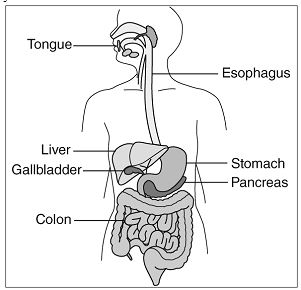
The diagram shows parts of the human body. These parts work together to help you digest the food you eat.
Which term best describes the entire group of parts that are labeled?

1

The cell theory is one of the unifying themes of biology. Which of the following is NOT one of the main components of the cell theory?

1

Some organisms have one cell. Other organisms have multiple cells. Which of the following is a characteristic of cells in a multicellular organism?

1

A cell needs to maintain a certain amount of water within it. The ability of the cell to maintain the stable internal condition is called _____________.

1

Under a high-powered microscope, Dan sees a cellular organelle. His teacher tells him that this organelle is called the “powerhouse,” of the cell. Which organelle does Dan see?

1

You are told that the cells on a microscope slide are plant, animal, or bacterial. You look at them through a microscope and see cell walls and chloroplasts. You conclude that the cells

1

Which ONE of the following correctly matches the organelle with its function?

1

Which of the following describes the relationship between chloroplasts and mitochondria?

1

Julia is learning about the nervous system in school. She learns the nervous system is made up of many parts.What is the main purpose of the nervous system in the human body?

1

Which of the following best explains the interaction between the digestive system and the respiratory system?

1

Which series includes three pathogens that cause infectious diseases?

1

Viruses cause many human diseases. A virus is a strand of DNA or RNA surrounded by a layer of protein. Viruses can replicate

1

In 1990, Carl Woese introduced the three domain system for classifying living things, after the
advancement of DNA analysis allowed for a comparison of species genetic code. Which of the following is the best explanation for why domains were added to the previous system of classification?

1

Felicia’s teacher gives her the following list of organisms:

1. Multicellular organism that has cells with cell walls and makes its own food
2. Multi-cellular organism with cell wall that absorbs food from its environment
3. Single-cellular organism with nucleus that makes its own food
4. Multicellular organism that gets food by eating other organisms

Felicia needs to identify the kingdom for each organism. In what order should she list the kingdoms for organisms 1 through 4?

1

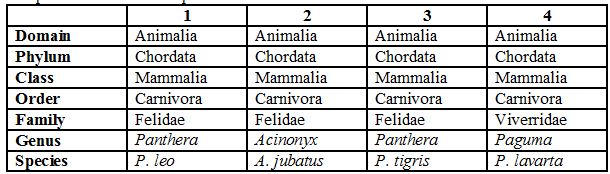
Penelope wants to identify the characteristics that each of four organisms have in common. She uses the following table to help in the identification process.
Which organism should she identify as having the least in common with the other organisms?

1

According to the theory of natural selection, what would happen to a species of lizards when a new predator is introduced into the environmnet where the lizards live?

1

Elephants are the largest land animals alive today. They are the only mammals to have four knees. Evidence of extinct woolly mammoths shows that they shared the trait of having four knees, but they were not African or Asian elephants. How could the mammoths and elephants share this characteristic?

1

A certain reptile species is a herbivore and exists only on an isolated island. Which of the following would most likely result in the extinction of the reptile species over a period of twenty thousand years?

1

Genes, chromosomes, and DNA are important structures for processes related to heredity and reproduction . How are these three structures related?

1

Is there a genetic difference in the daughter cells produced during mitosis and meiosis?

1

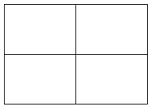
The trait for a dimples (D) is dominant over the trait for no dimples (d). Two people with dimples (Dd x Dd) got married. Complete the diagram below to show the genes of their children. What percentage of the offspring will most likely have no dimples?

1

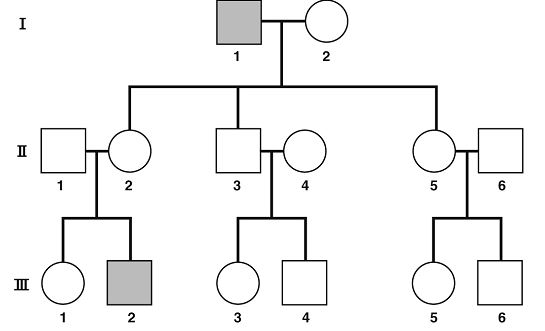
Look at the diagram below.

Assume that shaded individuals have the alleles gg. Which of these statements is true about the alleles of individual 2 in generation II?

1

Veronica discovers a new plant in a forest. She observes it for some time, and when it reproduces, she tests the offspring and finds that they are genetically identical to the parent. Which of these statements is true about Veronica’s find?

1

A spider hides in an orchid flower. It captures and eats insects as they enter the flower. In which case could this be an example of mutualism between the spider and the orchid plant?

1

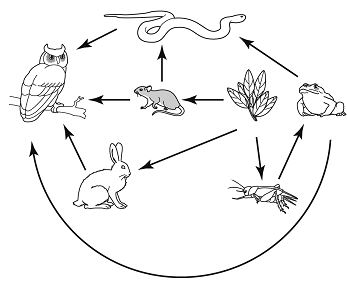
Scientists studied predator-prey relationships in a habitat. The diagram below shows the
feeding relationships among organisms in a certain environment.
Which animal is both a predator and prey?

1

In a pond, the primary producer is a green algea, spirogyra; the primary consumer is the crustacean, daphnia; the secondary consumer is a small fish, the bluegill; and the tertiary consumer is a larger fish, the smallmouth bass. What changes can be expected in the pond if the daphnia are killed with pesticides?

1

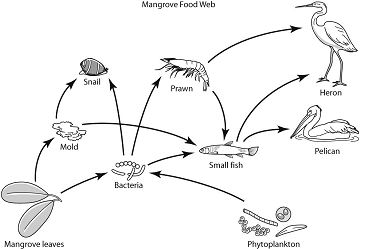
The diagram below shows a food web for a mangrove swamp ecosystem.

In this ecosystem, what organisms compete for the same resources?

1

Which process occurs inside plant and animal cells and releases energy from glucose for the cell to use for cellular functions?

1

In the process of photosynthesis, plants use carbon dioxide, water, and energy to form carbohydrates and oxygen. Which of the following best explains how plants follow the Law of Conservation of Mass during photosynthesis?

1

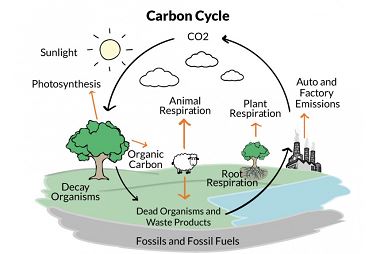
A diagram of the carbon cycle is shown below.

Which of the following best explains the roles plants and animals play in recycling carbon?