Ancient China Assessment
star
star
star
star
star
Last updated almost 7 years ago
21 Nsɛmmisa
1

1
1
1
1
1
1
1
1
1
1
1
1
1
1
1
1
1
1
1
1
HISTORY CLOSE-UP
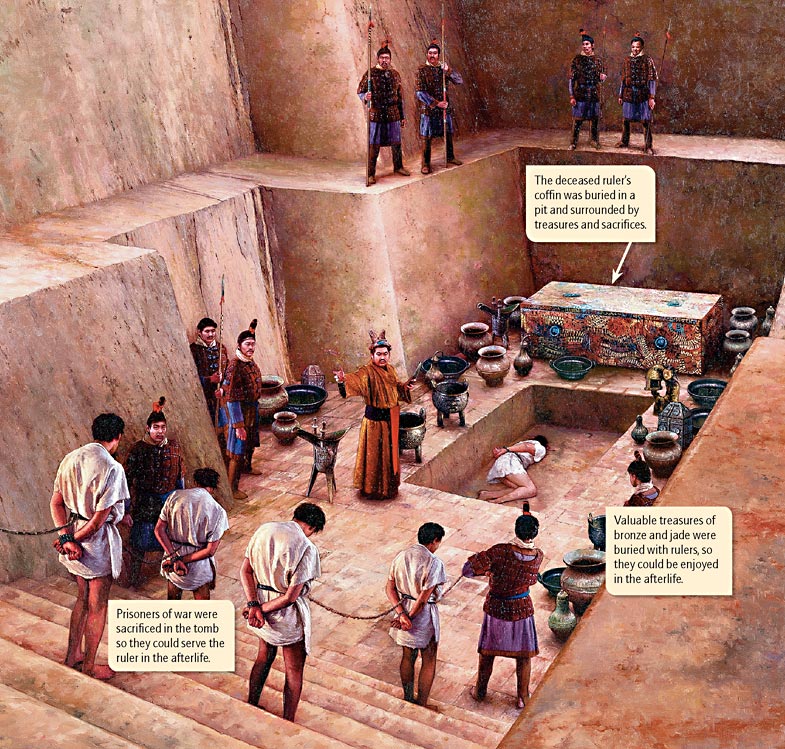
A Shang King’s Tomb Nearly all of the Shang artifacts that archaeologists have found have come from royal tombs. These tombs have not only been a source for material objects but have shed light on Shang beliefs and practices as well. For example, the presence of valuable objects and the remains of huge numbers of sacrificed people and animals in the tombs suggests that the Shang believed in an afterlife. Objects and people were probably placed in the tombs to serve the rulers after death.
What evidence can you see in this illustration that the people of Shang China honored and respected their rulers?
Which dynasty ruled earlier, the Shang or the Zhou?
Around which river valleys were both the Shang and the Zhou located?
Chinese Philosophers
CONFUCIUS
551–479 BC
Known in Chinese as Kongfuzi or Master Kong, the man known in the West as Confucius was born to a poor but noble family. From a young age, he was an eager student, constantly asking questions in order to learn more. As an adult, he became a teacher, the first in China to try to make education available to all children, regardless of their social class. He viewed education as the only way to improve oneself.
As he grew older, Confucius held several positions in local government. He also attracted followers to his teachings. By the time he died, Confucius had more than 3,000 followers.
LAOZI
500s BC
Little is known of the life of Laozi, the recorded author of the Dao De Jing, the major work of Daoist philosophy. According to one ancient historian who lived four centuries after Laozi is said to have died, Laozi had served as the official historian for a powerful noble. The same historian recorded that Laozi once met Confucius, who was younger than Laozi and quite pleased to meet the older philosopher.
Some historians believe that the Dao De Jing was not written by a single person but by several writers over a long period. Nonetheless, Daoists continue to honor the memory of Laozi as its creator.
What similarities can you see in the lives of Confucius and Laozi? How were the two different?
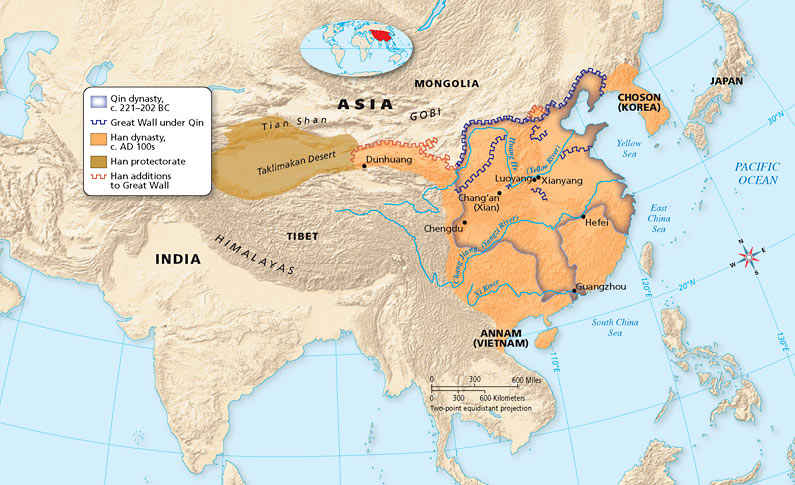
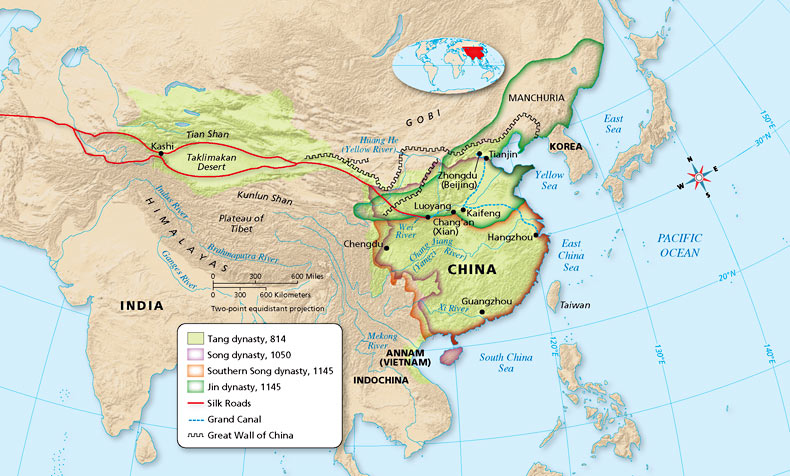
What human-made physical feature marked the northern boundary of both the Qin and Han dynasties?
Where was the Han protectorate located?
SHI HUANGDI
c. 259–210 BC
Qin emperor Shi Huangdi is remembered for unifying China as well as for his harsh Legalist policies and persecution of Confucianism. Later in life he grew paranoid, distrusting his advisors and increasingly isolating himself. His fears were not without merit. He escaped at least three assassination attempts on his life.
How might Shi Huangdi’s Legalist policies have contributed to some people’s desire to assassinate him?
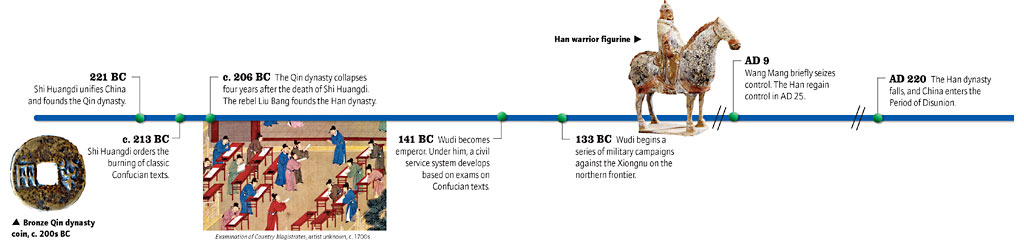
How did the death of Shi Huangdi affect imperial rule in China?
What conflict did the Han dynasty face from AD 9 to 25?
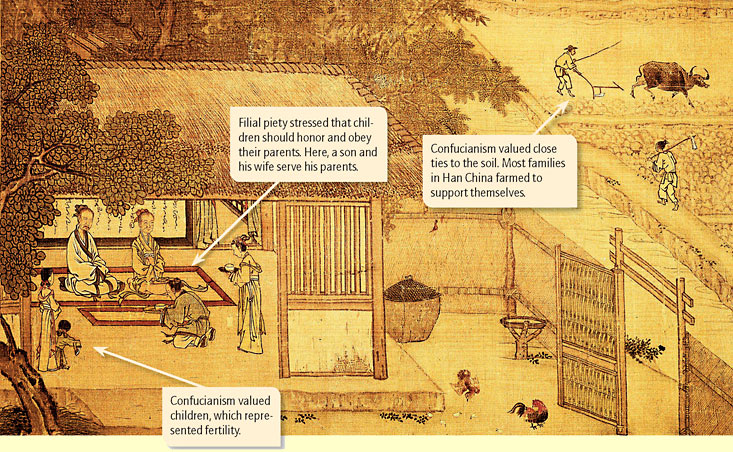
How did the Confucian principle of filial piety influence the roles of family members in Han China?
Based on this image, what were some features of rural homes in Han China?
WU Zhao
625–705
Married to the sickly emperor Kao Tsung, Wu Zhao became the virtual ruler of China. After her husband’s death, Wu Zhao continued to hold virtual power while two of her sons ruled. She considered her sons to be poor rulers, however, and soon took the title of emperor for herself. She then became known as Empress Wu.
Empress Wu ruled with an iron fist. During her rise to power, she had ordered many of her rivals executed, which led many people to oppose her. Nonetheless, she was a gifted and respected ruler. Empress Wu filled her government with talented advisors and administrators who were chosen for their ability rather than their social rank.
Why was Wu Zhao respected as a ruler despite her harsh treatment of her political opponents?
What important trade routes did China gain control of in Central Asia during the Tang dynasty?
How did the area of the Song dynasty differ from that of the Southern Song dynasty, and what major river did the dynasty lose access to when it moved south?
Reading like a Historian
Song City LifeAnalyzing Visuals
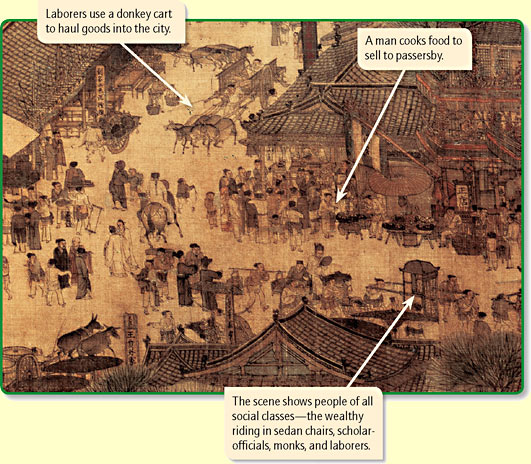
This painting is part of a scroll titled Going Upriver at the Qingming Festival, made by Zhang Zeduan around the 1100s. The image shows a bustling city scene of streets lined with shops and restaurants and people going about their daily activities. To analyze this image of Song city life, think about:
-the subject of the image,
-the details in the image, and
-how the subject is portrayed.
What can you learn about city life in the Song dynasty from this image?
The scroll is an important source of information on working people, who were not often included in the art of the period. What can you learn about working people from this image?
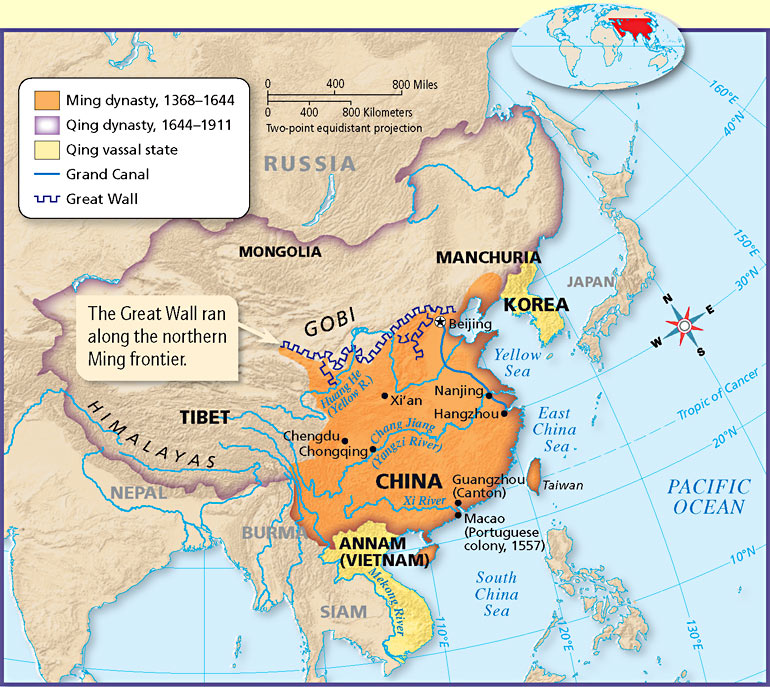
In what region of the Ming empire was Beijing, the capital, located?
What regions did China gain under Qing rule?
Counterpoints
Two Sources on China and Trade
In a letter to King George III of England, Qing emperor Qianlong explains his refusal of the king’s gifts andrequest for trade.
“Swaying the wide world, I have but one aim in view, to maintain a perfect governance and to fulfill the duties of the State: strange and costly objects do not interest me … Our dynasty’s majestic virtue has penetrated unto every country under Heaven, and Kings of all nations have offered their costly tribute by land and sea. As your Ambassador can see for himself, we possess all things. I set no value on objects strange or ingenious [clever], and have no use for your country’s manufactures [products].”
QIANLONG —from a letter to King George III
Lord George Macartney led Great Britain’s first attempt to expand trade relations with China. The Macartney Mission of 1792–1794 ended in failure.
“They receive us … with the highest distinction [and] show us every external mark of favour … Yet, in less than a couple months, they plainly discover that they wish us gone, refuse our requests without reserve …, and dismiss us dissatisfied … I must endeavour [try] to unravel this mystery if I can. Perhaps they have given way to impressions which they could not resist, but are ashamed to confess; perhaps they begin to find their mistake, and wish to make amends.”
LORD MACARTNEY —from an entry in Macartney’s diary
How does Lord Macartney’s view of the trade discussions compare with Emperor Qianlong’s view?
HISTORY & Geography
The Voyages of Zheng He
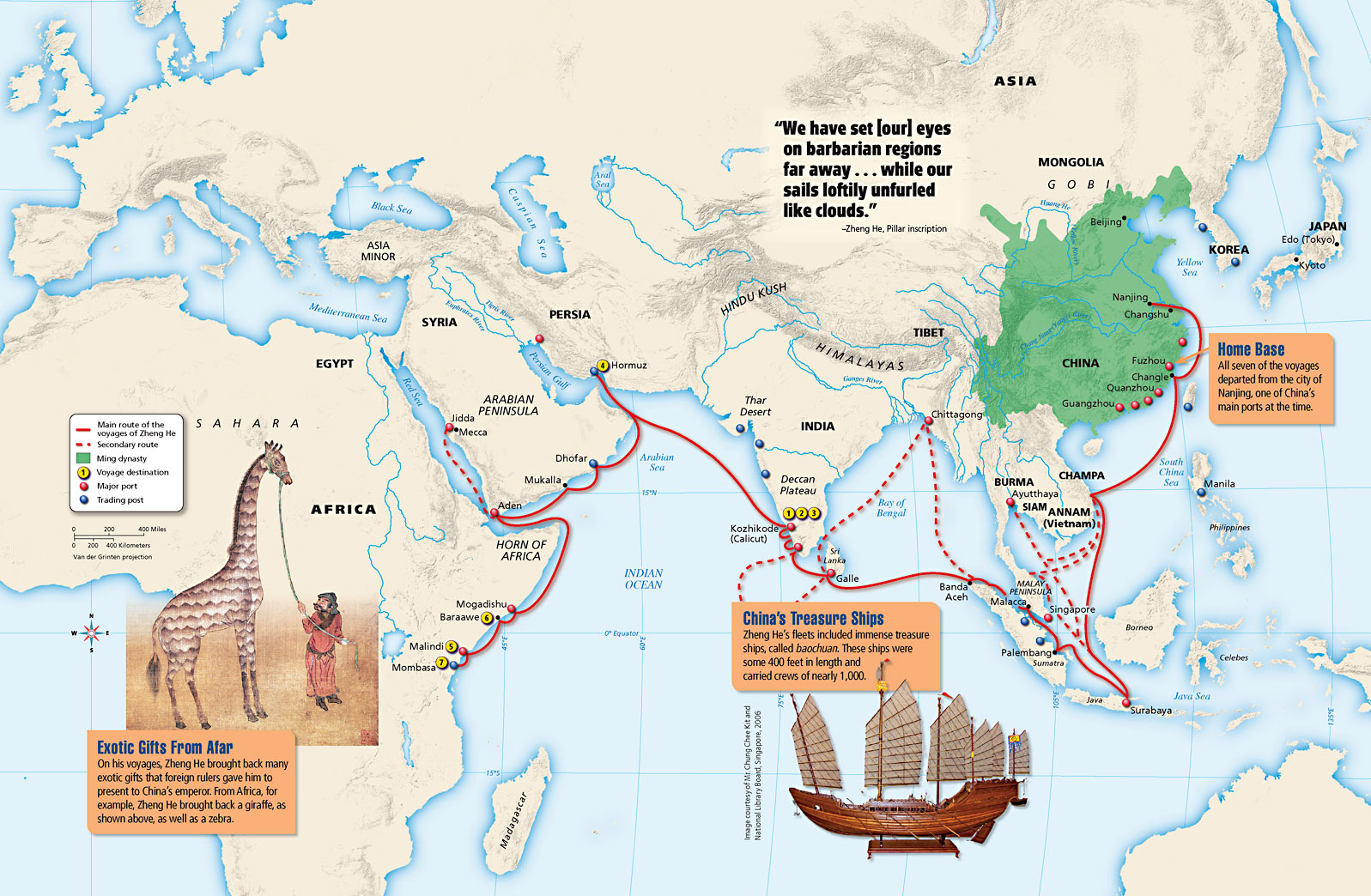
Between 1405 and 1433 the Chinese admiral Zheng He led seven grand voyages throughout the Indian Ocean. During the seven voyages, Zheng He visited ports in Southeast Asia, India, Persia, the Arabian Peninsula, and Africa. The voyages consisted of huge fleets, some with hundred of ships. These ships were like traveling cities; and their crews included not only sailors but also astrologers, blacksmiths, cooks, doctors, officials, royal guards, and translators.
On which of his seven voyages did Zheng He first visit Africa?
What Muslim religious center on the Arabian Peninsula did Zheng He visit on one of his side trips during his voyages?