Log in
Sign up for FREE
arrow_back
Library

Triangle Inequality Theorem

star
star
star
star
star
Last updated 24 days ago
22 questions
1
G.9-12.5.D
1
G.9-12.5.D
1
G.9-12.5.D
1
G.9-12.5.D
1
G.9-12.5.D
1
G.9-12.5.D
1
G.9-12.5.D
1
G.9-12.5.D
1
G.9-12.5.D
1
G.9-12.5.D
1
G.9-12.5.D
1
G.9-12.5.D
1
G.9-12.5.D
1
G.9-12.5.D
1
G.9-12.5.D
1
G.9-12.5.D
1
G.9-12.5.D
1
G.9-12.5.D
1
G.9-12.5.D
1
G.9-12.5.D
1
G.9-12.5.D
1
G.9-12.5.D
Question 1
1.

In your own words, describe what it takes to form a triangle.

Question 2
2.

You and a friend compete in a scavenger hunt at a museum. The two of you walk from the Picasso exhibit to the Native American gallery along the dashed red line. When he sees that another team is ahead of you, your friend says, “They must have cut through the courtyard.” Explain what your friend means.

Question 3
3.

Question 4
4.

Determine if the set of numbers could represent the lengths of the sides of a triangle. Explain.
10 in, 20 in, 30 in

Question 5
5.

Determine if the set of numbers could represent the lengths of the sides of a triangle. Explain.
5 ft, 14 ft, 7 ft

Question 6
6.

Determine if the set of numbers could represent the lengths of the sides of a triangle. Explain.
6 m, 6 m, 11 m

Question 7
7.

Determine if the set of numbers could represent the lengths of the sides of a triangle. Explain.
9 cm, 9 cm, 18 cm

Question 8
8.

Determine if the set of numbers could represent the lengths of the sides of a triangle. Explain.
4 yds, 9 yds, 15 yds

Question 9
9.

Determine if the set of numbers could represent the lengths of the sides of a triangle. Explain.
1 mi, 5 mi, 3 mi

Question 10
10.

Determine if the set of numbers could represent the lengths of the sides of a triangle. Explain.
10 km, 8 km, 6 km

Question 11
11.

Determine if the set of numbers could represent the lengths of the sides of a triangle. Explain.
2 in, 3 in, 6 in

Question 12
12.

Question 13
13.

Question 14
14.

A triangle has two sides of length 7, and 11. The third side must be greater than ________ and less than _______.

Question 15
15.

A triangle has two sides of length 15 and 8. The third side must be greater than ________ and less than ________.

Question 16
16.

A leg of an isosceles triangle is 18. The length of the base must be greater than ________ and less than _________.

Question 17
17.

If the sum of the lengths of two sides of a triangle is 15, what is the largest possible integral value for the length of the third side?

Question 18
18.

If the base of an isosceles triangle has a length of 10, what is the shortest possible integral value for the length of each of the congruent sides?

Question 19
19.

The perimeter of a triangle is 18 inches. If the length of each side is an integer, what length combinations will not form an isosceles triangle?

Question 20
20.

A triangle with one side 3 and another side 7 has perimeter P. What are the least and greatest possible integer values of P?

Question 21
21.

You are enclosing a triangular playground with fence. You have measured two sides of the playground to be 100 feet and 200 feet. What is the maximum total length of fence that you need?

Question 22
22.

D The sum of the lengths of any two sides of a triangle is greater than or equal to the length of the third side.
B The dashed red line and the courtyard walkway determine three sides of a triangle, so by the Triangle Inequality Theorem, the path that follows the dashed red line is equal to than the courtyard walkway.
C The dashed red line and the courtyard walkway determine three sides of a triangle, so by the Triangle Inequality Theorem, the path that follows the dashed red line is shorter than the courtyard walkway.
D The dashed red line and the courtyard walkway determine three sides of a triangle, so by the Triangle Inequality Theorem, the path that follows the dashed red line is longer than the courtyard walkway.
Your family drives across Kansas on Interstate 70. A sign reads, “Wichita 90 mi, Topeka 110 mi.” Your little brother says, “I didn’t know that it was only 20 miles from Wichita to Topeka.” Explain why the distance between the two cities does not have to be 20 mi.
A The sign, Topeka, and Wichita are collinear. If D is the distance between Topeka and Wichita, then
B The sign, Topeka, and Wichita determine the vertices of a triangle. If D is the distance between Topeka and Wichita, then
C The sign, Topeka, and Wichita determine the vertices of a triangle. If D is the distance between Topeka and Wichita, then
D The sign, Topeka, and Wichita determine the vertices of a triangle. If D is the distance between Topeka and Wichita, then
C Yes because the sum of the lengths of any two sides is greater than the length of the third​ side, and this satisfies the triangle inequality theorem.
D Yes because the sum of the lengths of any two sides is less than the length of the third​ side, and this satisfies the triangle inequality theorem.
C Yes because the sum of the lengths of any two sides is greater than the length of the third​ side, and this satisfies the triangle inequality theorem.
D Yes because the sum of the lengths of any two sides is less than the length of the third​ side, and this satisfies the triangle inequality theorem.
C Yes because the sum of the lengths of any two sides is greater than the length of the third​ side, and this satisfies the triangle inequality theorem.
D Yes because the sum of the lengths of any two sides is less than the length of the third​ side, and this satisfies the triangle inequality theorem.
C No because the sum of the lengths of the two shorter sides is less than the length of the third​ side, and this contradicts the triangle inequality theorem.
D No because the sum of the lengths of the two shorter sides is equal to the length of the third​ side, and this contradicts the triangle inequality theorem.
D Yes, because 4 + 9 < 15 satisfies the triangle inequality theorem.
D Yes, because 1 + 3 < 5 satisfies the triangle inequality theorem.
D Yes, because 6 + 8 > 10 satisfies the triangle inequality theorem.
D Yes, because 2 + 3 < 6 satisfies the triangle inequality theorem.
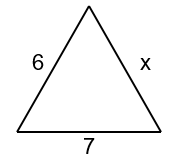
Write an inequality to show possible values of x.
A
B
C
D
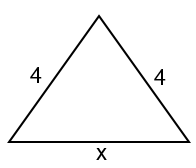
Write an inequality to show possible values of x.

A
B
C
D
C 5, 5, 8
D 6, 6, 6
E 0, 9, 9
C 9 and 15
D 9 and 19
E 15 and 19
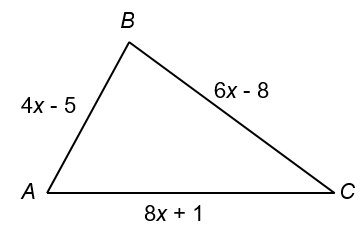
Use the inequality: AB + BC > AC to set up and solve a relationship between the sides of the triangle.
A
B
C
D