Log in
Sign up for FREE
arrow_back
Library
Warm Up Quiz #5
By Jennifer Brooke Passmore
star
star
star
star
star
Share
share
Last updated over 7 years ago
20 questions
Add this activity
Note from the author:
Warm up questions over levels of organization and some body systems
5
5
5
5
5
5
5
5
5
5
5
5
5
5
5
5
5
5
5
5
Question 1
1.
Which diagram shows the correct levels of organization in a multicellular organism?
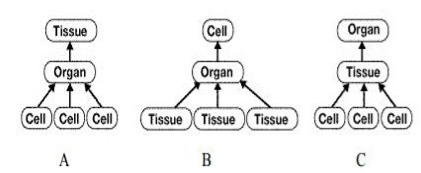
A
B
C
None of the above
Question 2
2.
Which of the following is an organ system?
A. Intestine
B. Heart
C. Circulatory
D. Pancreas
Question 3
3.
A group of cells similar in structure and function make up a(n):
A. Organ
B. Organ System
C. Organism
D. Tissue
Question 4
4.
What type of tissue is important to regulating the movement of substances in and out of structures in the body?
A. Epithelial
B. Connective
C. Muscular
D. Nervous
Question 5
5.
What type of tissue is specialized to react to stimuli by conducting impulses to various organs in the body?
A. Epithelial
B.Connective
C. Muscular
D. Nervous
Question 6
6.
Why is the skeletal system important to your body?
A. It protects internal organs
B. It supports the body
C. It allows the body to move
D. All of the above
Question 7
7.
What type of muscle is found in the heart?
A. Skeletal muscle
B. Smooth muscle
C. Cardiac muscle
D. Both a and b
Question 8
8.
Neurons are most important to the:
A. Nervous System
B. Skeletal System
C. Digestive System
D. Integumentary System (skin)
Question 9
9.
Why is cartilage important?
A. It stores calcium
B. It provides cushion between joints
C. It adds structure to parts of the body, such as the ears and nose
D. Both b and c
Question 10
10.
The bones in movable joints are held together by strong connective tissues called
A. ligaments.
B. cartilage.
C. muscles.
D. skin.
Question 11
11.
The joint in your shoulder is an example of a
A. ball and socket joint.
B. pivot joint.
C. hinge joint.
D. gliding joint.
Question 12
12.
The body's ability to maintain a steady internal temperature when the outside temperature changes is an example of
A. metabolism.
B. homeostasis.
C. respiration.
D. perspiration.
Question 13
13.
What is made inside bones?
A. Skin cells
B. Blood cells
C. Nerce cells
D. Cartilage
Question 14
14.
What type of muscle is most important to moving food through the
digestive system?
A. Seletal muscle
B. Smooth muscle
C. Cardiac muscle
D. Both a and c
Question 15
15.
What type of muscle can be consciously controlled?
A. Seletal muscle
B. Smooth muscle
C. Cardiac muscle
D. Both b and c
Question 16
16.
Which of the following is NOT a function of the skin?
A. To protect the body from disease and injury
B. To help regulate body temperature
C. To help digest nutrients
D. To help excrete waste
Question 17
17.
What type of tissue makes up the structural framework of the human body?
A. Epithelial
B. Connective
C. Muscular
D. Nervous
Question 18
18.
Organs that work together to perform a life function make up a(n):
A. Cellular System
B. Organ System
C. Organism
D. Tissue
Question 19
19.
Which type of tissue provides support for the human body and attaches the various parts together?
A. Muscle
B. Nervous
C. connective
D. Sensory
Question 20
20.
The heart, brain, and stomach are made up of groups of
A. Organelles
B. Organ System
C. Tissues
D. Blood