Right Triangle Trigonometry in Real Life
star
star
star
star
star
Last updated over 7 years ago
15 Nsɛmmisa
1
1
1
MGSE9-12.G.SRT.8
1
1
1
1
1
1
1
1
1
1
1
1
In this lesson, you will apply what you know about solving right triangles to real-life situations.
Before you proceed, you should know the basics of Trigonometry, like how to:
- Label sides of the triangle (hypotenue, opposite, adjacent)
- Choose the right ratio (sine, cosine, or tangent)
- Use the Pythagorean Theorem to find a missing side
- Use the Triangle Sum Theorem to find a missing angle
- Solve an equation involving trig (find the missing side or angle)
If you'd like more practice on any of these foundational skills, please go back to the hyperdoc and select the Google Form in the "Remediate" section.
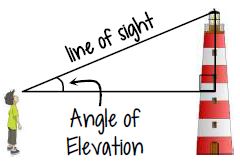
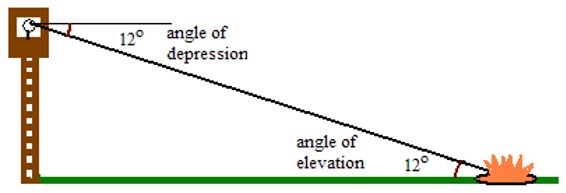
The "line of sight" is what part of the right triangle?
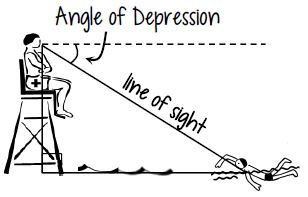
The angle of depression is ____________ to the angle of elevation because they are _______________________.
• Mark the right angle in the diagram.
• Mark given angle measures or side lengths.
• Use “x” to mark the side/angle you're asked to find.
• Decide which trig function to use.
• Write an equation and solve.
• Check that your answer is reasonable.
Draw the variable x on the side or angle that is described below.
Draw the variable x on the side or angle that is described below.
Label the picture with the given information and place an x on the part we want to know.
Which trig ratio can be used to solve this problem?
What is the approximate height of the tower? Round to the nearest tenth. (numberonly)
Label the picture with the given information and place an x on the part we want to know.
Which trig ratio can be used to solve this problem?
What is the approximate height of the lamp post? Round to the nearest tenth. (number only)
Label the picture with the given information and place an x on the part we want to know.
Which trig ratio can be used to solve this problem?
Label the picture with the given information and place an x on the part we want to know.
Which trig ratio can be used to solve this problem?
What is the approximate measure of the angle to the nearest degree? (number only)