The diagram below shows the feeding relationships between populations of organisms in an area. The arrows point from the organisms being eaten to the organisms that eat them.
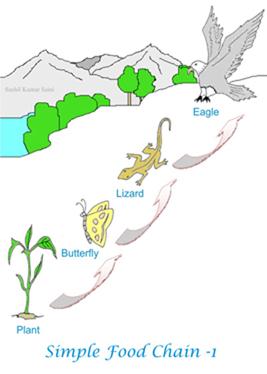
Using only the the relationships between the organisms shown in the diagram, if most of the butterflies are killed, which of the following statements describes what will happen to the number of lizards and why? (SC.7.L.17.1)
1 point
1
Question 2
2.
Which organisms in the food web
shown above compete for the same food source? (SC.7.L.17.2)
1 point
1
Question 3
3.
Which pair of terms could apply to the same organism? (SC.7.L.17.1)
1 point
1
Question 4
4.
All organisms take energy from their environment. Every organism needs this energy in order to grow and reproduce. How do producers get energy? (SC.7.L.17.1)
1 point
1
Question 5
5.
According to the food web above, which organism is a producer in this ecosystem? (SC.7.L.17.1)
1 point
1
Question 6
6.
Fungi, which break down dead organisms, are _____________. (SC.7.L.17.1)
1 point
1
Question 7
7.
Remoras are small fish that attach to sharks but do not harm them. When sharks tear prey apart, remoras eat the leftovers and the sharks don’t receive any benefit. What relationship do remoras have with sharks? (SC.7.L.17.2)
1 point
1
Question 8
8.
An orgamism that gets energy from the sun to make its own food is a _____________. (SC.7.L.17.1)
1 point
1
Question 9
9.
An organism that gets energy by eating other organisms is a _________________. (SC.7.L.17.1)
1 point
1
Question 10
10.
The place in an ecosystem where an organism lives is called ____________________. (SC.7.L.17.2)
1 point
1
Question 11
11.
The organisms living in an area and the nonliving features of that environment form __________. (SC.7.L.17.1)
1 point
1
Question 12
12.
All the tortoises living in a specific region of a desert ecosystem make up what? (SC.7.L.17.1)
1 point
1
Question 13
13.
The largest number of organisms from a particular species that can live in an ecosystem at one time is the __________ for that species in that ecosystem. (SC.7.L.17.2)
1 point
1
Question 14
14.
Which of these organisms is a producer? (SC.7.L.17.1)
1 point
1
Question 15
15.
Your sick puppy is diagnosed with roundworms. What type of symbiotic relationship do the puppy and the roundworms have? (SC.7.L.17.3)
1 point
1
Question 16
16.
Compared to a carnivore, what advantage does an omnivore have? (SC.7.L.17.2)
1 point
1
Question 17
17.
This figure is an example of which type of interaction in an ecosystem? (SC.7.L.17.3)
1 point
1
Question 18
18.
What causes competition? (SC.7.L.17.1)
1 point
1
Question 19
19.
Mushrooms, bacteria and worms are excellent decomposers putting essential elements back into the soil. What is another name for this category of organisms? (SC.7.L.17.3)
1 point
1
Question 20
20.
From the chart, which type of move did the largest population make? (SC.7.L.17.2)
