Quiz: Endothermic and Exothermic Rxns
star
star
star
star
star
Last updated over 7 years ago
20 Nsɛmmisa
Hyɛ no nsow a efi ɔkyerɛwfo no hɔ:
Properties (descriptions) of endothermic and exothermic reactions.
1
1
1
1
1
1
1
1
1
1
1
1
1
1
1
1
1
1
1
1
Properties (descriptions) of endothermic and exothermic reactions.
Chemical reactions don't need energy to break apart bonds.
In a chemical reactions new bonds form to make the products.
Energy cannot be created nor destroyed.
More energy is released by products than is needed to break bonds.
Products have less energy than the reactants.
It literally means "taking in heat."
Energy is needed to keep the reaction going.
Reactions feel hot to us.
An example is baking soda and vinegar.
Reaction feels cold.
Wood burning is an example.
Products have more energy than the reactants.
Heat is absorbed.
Photosynthesis is an example.
Combustion reactions are examples.
This equation: Reactants→Products+Energy
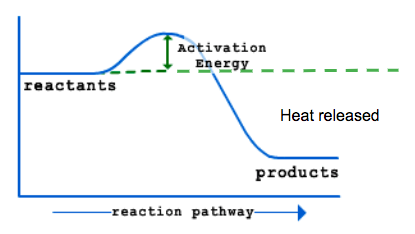
Is the graph above respresentative of an endothermic or exothermic reaction?
From where does the energy for photosynthesis come?
During the photosynthesis reaction plants convert carbon dioxide and water to
The energy needed to start reactions is called