Algebra 1 4-2 Guided Practice: Patterns and Linear Functions
star
star
star
star
star
Last updated over 4 years ago
16 Nsɛmmisa

Solve It! Identify quantities in the picture that vary in response to other quantities. Select all that apply.

Take Note: Define dependent variable.
Take Note: Define independent variable.
Take Note: Describe an example relationship between two variables. Identify the dependent variable and independent variable.
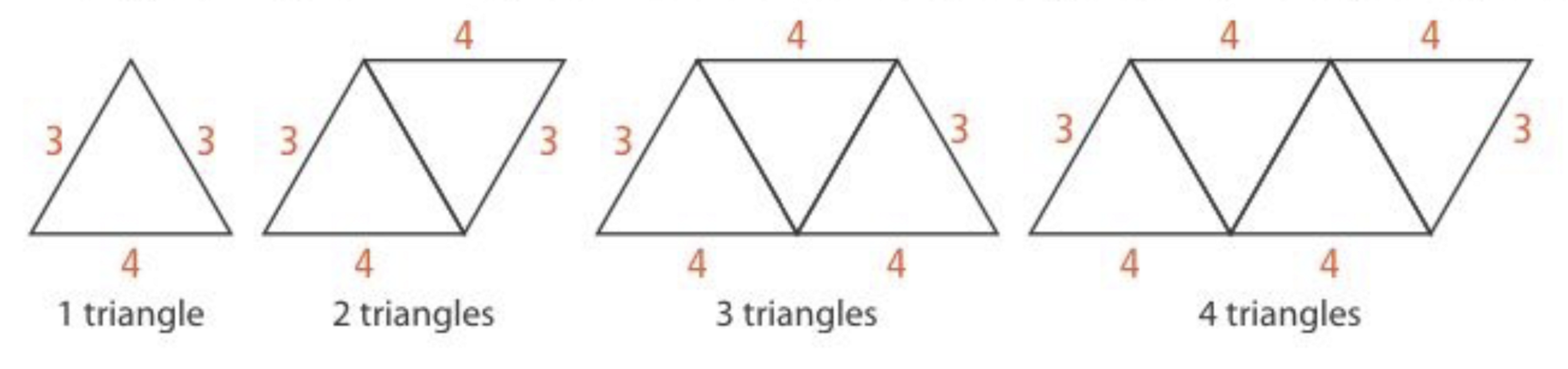
Problem 1 Got It? Consider the relationship between the number of triangles in each figure in the diagram below and the perimeter of each figure.
Problem 1 Got It? Represent this relationship with a table and a graph.
Use contrasting colors to:
Complete the table on the canvas.
Plot the points on the coordinate plane
Indicate scale on both axes
You may complete your work on paper or on a whiteboard and upload a clear picture of it to the canvas.

Take Note: Define function.
Take Note: Define linear function.
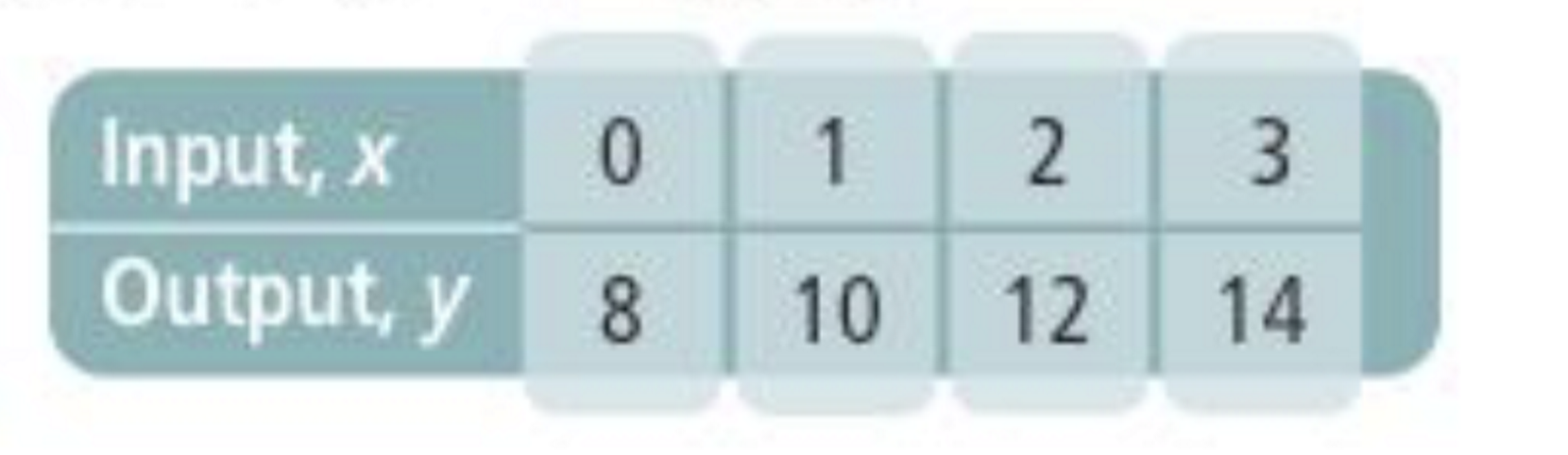
Problem 2 Got It? Consider the relationship represented in the table below.
Problem 2 Got It? Does the relationship represent a linear function?
Problem 2 Got It? Describe the relationship using words.
Take Note: Summarize the mathematical content of this lesson. What topics, ideas, and vocabulary were introduced?
Take Note: Are values of the dependent variable the inputs or outputs of the relation?
Take Note: Are values of the independent variable the inputs or outputs of the relation?
Problem 1 Got It? Which equation represents the relationship?
Problem 1 Got It? Reasoning: Suppose you know the perimeter of n triangles. What would you do to find the perimeter of n + 1 triangles?
Problem 2 Got It? Which equation represents the relationship?
Problem 2 Got It? Represent the relationship using a graph. Use contrasting colors. You may complete your work on paper or on a whiteboard and upload a clear picture of it to the canvas.
Be sure to include relevant graph detail: label axes, indicate units and scale on both axes, and use arrows to represent end behavior, as appropriate.