Algebra 2 5-5 Guided Practice: Theorems About Roots of Polynomial Equations
star
star
star
star
star
Last updated almost 4 years ago
25 Nsɛmmisa

3
10
3
10
3


3
10
3

3
12
8
8
10

Video Check: Select all that apply with regards to the video embedded directly above this item.
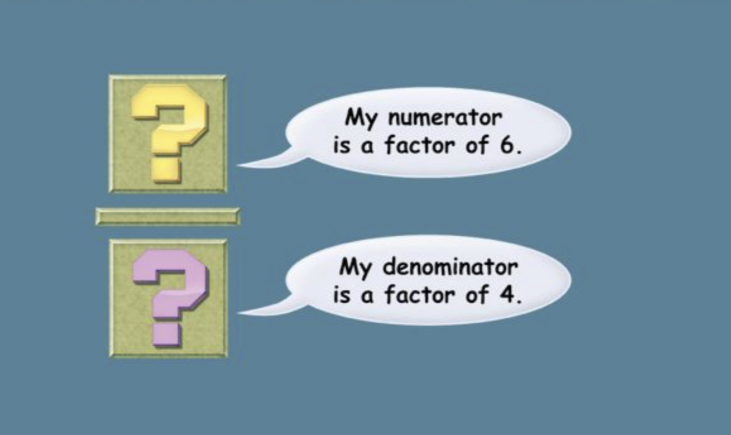
Solve It! I am greater than my square. The sum of my numerator and denominator is 5. What fraction am I?
Video Check: Select all that apply with regards to the video embedded directly above this item.

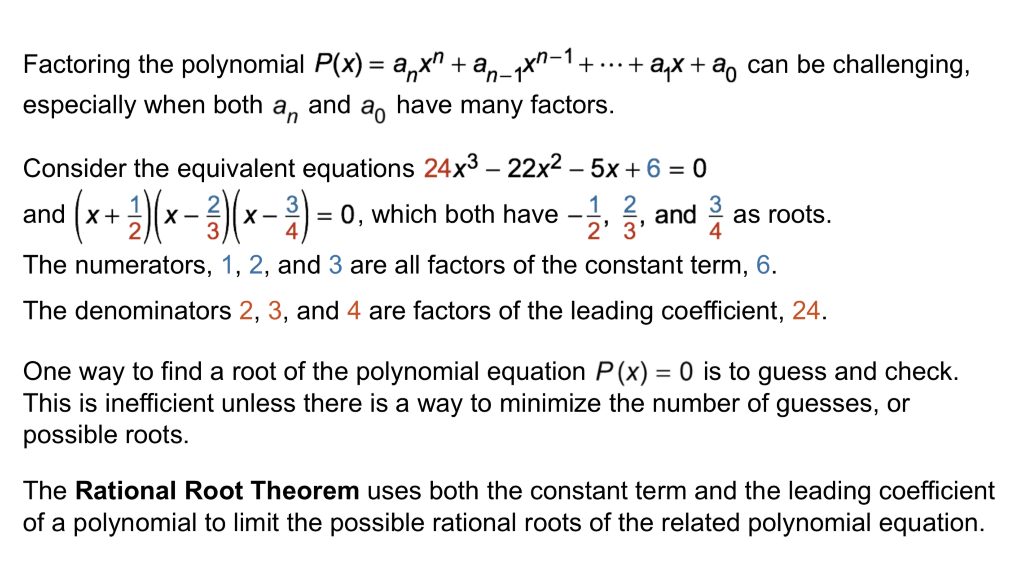
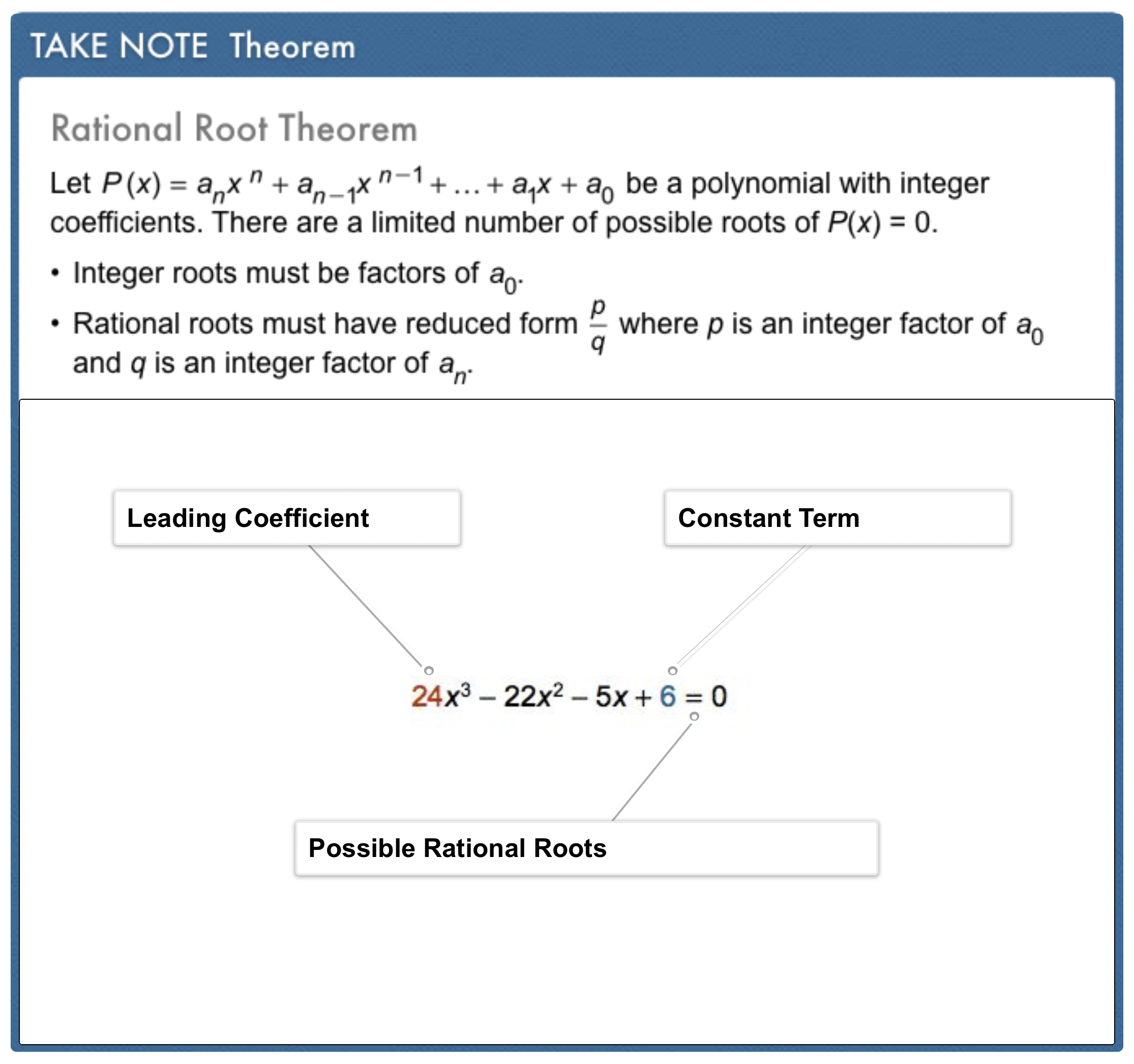
Take Note: Consider the polynomial function
Place each item from the left into the correct category on the right.
2
3
5
-3
1
The constant term
The leading coefficient

Take Note: Summarize the Rational Root Theorem. You may use the canvas to help illustrate your written summary.

Problem 1 Got It?
Video Check: Select all that apply with regards to the video embedded directly above this item.
Take Note: Summarize the process of using the Rational Root Theorem to find rational roots. (This is the process used in Problem 2.) You may use the canvas to help illustrate your written summary.

Problem 2 Got It?
Video Check: Select all that apply with regards to the video embedded directly above this item.
Take Note: Match each expression with its conjugate.
| Draggable item | arrow_right_alt | Ade a ɛne no hyia |
|---|---|---|
| arrow_right_alt | ||
| arrow_right_alt | ||
| arrow_right_alt | ||
| arrow_right_alt | ||
| arrow_right_alt |
Take Note: Summarize the Conjugate Root Theorem.
Take Note: According to the Conjugate Root Theorem, if you know that
Take Note: According to the Conjugate Root Theorem, if you know that

Problem 3 Got It?
Video Check: Select all that apply with regards to the video embedded directly above this item.

Problem 4 Got It?
HINT: you will need to multiply factors derived from the given roots, including (x - (2 - 3i)) and (x - (2 + 3i)).
Video Check: Select all that apply with regards to the video embedded directly above this item.
Take Note: Categorize each polynomial function on the left based on its number of sign changes.
You may need to zoom out to see all of the items. You can also place each item from the left column by selecting it (click it) then selecting (clicking on) the category for it.
0 Sign Changes
1 Sign Change
2 Sign Changes
3 Sign Changes
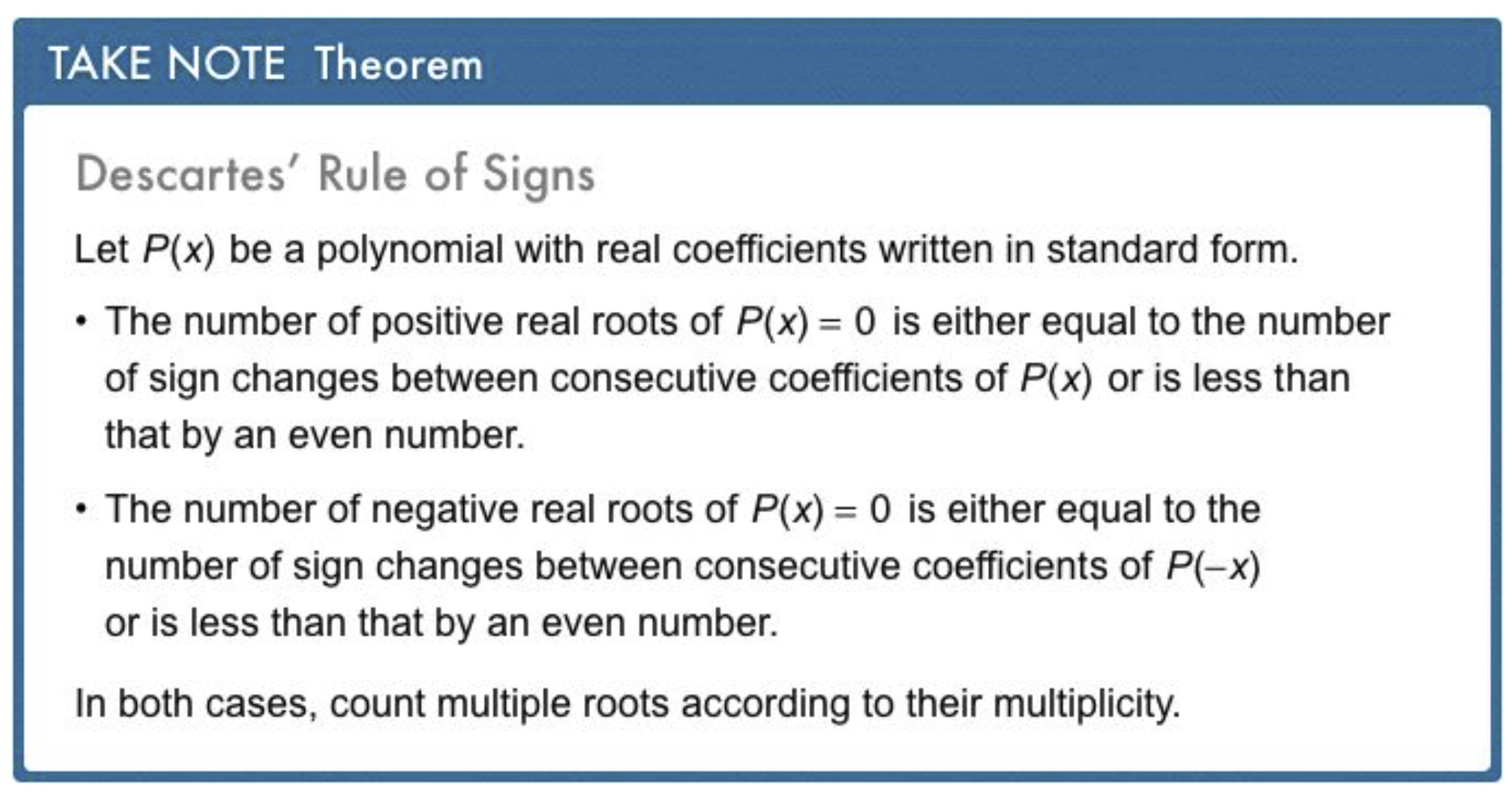
Take Note: Summarize Descartes' Rule of Signs. You may use the canvas to help illustrate your written summary.
Take Note: Descartes' Rule of Signs depends on being able to count sign changes in both P(x) and P(-x). If
what is P(-x)? Write the function in the same format as P(x), beginning with P(-x)=.
Take Note: Use Descartes' Rule of Signs to identify ALL of the possible numbers of roots that the polynomial function P(x) may have based on the sign change information provided.
HINT: Each category contains 3 items.
0
1
2
3
4
5
6
7
P(x) has 5 sign changes, how many POSITIVE real roots may it have?
P(-x) has 4 sign changes, how many NEGATIVE real roots may it have?
Problem 5 Got It? Identify the statements that can be made using Descartes' Rule of Signs regarding the function.
There is one negative real root.
There are two negative real roots.
There are one or three positive real roots.
There are two or four positive real roots.
According to Descartes' Rule of Signs:
Problem 5 Got It? Reasoning: Can you confirm real and complex roots graphically? Explain. Identify the true statements below.

🧠 Retrieval Practice:
Summarize the mathematical content of this lesson. What topics, ideas, and vocabulary were introduced?