Log in
Sign up for FREE
arrow_back
Library

Algebra 2 7-1 Complete Lesson: Exploring Exponential Models

star
star
star
star
star
Last updated over 4 years ago
35 questions
Note from the author:
10
A.CED.2
30
F.IF.7.e
10
F.IF.7.e

10
A.CED.2
10
A.CED.2
30
F.IF.7.e
30
F.IF.7.e
10
A.SSE.1.b
10
A.SSE.1.b
10
A.SSE.1.b
10
A.SSE.1.b
10
A.SSE.1.b
10
A.SSE.1.b
10
F.IF.7.b
10
F.IF.7.b
20
F.IF.7.b
10
F.IF.8.a
30
A.REI.8
10
F.IF.7.e
10
10
10
A.SSE.1.b
10
A.SSE.1.b
100
10
A.CED.2
A.SSE.1.b
F.IF.7.e
A complete formative lesson with embedded slideshow, mini lecture screencasts, checks for understanding, practice items, mixed review, and reflection. I create these assignments to supplement each lesson of Pearson's Common Core Edition Algebra 1, Algebra 2, and Geometry courses. See also mathquest.net and twitter.com/mathquestEDU.
Question 1
1.

Question 2
2.

Problem 1 Got It? Graph the functions in the same coordinate plane using contrasting colors. Include all relevant graph detail and label the functions.
Graph the functions by hand first, but you may check your graphs with Desmos and make edits as needed.

Question 3
3.

10
F.IF.7.e
10
F.IF.7.e
10
F.IF.7.e
10
A.CED.2
Question 8
8.

Question 9
9.

10
10
F.IF.7.e
10
A.SSE.1.b
10
A.SSE.1.b
10
A.SSE.1.b
10
A.SSE.1.b
Question 16
16.

a. Sketch the function on the canvas below by hand using the blue pen tool
b. Graph the function on the embedded Desmos graphing calculator above
c. Sketch a copy of the Desmos graph below using the red pen tool on the same plane as your blue sketch (it is okay if your graphs overlap, that's good!)

Be sure to include important graph detail: label axes and indicate the scale of each axis.
Question 17
17.

a. Sketch the function on the canvas below by hand using the blue pen tool
b. Graph the function on the embedded Desmos graphing calculator above
c. Sketch a copy of the Desmos graph below using the red pen tool on the same plane as your blue sketch (it is okay if your graphs overlap, that's good!)

Be sure to include important graph detail: label axes and indicate the scale of each axis.
Question 19
19.

Question 20
20.

Question 21
21.

Question 22
22.

Question 23
23.

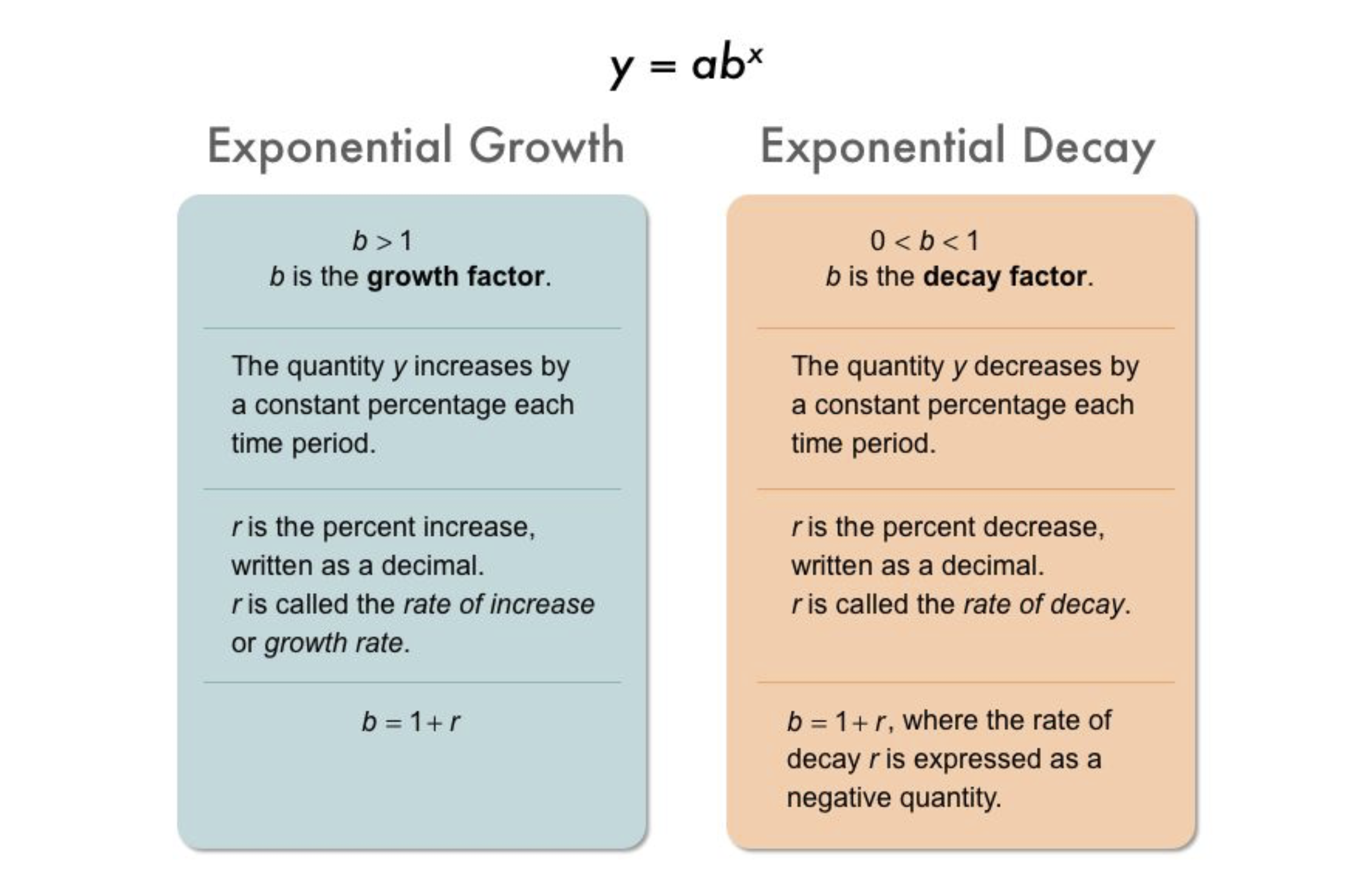
Error Analysis: A classmate says that the function shown has a growth factor of 0.3. What is the student's mistake?

Question 24
24.

Review Lesson 6-8: Graph the function. Zoom and pan your graph to establish an appropriate viewing window.

We have released a new and improved Graphing question type! Students will no longer be able to answer this question.
Question 25
25.

Review Lesson 6-8: Graph the function. Zoom and pan your graph to establish an appropriate viewing window.

We have released a new and improved Graphing question type! Students will no longer be able to answer this question.
Question 26
26.

Review Lesson 6-8: Graph the function on the canvas. Consider creating a table of values or translating the parent function. Include relevant graph detail.

Question 27
27.

Review Lesson 4-4: Factor the expression completely.

Question 28
28.

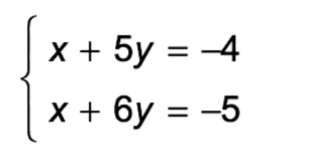
Review Lesson 3-6: Solve the system of equations using a matrix. Matrix frame rectangles have been added to the canvas for your convenience, along with a some matrix elements in blue. Complete your work using contrasting colors.

Question 29
29.

Review Lesson 7-1: Graph each function in the same plane. Zoom and pan your graph to establish an appropriate viewing window.

We have released a new and improved Graphing question type! Students will no longer be able to answer this question.
Question 30
30.

Question 31
31.

Question 32
32.

Question 33
33.

Question 34
34.

Notes: Take a clear picture or screenshot of your Cornell notes for this lesson. Upload it to the canvas. Zoom and pan as needed.

For a refresher on the Cornell note-taking system, click here.

Question 35
35.

Reflection: Math Success

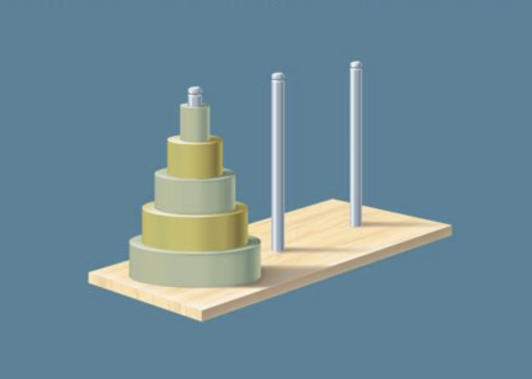
Solve It! You are to move the stack of 5 rings to another post.
Here are the rules:
◆ A move must consist of taking the top ring from one post and placing it onto another post.
◆ You can move only one ring at a time.
◆ Do not place a ring on top of a smaller ring.

Consider the fewest number of moves needed to solve pyramids composed of 1, 2, 3... rings. Match the correct minimum number of moves on the left with each pyramid described on the right.

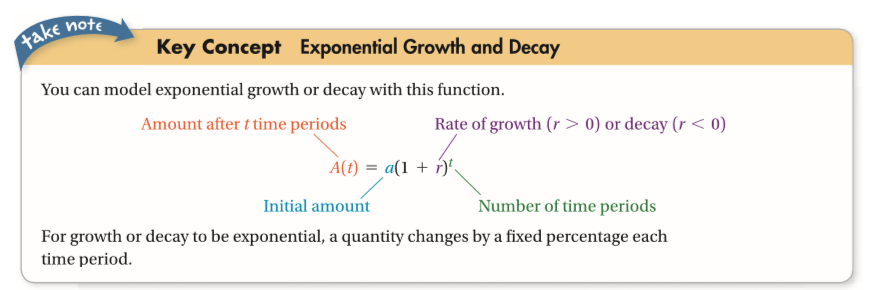
Hint: Consider modeling the scenario with an equation in the following format:
where m = number of moves, n = number of rings, and a and b are constants.
1 move
2 moves
3 moves
5 moves
10 moves
31 moves
42 moves
1023 moves
1,048,575 moves
2,531,703 moves
Pyramid with 1 ring
Pyramid with 2 rings
Pyramid with 5 rings
Pyramid with 10 rings
Pyramid with 20 rings
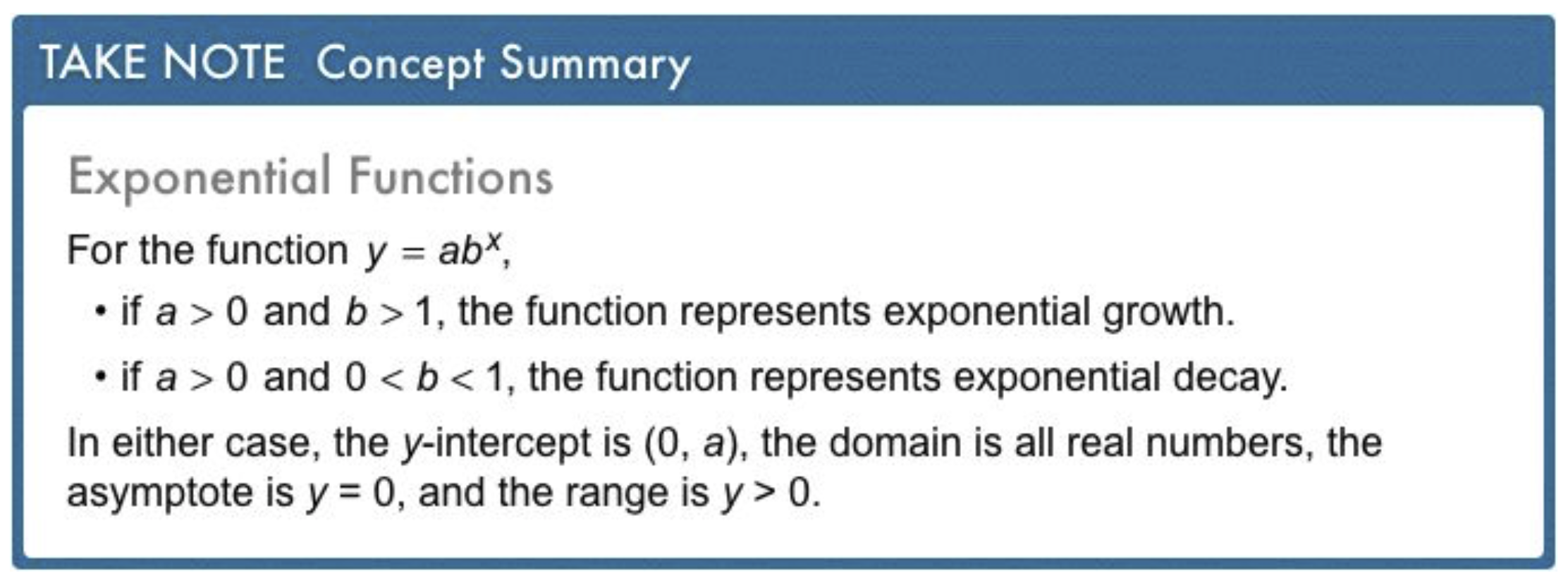
Problem 1 Got It? Reasoning: What generalization(s) can you make about the domain, range, and y-intercepts of these functions? Select all that apply.
Domain: all real numbers
Range: all real numbers
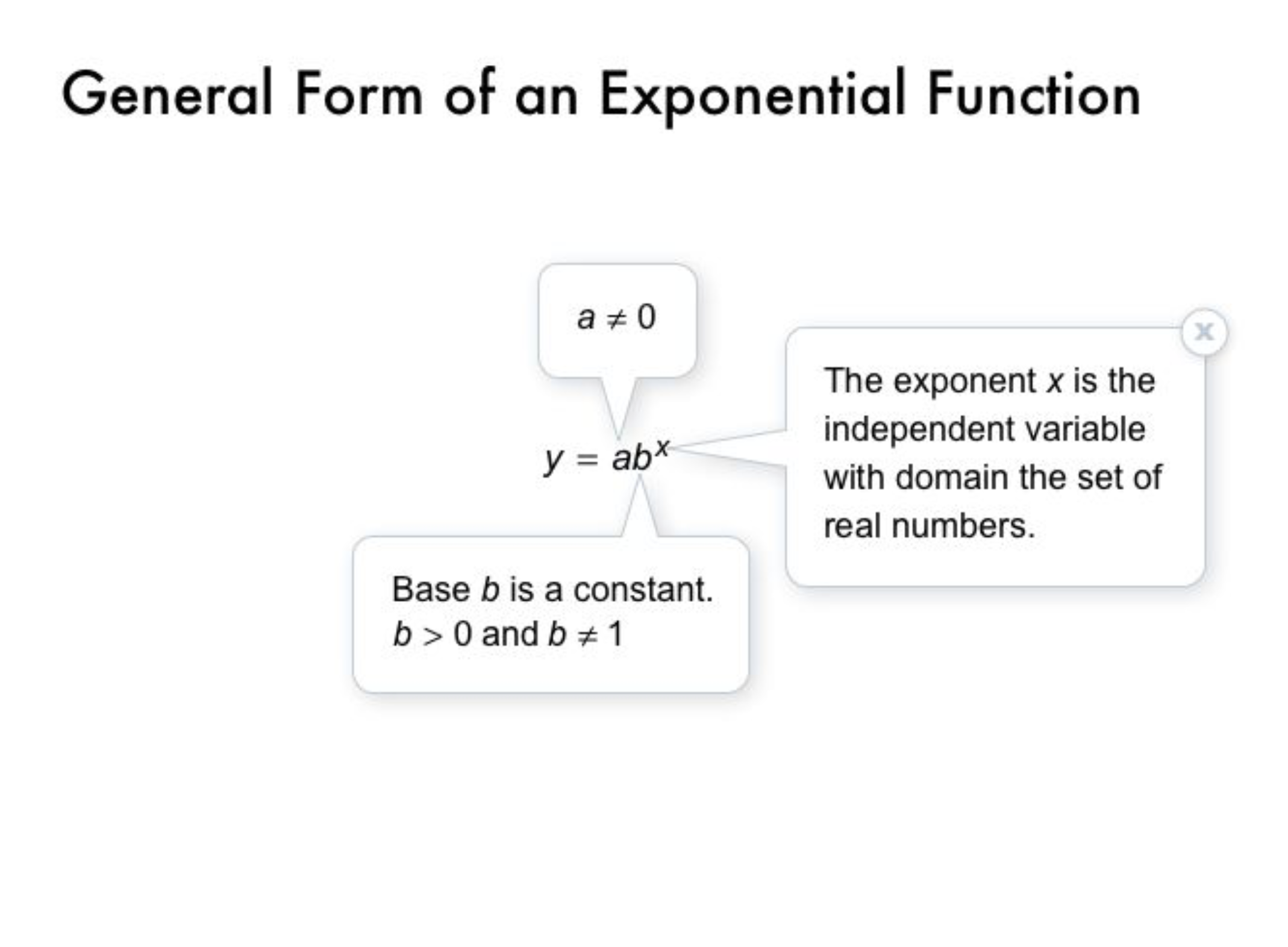
y-intercept (0, a), where y = abx
Range: x < -1
Range: y > 0
Question 4
4.

Question 5
5.

Question 6
6.

Question 7
7.

Problem 4 Got It? Suppose you invest $500 in a savings account that pays 3.5% annual interest. When will the account contain at least $650?
After 2 years
After 3 years
After 5 years
After 8 years
After 10 years
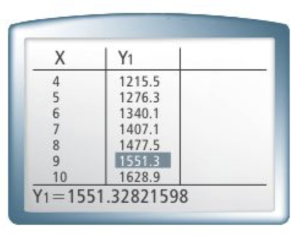
Problem 4 Got It? Reasoning: Use the table in Problem 4 (provided again below) to determine when that account will contain at least $1650. Explain.

After 13 years the account will contain $1710.34.
After 11 years the account will contain $1710.34.
After 8 years the account will contain $1477.50.
Question 10
10.

Question 11
11.

Question 12
12.
Question 13
13.
Question 14
14.
Question 15
15.
Reasoning: Identify the function as linear, quadratic, or exponential.
Exponential
Linear
Quadratic
Reasoning: Identify the function as linear, quadratic, or exponential.
Linear
Exponential
Quadratic
Reasoning: Identify the function as linear, quadratic, or exponential.
Exponential
Linear
Quadratic
Reasoning: Identify the function as linear, quadratic, or exponential.
Linear
Quadratic
Exponential
Vocabulary Review: Identify the expressions that are NOT powers. Select all that apply.
Vocabular Review: Match the number(s) on the left with the expression(s) on the right that contain them as exponents.
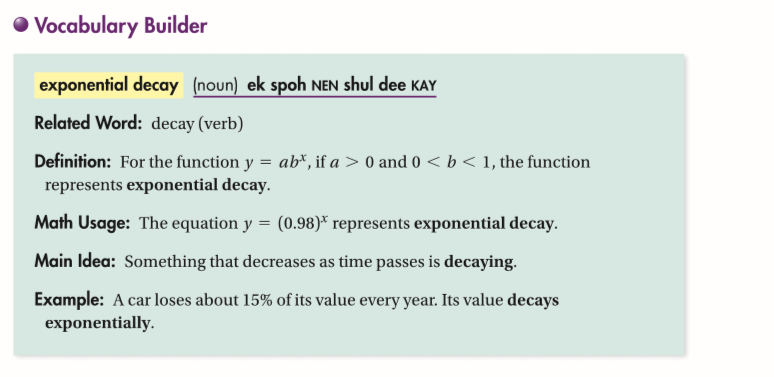
Use Your Vocabulary: Identify the equations that represent exponential decay. Select all that apply.
Use Your Vocabulary: Use an appropriate number from the left to fill in each blank on the right and create equations representing exponential decay.
0.98
7.1
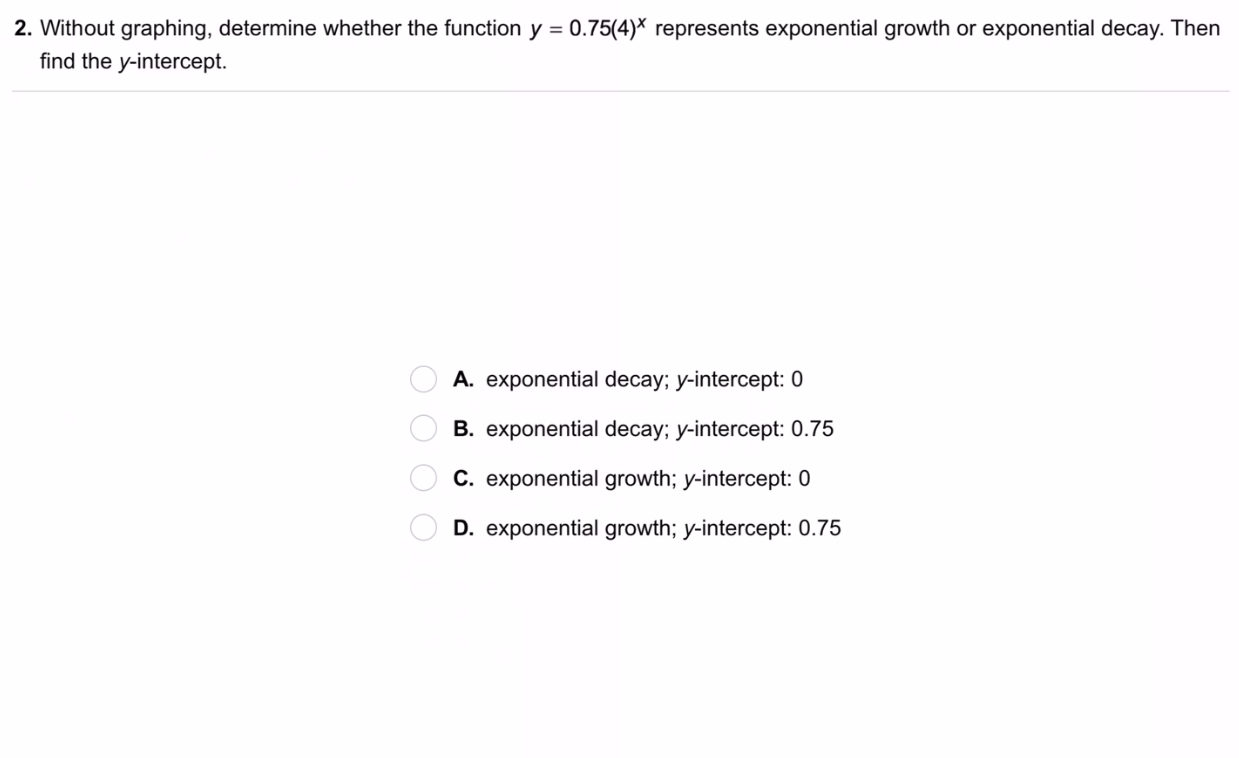
Problem 2 Got It?
A
B
C
D
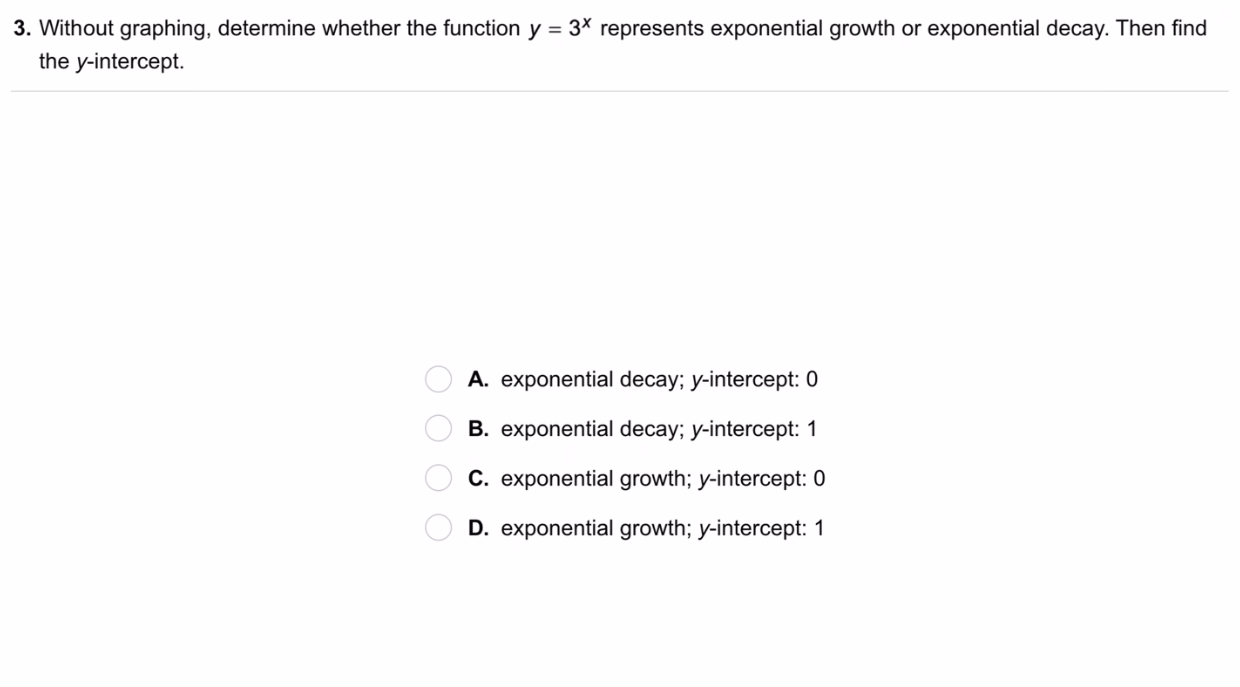
Problem 2 Got It?
A
B
C
D
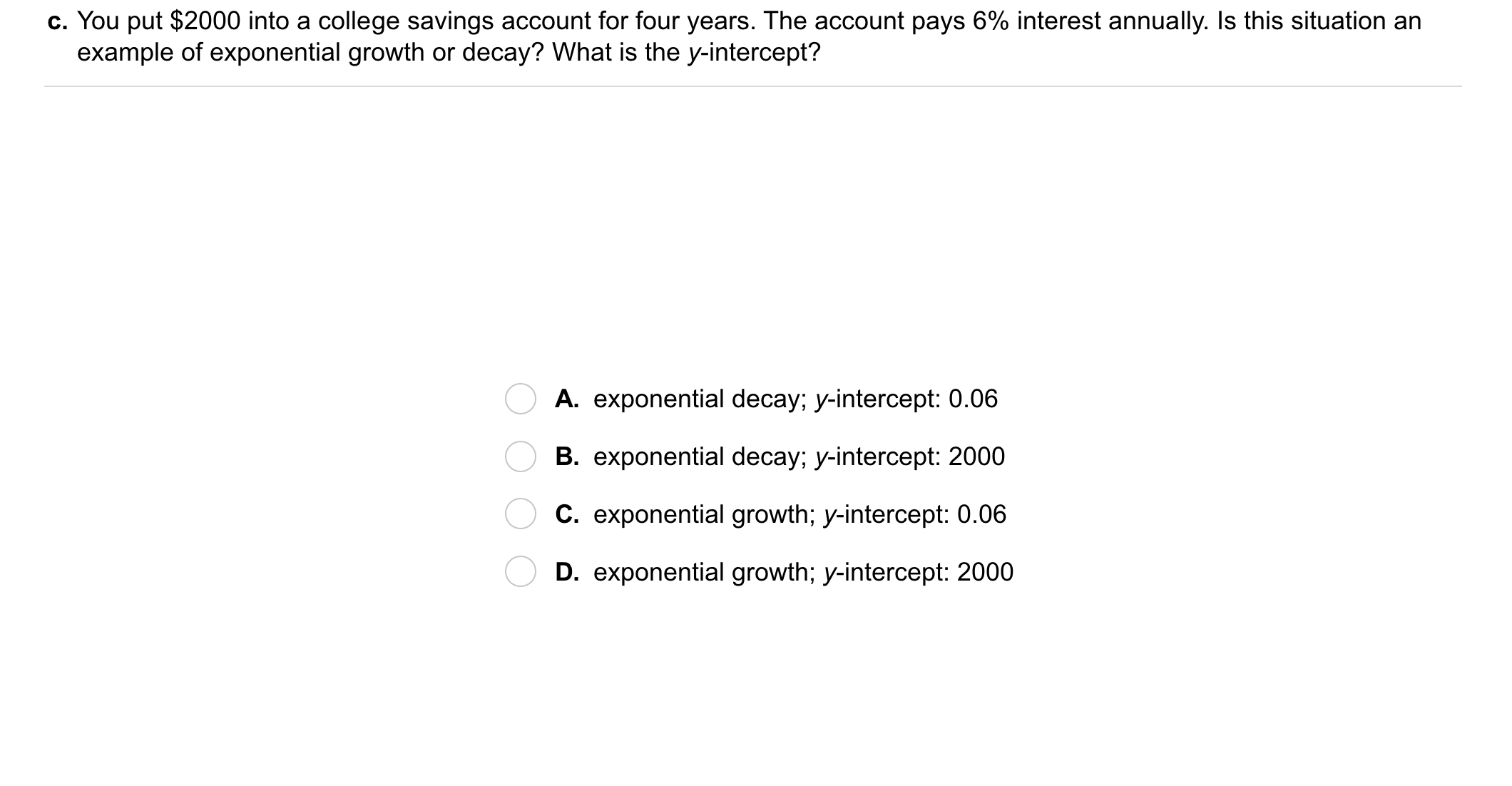
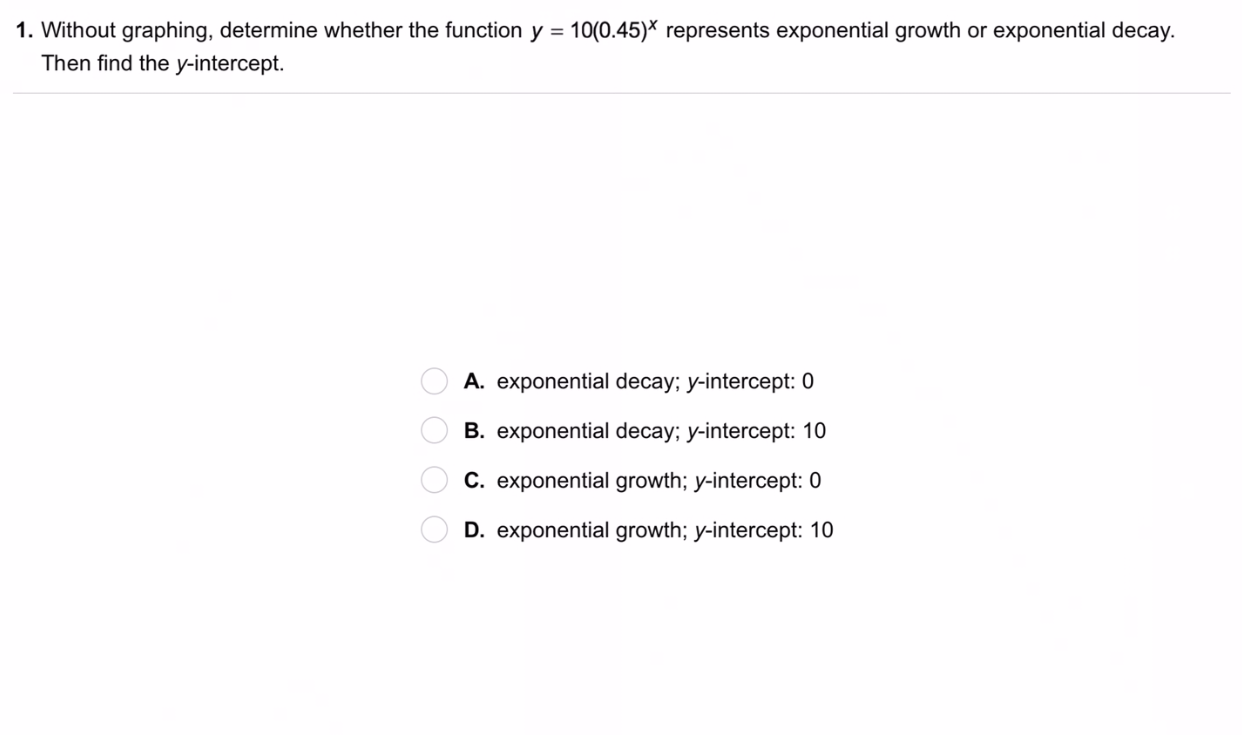
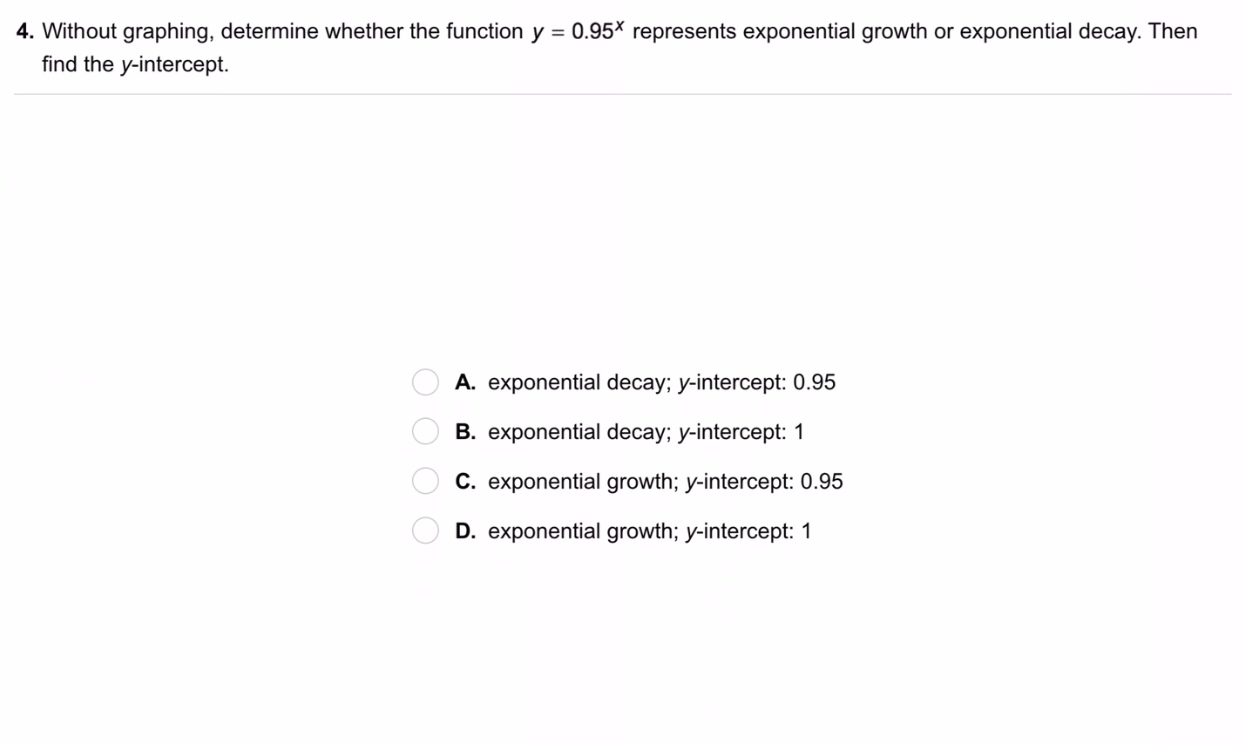
Problem 2 Got It? You put $2000 into a college savings account for four years. The account pays 6% interest annually. Is this situation an example of exponential growth or decay? What is the y-intercept?
A
B
C
D
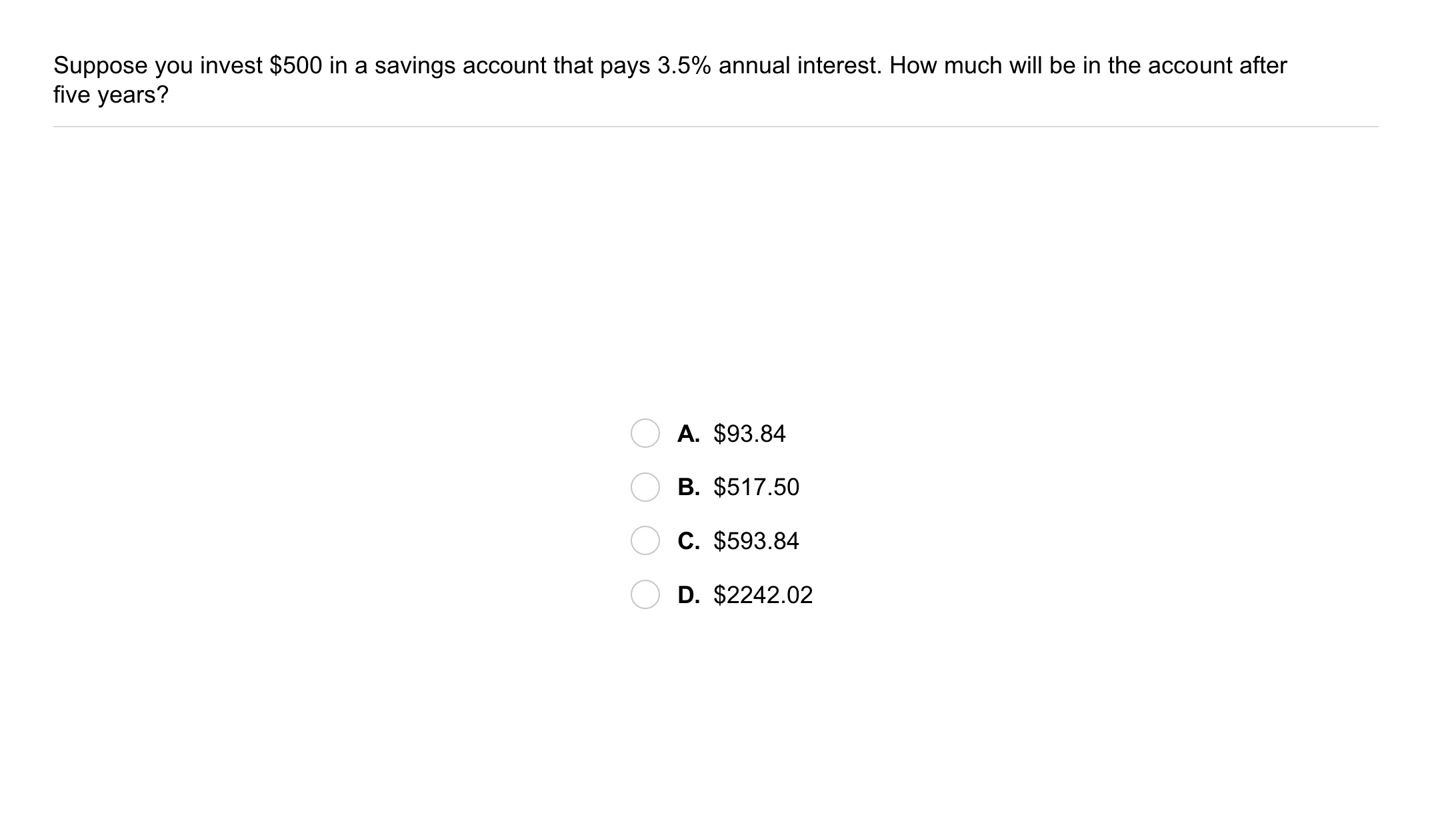
Problem 3 Got It? Suppose you invest $500 in a savings account that pays 3.5% annual interest. How much will be in the account after five years?
A
B
C
D
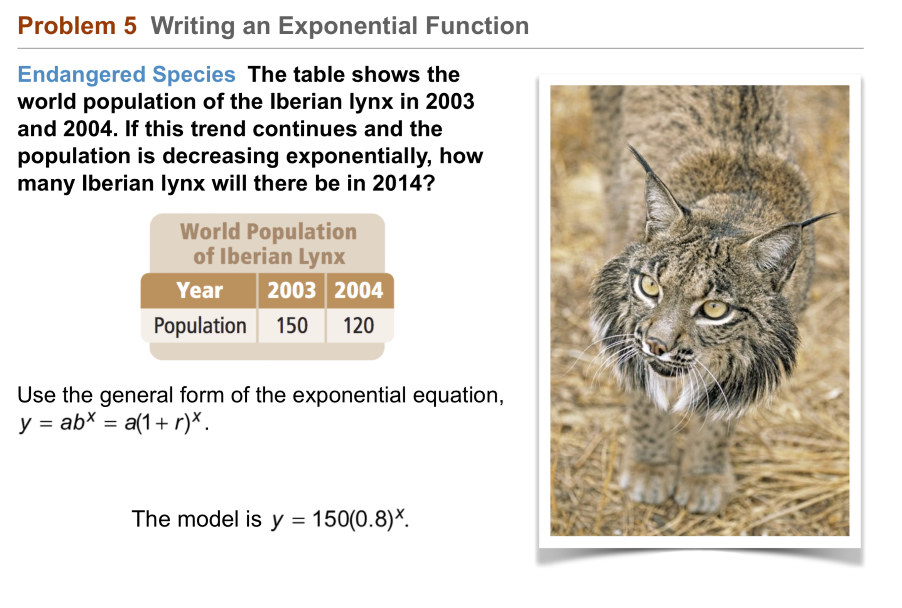
Problem 5 Got It? For the model in Problem 5, what will the world population of liberian lynx in 2020?
≈ 5
≈ 3
≈ 1
≈ 12
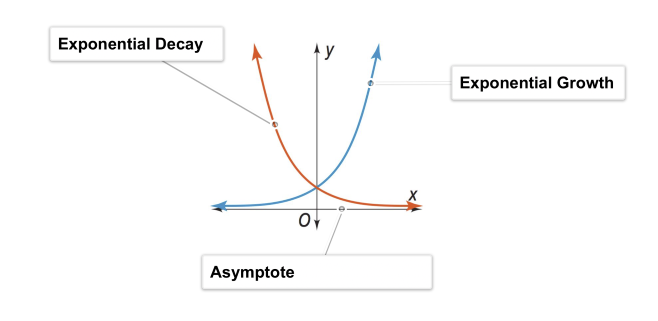
Problem 5 Got It? Reasoning: If you graphed the model in Problem 5, would it ever cross the x-axis? Explain.
Yes; the function has an x-intercept near 2031.
Yes; the function has an x-intercept near 2052.
No; the function is asymptotic to the x-axis. It gets closer and closer indefinitely, but never intersects the axis.
A
B
C
D
A
B
C
D
A
B
C
D
A
B
C
D