Log in
Sign up for FREE
arrow_back
Library

Algebra 2 6-7 Complete Lesson: Inverse Relations and Functions

star
star
star
star
star
Last updated about 4 years ago
29 questions
Note from the author:
A complete formative lesson with embedded slideshow, mini lecture screencasts, checks for understanding, practice items, mixed review, and reflection. I create these assignments to supplement each lesson of Pearson's Common Core Edition Algebra 1, Algebra 2, and Geometry courses. See also mathquest.net and twitter.com/mathquestEDU.

10
10
10
10
10
10
10
10
10
10
10
10
10
100
10
Question 1
1.

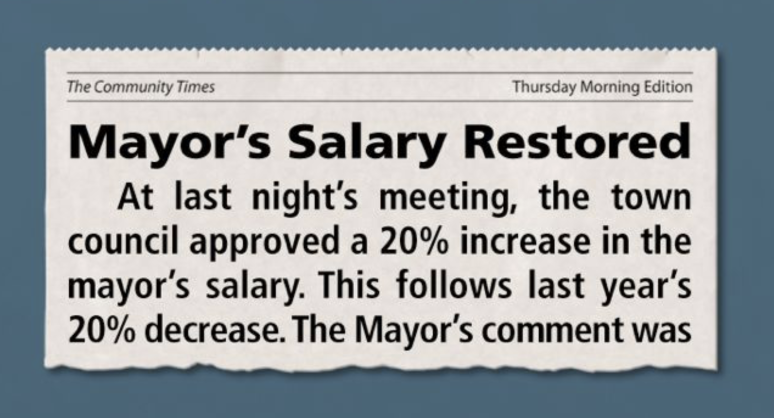
Solve It! What's wrong with the headline? Why? What is a more appropriate headline?

Question 2
2.

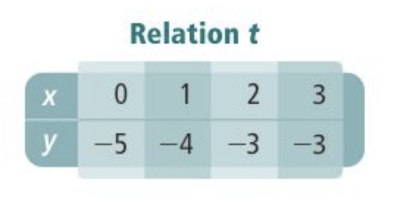
Problem 1 Got It? What are the graphs of t and its inverse? Represent both relations as mapping diagrams on the canvas.

Question 3
3.

Problem 1 Got It? Reasoning: Is t a function? Is the inverse of t a function? Explain.

10
Question 4
4.

Problem 2 Got It?

Question 5
5.

Problem 3 Got It? Graph the function, its inverse, and the line y = x on the same plane.
Note that the function and its inverse should be reflective across the line y = x.
Zoom and pan your graph to establish an appropriate viewing window.

We have released a new and improved Graphing question type! Students will no longer be able to answer this question.
10
Question 6
6.

Problem 4 Got It?

10
Question 7
7.

Problem 4 Got It?

10
Question 8
8.

Problem 4 Got It?

10
Question 9
9.

Problem 4 Got It?

10
Question 11
11.

Problem 6 Got It? Given g(x) below, find g-1(x).

10
Question 12
12.

Problem 6 Got It?

10
Question 13
13.

Problem 6 Got It?

10
Question 14
14.

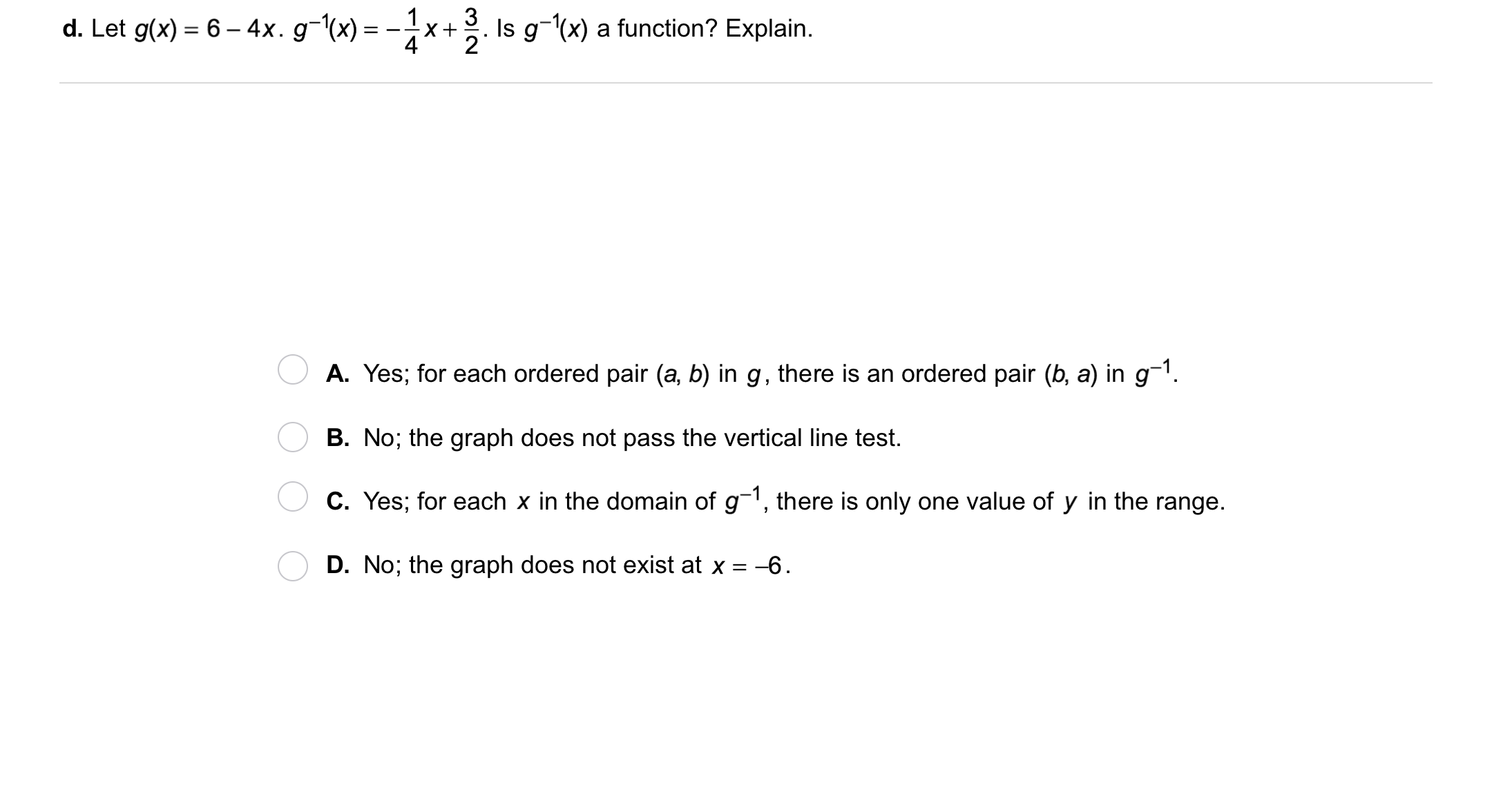
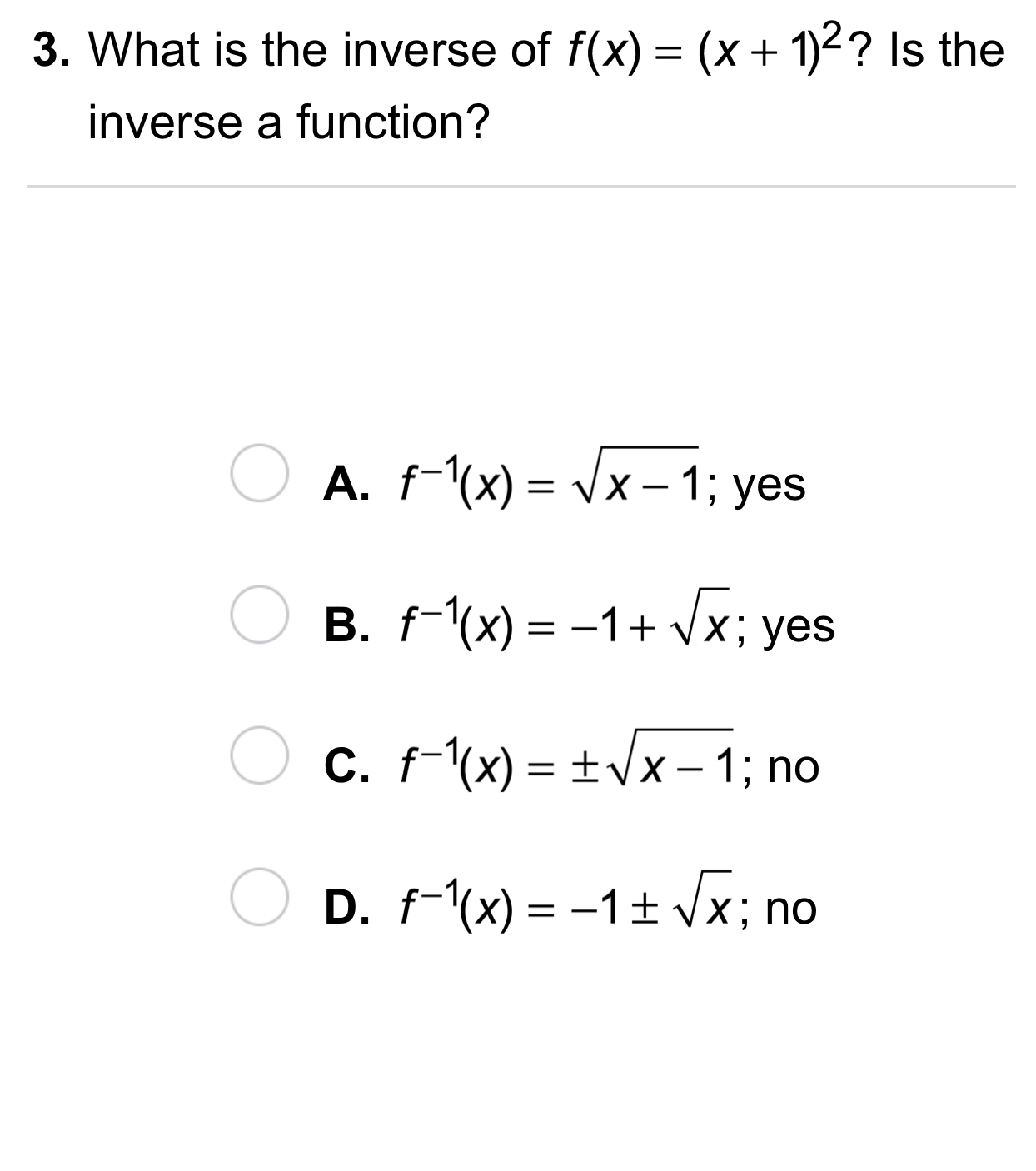
What is the inverse of f ? Is the inverse a function?

10
Question 15
15.

What is the inverse of f ? Is the inverse a function?

10
10
Question 17
17.
10
Question 18
18.
10
Question 21
21.

Reasoning: A function consists of the pairs (2, 3), (x, 4), and (5, 6). What values, if any, may x not assume?

Question 22
22.

Error Analysis: A classmate says the following.
Show that this is incorrect by finding examples of f(x) and g(x) for which the equation does not hold.

Question 23
23.

Review Lesson 6-6: For the given functions f, g, and h, match each function operation and composition on the left with the equivalent simplified expression on the right.

Question 24
24.

Review Lesson 6-1: Find each real root.

  • No real roots
Question 25
25.

Review Lesson 4-1: Graph the functions on the same plane.
Note how the functions are transformations of the parent quadratic function y = x2.
Zoom and pan your graph to establish an appropriate viewing window.

We have released a new and improved Graphing question type! Students will no longer be able to answer this question.
Question 26
26.

Vocabulary Review: Fill in each blank on the right with the appropriate item from the left.

Consider the relation below for some items.

  • y-
  • x-
  • The domain of a relation is the set of inputs, also called the __?__ coordinates of the ordered pair.
  • The range of a relation is the set of inputs, also called the __?__ coordinates of the ordered pair.
  • The domain of the relation above is __?__.
  • The range of the relation above is __?__.
Question 27
27.

Use Your Vocabulary: Categorize the domains and ranges on the left.

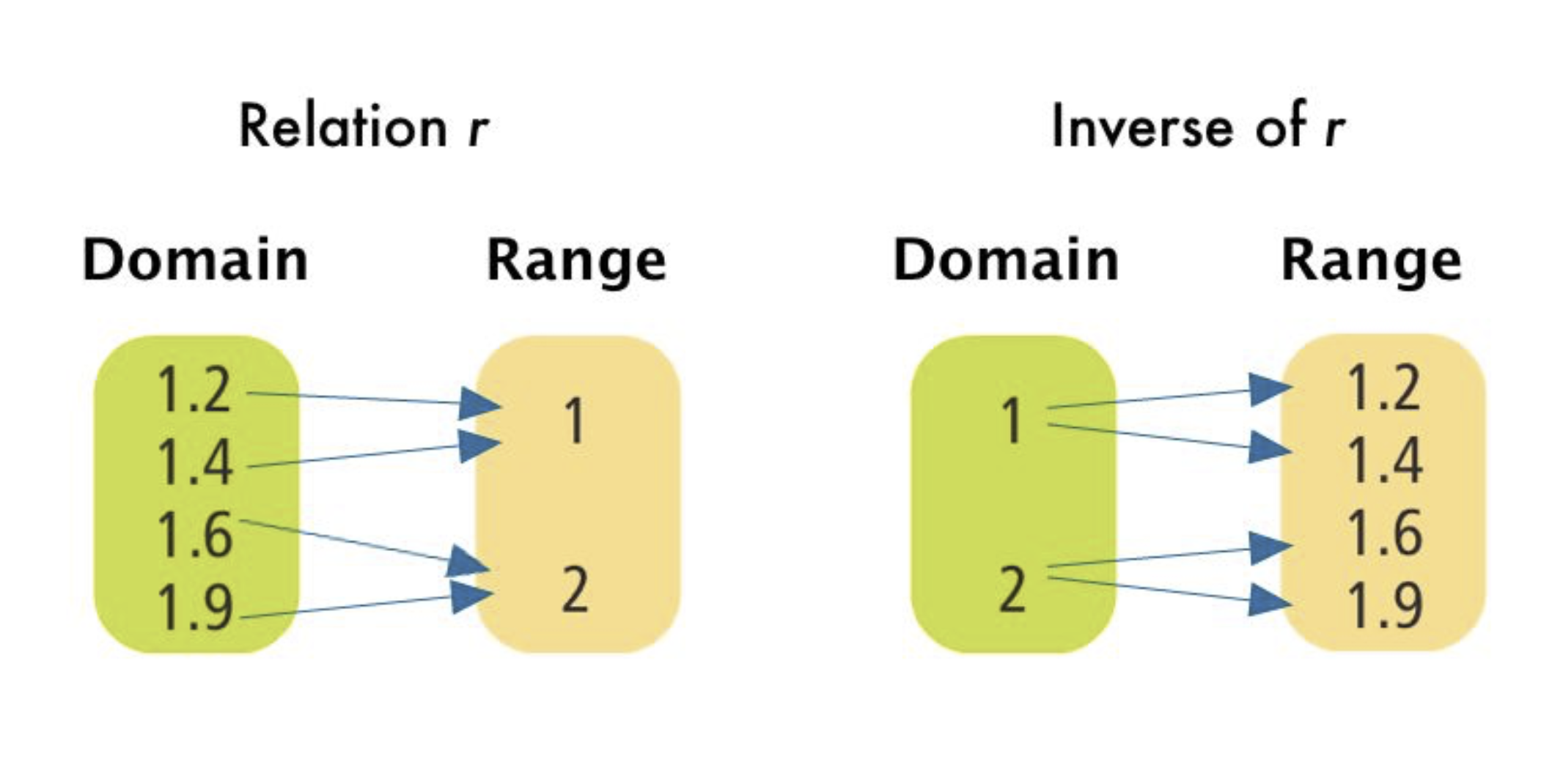
Use the relation r, as defined here.

  • Domain of r
  • Range of r
  • Domain of the inverse of r
  • Range of the inverse of r
Question 28
28.

Notes: Take a clear picture or screenshot of your Cornell notes for this lesson. Upload it to the canvas. Zoom and pan as needed.

For a refresher on the Cornell note-taking system, click here.

Question 29
29.

Reflection: Math Success

Question 10
10.

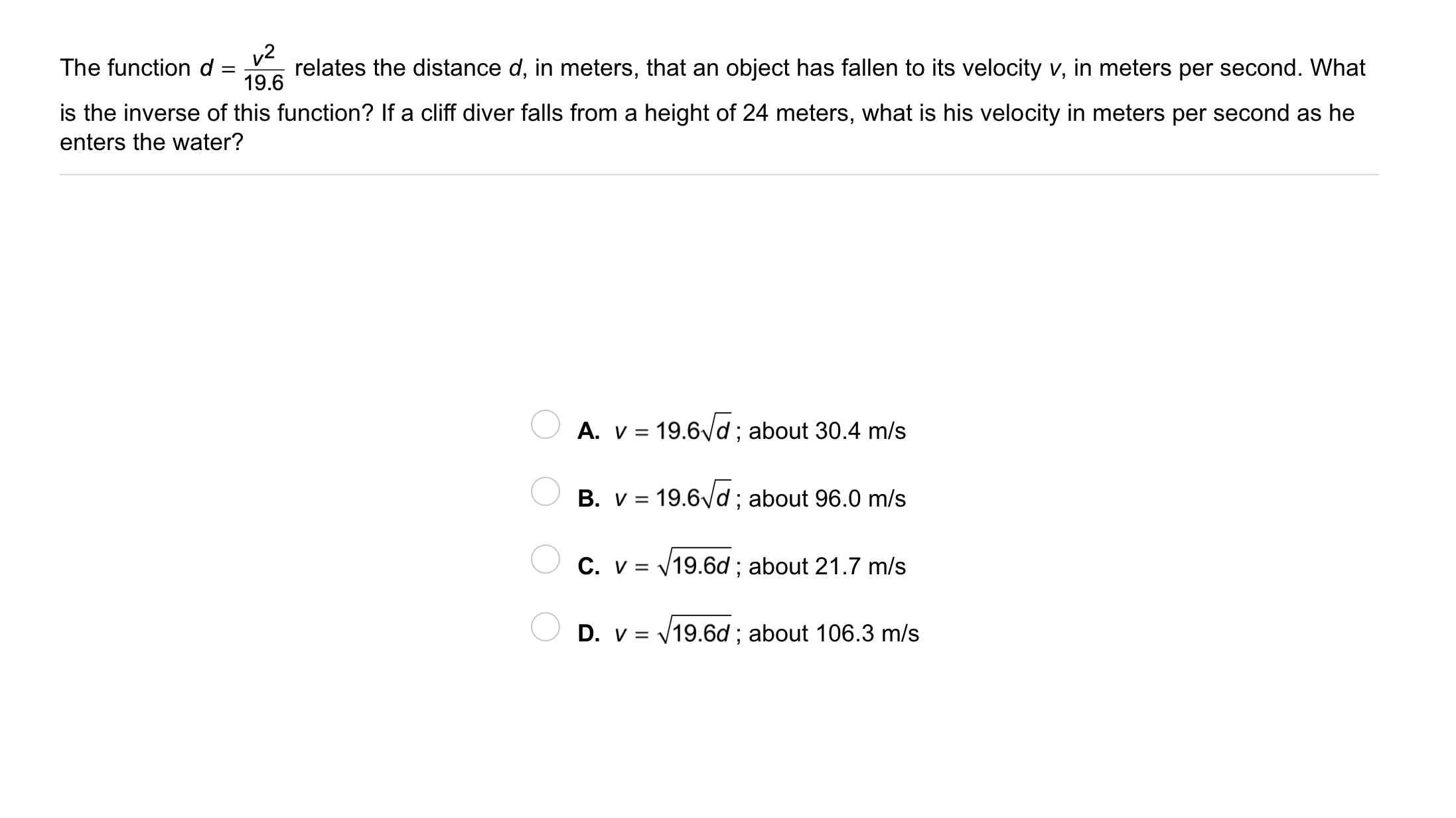
Problem 5 Got It? The function d, below, relates the distance d, in meters, that an object has fallen to its velocity, v, in meters per second.
What is the inverse of this function?

If a cliff diver falls from a height of 24 meters, what is his velocity in meters per second as he enters the water?

Question 16
16.

What is the inverse of f ? Is the inverse a function?

Question 19
19.

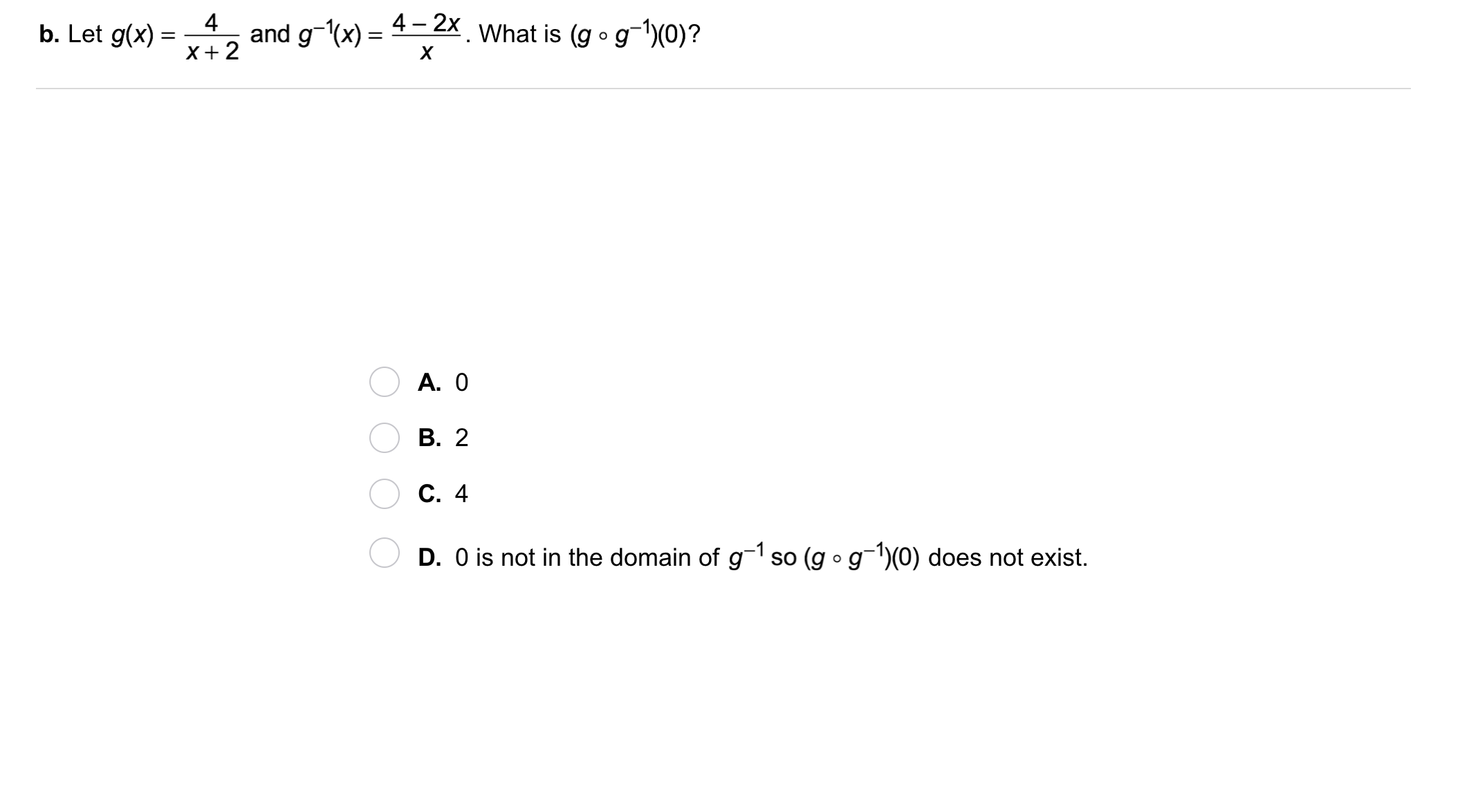
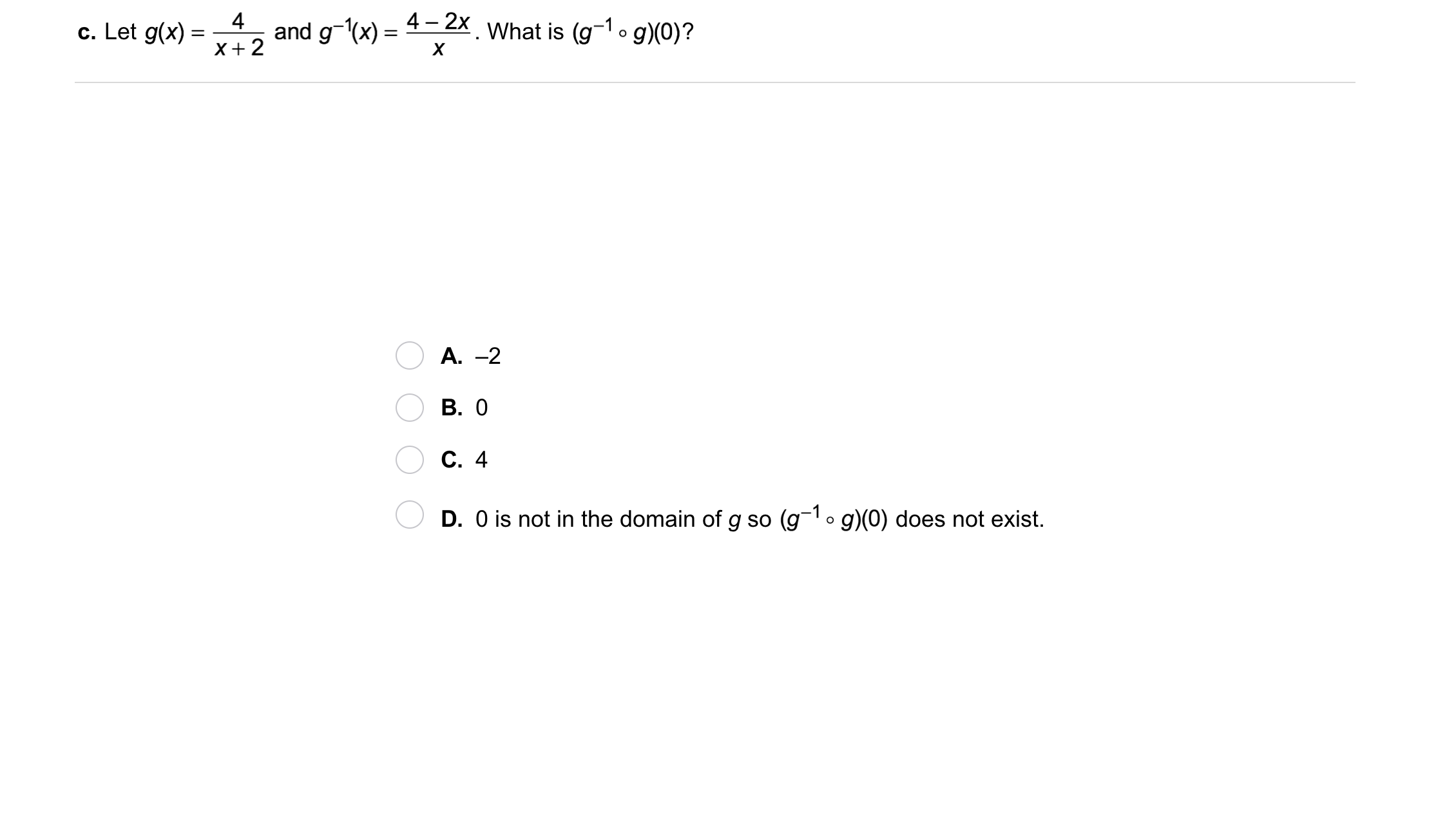
For h, find the value for x for which the equality
(h ◦ h-1)(x) = x does not hold.