A complete formative lesson with embedded slideshow, mini lecture screencasts, checks for understanding, practice items, mixed review, and reflection. I create these assignments to supplement each lesson of Pearson's Common Core Edition Algebra 1, Algebra 2, and Geometry courses. See also mathquest.net and twitter.com/mathquestEDU.

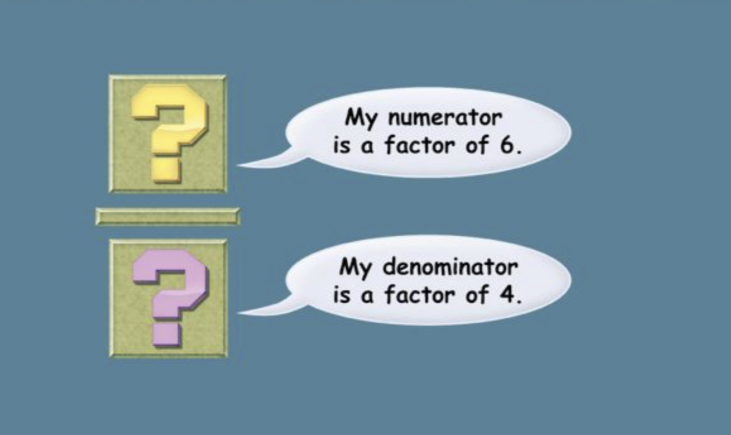
Solve It! I am greater than my square. The sum of my numerator and denominator is 5. What fraction am I?


Problem 1 Got It?

Problem 2 Got It?

Problem 3 Got It?

Problem 4 Got It?
HINT: you will need to multiply factors derived from the given roots, including (x - (2 - 3i)) and (x - (2 + 3i)).
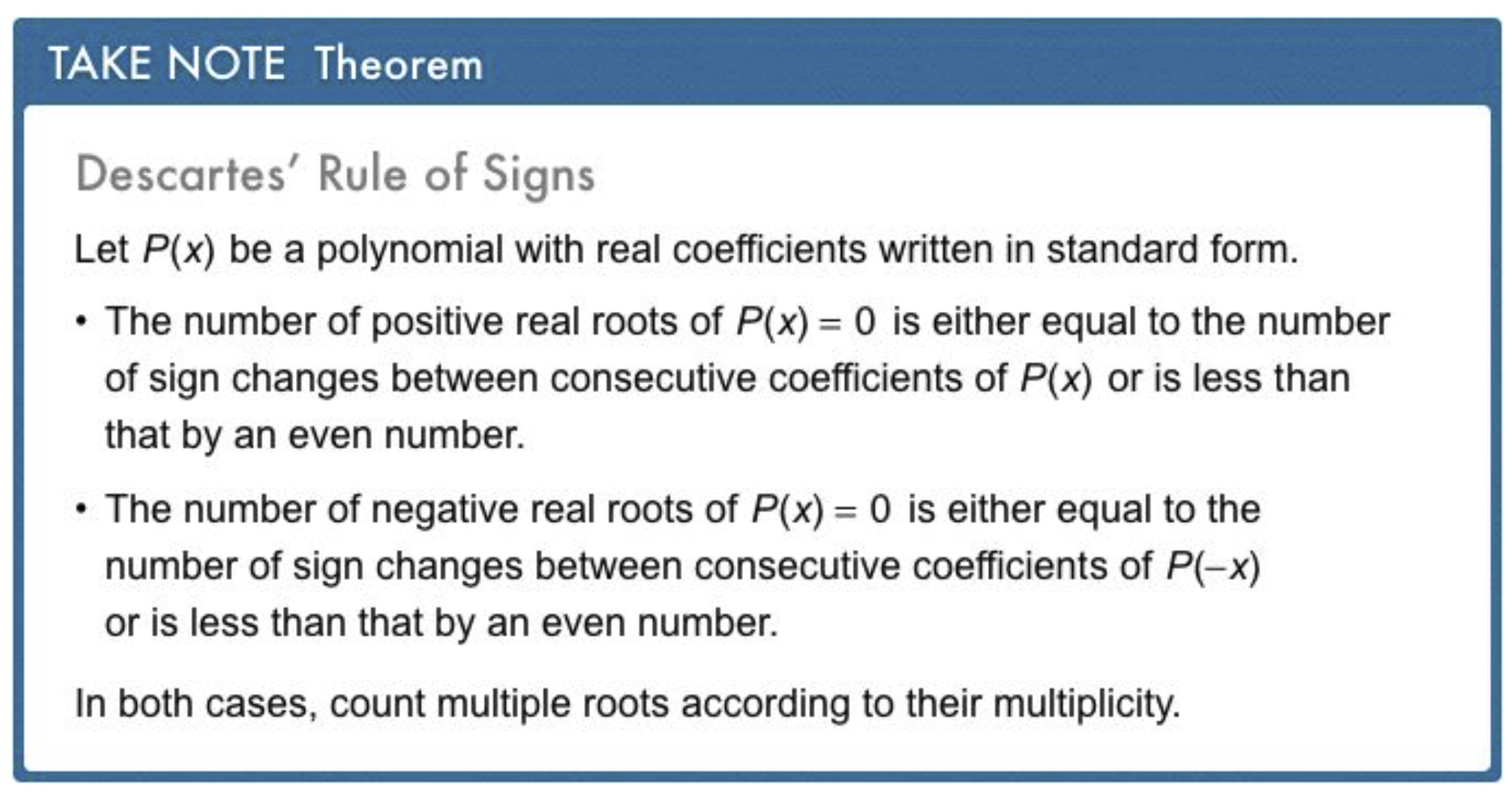
Problem 5 Got It? Identify the statements that can be made using Descartes' Rule of Signs regarding the function.
There is one negative real root.
There are two negative real roots.
There are one or three positive real roots.
There are two or four positive real roots.
According to Descartes' Rule of Signs:
Problem 5 Got It? Reasoning: Can you confirm real and complex roots graphically? Explain. Identify the true statements below.


Vocabulary: Drag a complex number from the left to create a conjugate pair.
Reasoning: In the statement below, r and s represent integers. Is the statement always, sometimes, or never true?
Review Lesson 5-4: Match each expression on the left with its quotient on the right.
Review Lesson 5-1: Consider the standard form of each polynomial. Then classify it by its degree AND number of terms.
monomial
binomial
trinomial
polynomial of four terms
constant
linear
quadratic
cubic
quartic
quintic
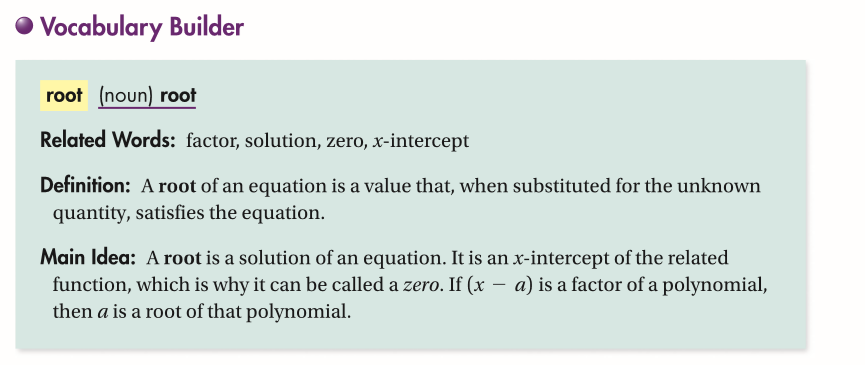
Use Your Vocabulary: True or False? 1 and -1 are roots of the equation.
Use Your Vocabulary: True or False? The equation has roots 4 and -4.
Use Your Vocabulary: Identify the number of roots each polynomial has.
1
2
4
6
7
8
Notes: Take a clear picture or screenshot of your Cornell notes for this lesson. Upload it to the canvas. Zoom and pan as needed.
For a refresher on the Cornell note-taking system, click here.
Reflection: Math Success