SCI 8 - Forces and Interactions (electricity & magnetism) (2018)
star
star
star
star
star
Last updated 2 months ago
8 questions
1
1
1
1
1
1
1
1
Question 1
1.
Question 2
2.
Question 3
3.
Question 4
4.
Question 5
5.
Question 6
6.
Question 7
7.
Question 8
8.
**Explain how a compass works.
How would the gravitational force be impacted if the moon moved further from the earth?
A) The gravitational force would stay the same.
B) The gravitational force would decrease.
C) The gravitational force would increase.
D) There is no gravitational force.
Which types of charges would repel each other? (SELECT ALL THAT APPLY)
A) negative charge to negative charge
B) negative charge to positive charge
C) positive charge to positive charge
D) positive charge to neutral charge
E) negative charge to neutral charge
Moving a magnet near a compass can cause the compass needle to move, even though the magnet does not touch the compass. This observation is evidence for which characteristic of magnetic fields?
A) They have a north and a south pole.
B) They can be generated by electricity.
C) They are constantly changing direction.
D) They can exert a force across a distance.
Students want to investigate how the amount of electric energy delivered to a motor affects its speed. Which of the following procedures will most likely produce the data students need to answer their question?
A) Measure the rotations per second of a motor when it is connected to one battery, two batteries, and three batteries.
B) Add larger and larger motors to a battery to determine the size of the largest motor the battery is able to run.
C) Closely observe the rotation of the motor to see if the direction of spin reverses when the poles of the battery are switched.
D) Connect a series of motors to the same battery to figure out how many motors can be run off the same battery.
When the charge of an electromagnet is increased, what happens to the force?
A) The force decreases.
B) The force increases.
C) The force stays the same.
D) There is no force.
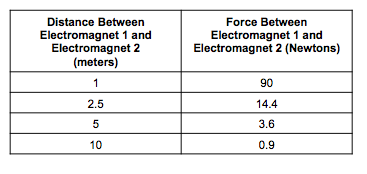
This table above shows the magnitude of electromagnetic force exerted by two electromagnets on each other as the distance between the two electromagnets is varied. The data on the table provide evidence for which of the following conclusions?
A) The force between any two magnets is always constant, regardless of distance.
B) As distance between electromagnets increases, the electromagnetic force also increases.
C) The smaller the distance between two electromagnets, the greater the force.
D) The force between two magnets depends only on the charge of the electromagnets.
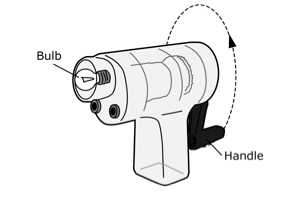
The illustration above shows a hand generator. Turning the handle of the generator spins a magnet and creates an electric current that lights the bulb. Which of the following observations can be used to indicate the strength of the current created by the generator?