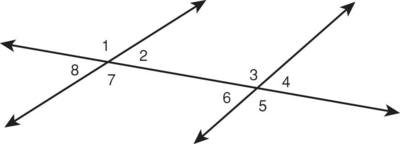
Which pair of angles are alternate exterior angles?
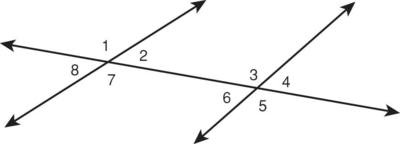
Which pair of angles are alternate exterior angles?
Which pair of angles are alternate exterior angles?
Which pair of angles are corresponding angles?
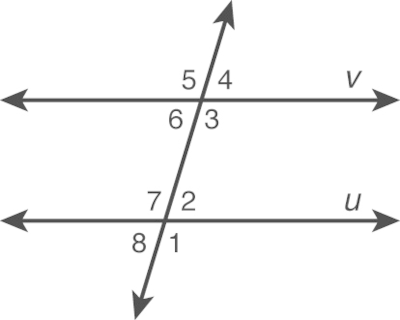
Which could you use to show that u || v?
TRUE or FALSE.
When a shape is dilated, angles within the shape change.
TRUE or FALSE. When a shape is translated, lengths within the shape change.
TRUE or FALSE. Rotation, translations, and dilations preserve congruence.
TRUE or FALSE. A translation keeps corresponding sides and angles congruent.
TRUE or FALSE. When a shape is dilated, parallel lines remain parallel.
Circle a pair of same-side interior angles.
TRUE or FALSE. Same side interior angles are congruent.
TRUE or FALSE. Opposite sides of a parallelogram are congruent.
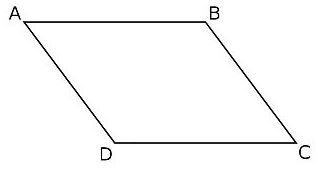
Fill in the blank.
∠A ≅ ∠A is an example of the ____________ property.
All corresponding sides are congruent in similar figures.
Two shapes that are congruent are also similar.
Explain why shapes that are congruent are also similar.
Two shapes that are similar are also congruent.
The triangles are similar by...
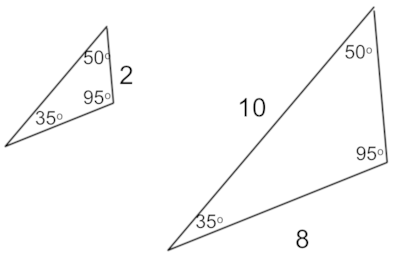
Which theorem can be used to prove that the triangles are similar?
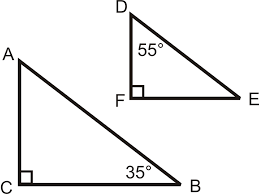
Which of the following cannot be used to prove triangles congruent?
All of the following prove triangles congruent except:
When does one use CPCTC?
Which diagram shows a correct mathematical construction using only a compass and a straightedge to bisect an angle?
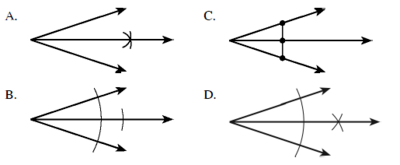
What geometric construction is shown in the diagram below?
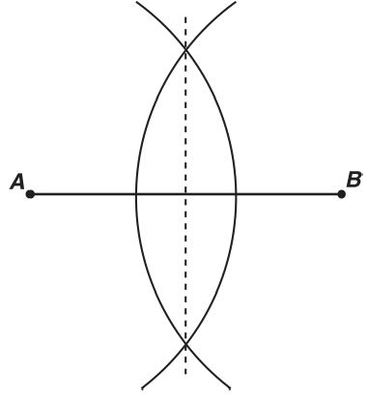
A dilation produces a congruent figure.
What kind of figures do dilations produce?
When the scale factor of a dilation is less than one, the dilation is a reduction.
When the scale factor of a dilation is greater than one, the dilation is a(n) _________________.
What is the justification (reason)?
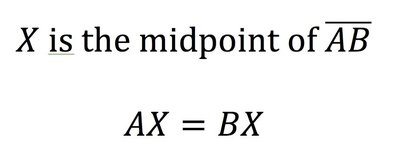
What does CPCTC stand for?
By definition, a parallelogram ...
A triangle with two congruent sides and two congruent angles (base angles) is called ...
Identify the angle pair.
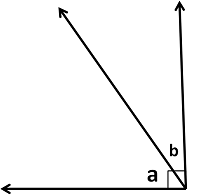
Mark a pair of VERTICAL angles:
Mark a LINEAR PAIR.