Log in
Sign up for FREE
arrow_back
Library

Warm up 2/7

star
star
star
star
star
Last updated over 6 years ago
3 questions
1
1
1
Question 1
1.

Question 2
2.

Question 3
3.

Normal fruit flies have brownish-yellow bodies, and this body color is dominant. A mutation in the gene for body color can produce files with an ebony body color. A homozygous normal fruit fly (e+e+) is crossed with a homozygous ebony fruit fly (ee). What is the predicted outcome of this genetic cross?
All the offspring will have ebony bodies
Of the offspring, 75% will have brownish-yellow bodies, and 25% will have ebony bodies.
All of the offspring will have brownish-yellow bodies
Of the offspring, 75% will have ebony bodies, and 25% will have brownish-yellow bodies
Lord Howe Island is a volcanic island in the Tasman Sea that is about 11 km long an 2.8 km wide. The island has two species of palm trees, Howea forsterian and the more abundant Howea belmoreana. The two species do not interbreed even when they grow very close to each other. Which evolutionary process fails to occur?
Genetic drift of Howea forsteriana
Natural selection of adaptive traits in both species
Gene flow between the two species
Mutations in Howea belmoreana
Amphibians are dying in large numbers after being infected by an aquatic fungus called Batrachochytrium dendrobatidis. The origin of this fungus is unknown, but scientists suspect that humans are helping spread it. More than 350 amphibian species have been affected, and at least 200 species of frogs have suffered serious reductions in population or become extinct. The map below shows the worldwide distribution of B. dendrobatidis. What will be the most likely impact of the decline in frog populations resulting from the fungal infection?
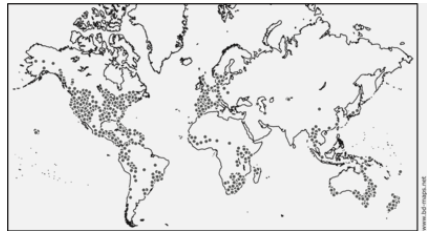
New species of frogs that feed on both the fungus and the infected species of frogs will evolve
Plants will no longer grow in the waters of the affected ecosystms, and fish species will increase.
The fungus will move on land and destroy reptile and mammal populations in tropical ecosystems.
Populations of algae and mosquitoes will increase, leading to fish die-offs and potential increases in human malaria cases.