What is an equation of the graph at the right?
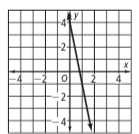
What is an equation of the graph at the right?
matches to chapter 5 Pearson Algebra 1 Book Lessons 5.1, 5.3, 5.4, 5.5, 5.6
What is true about the graphs of the following equations:
Which of the following statements is NOT true for the graph of the equation:
What is an equation of the graph at the right?
Find the y-intercept of the graph of the following equation:
Find the slope of the line containing points (3, -6) and (4, -5).
Find the slope of the line described by the equation:
Find the slope of the line that is perpendicular to the graph of:
Find the slope of the line that is parallel to the graph of:
Write an equation for the line (in slope intercept form) that passes through the points (–2,2) and (2, –8).
The table shows the distance a cyclist rides her bicycle over time. Is the rate of change in distance with respect to time constant? What does the rate of change represent?

What is the slope of the line shown below?

Write the equation in slope intercept form of the line with a slope of 1/2 and a y intercept of -7.
What is the slope of the equation x = 4 ?
Write the equation of the line in point-slope form with a slope of zero and passing through (2, -5).
Write the equation of the line in point-slope form that passes through (1, -6) and has a slope of -2.
Write y = 4/5 x + 8 in standard form using integers.
Will the graph of the line represented by the table intersect the graph of y = 5x + 4? Explain.

What is an equation in slope-intercept form of the line that passes through (6, −7) and is perpendicular to the line shown below?

Graph the equation. 2x − 5y = −10
Graph the equation. y + 2 = 3(x + 1)
Write the equation of the line in standard form that has a slope of 8 and a y intercept of 2.
Perpendicular lines have slopes that are the same.
What are the x and y intercepts of the equation x - 2y = 2
The equation y = 9 is vertical.
The equation x = 5 is vertical.