Log in
Sign up for FREE
arrow_back
Library

Review 8.L.1.2 Spread of Disease

star
star
star
star
star
Last updated over 7 years ago
28 questions
1
1
1
1
1
1
1
1
1
1
1
1
1
1
1
1
1
1
1
1
1
1
1
1
1
1
1
1
Question 1
1.

Question 2
2.

Question 3
3.

Question 4
4.

Question 5
5.

Question 6
6.

Question 7
7.

Question 8
8.

Question 9
9.

Question 10
10.

Question 11
11.

Question 12
12.

Question 13
13.

Question 14
14.

Question 15
15.

Question 16
16.

Question 17
17.

Question 18
18.

Question 19
19.

Question 20
20.

Question 21
21.

Question 22
22.

Question 23
23.

Question 24
24.

Question 25
25.

Question 26
26.

Question 27
27.

Question 28
28.

Which would have the most positive effect in preventing an epidemic from becoming a pandemic?
A quarantine
B vaccination
C hand washing
Which poses the greatest challenge for researchers when attempting to locate the source of a nationwide food-based salmonella outbreak?
A cost of the study
B time needed for the study
C number of people affected
D number of food producers involved
How are epidemics different from pandemics?
A Epidemics affect large numbers of people worldwide and pandemics affect large numbers of people within a local population.
B Pandemics affect large numbers of people worldwide and epidemics affect large numbers of people within a local population.
C Epidemics are easily curable while pandemics are difficult to contain and handle.
A small community had a recent outbreak of measles among local unvaccinated families. Which best describes this event?
A An epidemic because it happened within the last five years.
B An epidemic because it occurred in a single geographic area.
C A pandemic because it occurred in a single geographic area.
D A pandemic because several families were affected by the disease.
A strain of influenza originates in Southeast Asia and spreads to countries including the United States and Europe, infecting millions of individuals worldwide. Which best describes the spread of this disease?
A Epidemic, then a pandemic because it did not originate in the United States.
B Pandemic, then an epidemic because it affected citizens of the United States.
C Epidemic, then a pandemic because it originated in one geographic area before spreading to others.
D Pandemic, then an epidemic because it originated in one geographic area before spreading to others.
Which would most likely prevent a cold virus from spreading through a classroom?
A Have a large supply of tissues on the teacher’s desk.
B Have all students wash their hands regularly with soap.
C Have all students shake hands regularly with all students.
D Have all students wipe desk with dry paper towel at end of class.
Which is the best description for the human body’s defenses against pathogens?
A attack by red blood cells
B antibacterial treatment
C the immune response
Which is an example of an epidemic?
A dengue fever in an African village
B smallpox outbreak on several continents
C swine flu cases reported in multiple countries
D many people affected by tuberculosis worldwide
Which is a distinction between an epidemic and a pandemic?
A the symptoms of the disease
B the geographical area affected
C the species of organisms infected
D the season in which the disease spreads
Which best explains why influenza H1N1 was declared a pandemic in 2009?
A More cases than expected were reported.
B It was contained to one geographic region.
C It was a highly contagious form of the virus.
D More than 206 countries reported cases of H1N1.
Which best distinguishes an infectious disease from a noninfectious disease?
A Infectious diseases can be cured with antibiotics; noninfectious diseases cannot.
B Infectious diseases can be prevented with vaccines; noninfectious diseases cannot.
C Infectious diseases can be spread from one organism to another; noninfectious diseases cannot.
D Infectious diseases cannot be transmitted from one organism to another; noninfectious diseases can.
Which situation would most favor the spread of infectious disease?
A overcrowding
B use of vaccines
C small population
D sanitary conditions
A village has an outbreak of cholera. Which would be the easiest way for a neighboring village to prevent the cholera epidemic from spreading to their village?
A Develop a cholera vaccination.
B Quarantine all individuals infected with cholera.
C Avoid or treat contaminated water before drinking.
D Restrict travel to other villages that are farther away.
How does the spread of an epidemic and pandemic differ?
A A pandemic spreads slowly, and an epidemic spreads quickly.
B An epidemic spreads slowly, and a pandemic spreads quickly.
C A pandemic affects a small region, and an epidemic affects many regions.
D An epidemic affects a small region, and a pandemic affects many regions.
Which best explains the purpose of the research on drug-resistant microbes?
A to find all drug-resistant microbes
B to lower the number of drug-resistant microbes
C to maintain the number of drug-resistant microbes
Why is the prevention of epidemics usually easier than the prevention of a pandemic?
A The diseases in an epidemic are less severe than in a pandemic.
B Diseases causing pandemics are more contagious than diseases in an epidemic.
C Affected individuals in epidemics are usually more concentrated in one area than in pandemics.
Which has made the most significant difference to reduce the spread of epidemics and pandemics worldwide?
A water treatment
B decreased pollution
C increased medical aid
Which would best prevent the pandemic spread of a flu virus?
A Decrease vaccinations.
B Isolate sick individuals.
C Restrict travel to other countries.
D Wash hands frequently with soap and water.
Which would be the most successful way to make antibiotics that prevent microbial infections?
A Accurately identify the specific source of infections.
B Use antibacterial hand soaps and cleaners on a regular basis.
C Reduce the number of prescriptions written for children under the age of two.
Which vector could lead to a malaria epidemic?
A fly
B bat
C mosquito
Which best explains the difference between the spread of an epidemic and the spread of a pandemic?
A A pandemic is the spread of a disease across a large region or even worldwide, while an epidemic covers a much smaller area and population.
B An epidemic is the spread of a disease across a large region or even worldwide, while a pandemic covers a much smaller area and population.
C In a pandemic, the spread of the disease is stable with regard to the number of individuals infected, while in an epidemic the number of infected people is unstable across the region.
D In an epidemic, the spread of the disease is stable with regard to the number of individuals infected, while in a pandemic the number of infected people is unstable across the region.
In tropical regions with high mosquito populations, malaria is a significant problem. Which term best describes an outbreak in these particular areas?
A antibiotic
B epidemic
C pandemic
D parasitic
Which condition will most likely increase the number of people infected with a contagious disease in one area?
A climate change
B overpopulation
C improved sanitation
D limited water supply
Which would most likely contribute to the spread of a pandemic?
A a doctor at a city hospital
B a neighborhood trash collector
C a teacher at the local community school
D an attendant on an international airplane flight
Which has had the greatest impact on preventing epidemics in the twenty-first century?
A immunizations
B new medicines
C good hygiene
Cholera is a bacterial disease that is generally spread through contaminated water. The graph below shows the number of deaths in a developing country resulting from cholera over time.
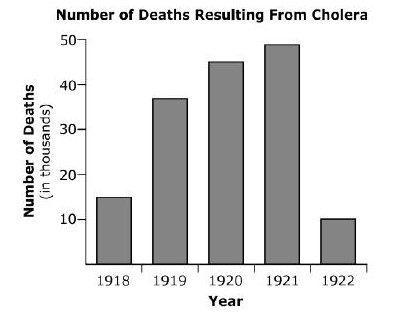
In 1923, the country experienced massive flooding. What was most likely the result?
A There was a decrease in the number of cholera deaths.
B There was an increase in the number of cholera deaths.
C There was approximately the same number of cholera deaths.
D The flooding prevented cholera infections, so there were no deaths.
Which aspect of modern life could MOSTlikely cause an epidemic to turn into a pandemic?
A vaccination
B transportation
C communication
D sanitation
Which is an example of a slow but deadly viral pandemic?
A HIV
B Ebola
C Influenza
D Whooping Cough