
1
1
1
1
1
1
1
Homeroom Teacher
Read the following short passage. Then select the text structure that most fits the passage.
All crocodilians are reptiles with long snouts, long tails, four short legs, tough skin, and sharp teeth. Members of the crocodilian family include alligators, crocodiles, caimans, and gavials. Crocodilians live in warm weather throughout the year and they spend part of their time in the water and part of their time on land. Almost all crocodilians grow to be very large, with the largest more than twenty feet long. There are two kinds of alligators, 14 kinds of crocodiles, eight kinds of caimans, and one kind of gavial.
Read the following short passage. Then select the text structure that most fits the passage.
Recently, scientists have gained an understanding of a crocodile’s reproductive activity. Crocodiles mate in the water, where the buoyancy keeps them from crushing each other. Prior to mating, there are stylized postures, jumping, submerged bubble blowing, and snout contact. After mating, hard‐shelled eggs are laid in a nest, in a hole scooped in the sand. When it is time to hatch, the infant crocodiles begin a loud chirping sound that leads the female to the nest, which she excavates. Finally, when all the babies are accounted for, the mother crocodile transports them to the shallow water where they will remain under adult protection for weeks or months.
Read the following short passage. Then select the text structure that most fits the passage.
On the river banks of the Nile River, home to some crocodiles, there are many kinds of birds, sometimes called crocodile birds because they are always hopping around crocodiles. The big crocodiles and the birds are useful to each other for several reasons. The birds eat flies and leeches that they find on the crocodiles’ skin and mouths. In this way, the birds get a good meal and the crocodiles get rid of the leeches and flies. Sometimes an enemy frightens the birds who scream and fly away. As a result of the noise, the birds give the crocodiles a warning of danger.
Read the following short passage. Then select the text structure that most fits the passage.
In most parts of the world there are not as many crocodiles as there used to be. This is a problem because crocodiles are becoming endangered and also crocodile are necessary to the balance of nature. Many crocodiles have died because people dried up the swamps and marshes where the crocodiles live. Poachers have also contributed to the dilemma as crocodiles have been desired for their strong, smooth, leathery skins. In order to preserve these mighty creatures, people must take care of the crocodiles’ environment and help put a stop to the needless shooting of these animals.
Read the following short passage. Then select the text structure that most fits the passage.
Alligators and crocodiles, along with their relatives the caimans and the gavials, are very much alike. These crocodilians are reptiles with long snouts, long tails, four short legs, tough skin, and sharp teeth. There are some differences, however. Gavials have the longest snout and the most teeth. Some people say that alligators and crocodiles differ in the shape of their snouts and the positioning of their teeth. Zookeepers say that crocodiles move faster than alligators and have nastier dispositions.
Which text structure did the author use?
The author writes about Jim Thorpe because he wants to-
If the author had included struggles that Jim encountered as a child, in which paragraph would they appear?
Which sentence supports the idea that Jim Thorpe had a tough childhood?
What is this passage mostly about?
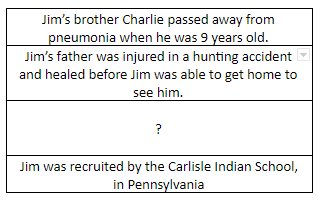
Look at this timeline listing some of the events in the passage.
Which detail from the passage best supports the text structure?