Data Displays (Two Way Tables)
star
star
star
star
star
Last updated almost 7 years ago
21 questions
1
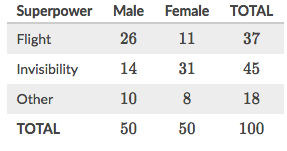
What percent of males chose invisibility as their superpower?
1
What percent of males chose other as their superpower?
1
What percent of students chose flight as their superpower?
1
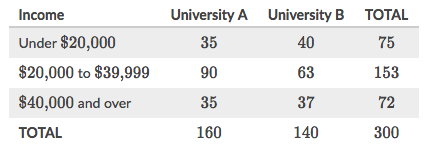
Approximately what percent of graduates in the sample came from University A?
1
Approximately what percent of graduates from University A make $40,000 and over?
1
STUDENTS PLAYING SPORTS AND INSTRUMENTSHere is a two-way table that gives some results from the survey. Please complete the remainder of the table, so all the totals are correct.
STUDENTS PLAYING SPORTS AND INSTRUMENTS
Here is a two-way table that gives some results from the survey. Please complete the remainder of the table, so all the totals are correct.
1
To the nearest percentage point, what percentage of students who play a sport don’t play a musical instrument?
1
To the nearest percentage point, what percentage of students who don’t play a sport also don’t play a musical instrument?
1
Name two things you notice and two things you wonder about the table.
1
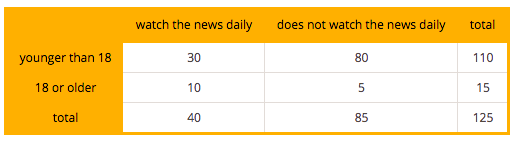
How many people did the reporter survey?
1
How many people in the age group of 16–30 years old were against the increase in minimum wage?
1
Were more people in favor of the increase or against the increase?
1
A random group of students are polled about how they get to school by walking, riding the bus, or carpooling.- Of the 44 male students polled, 9 of them walk and 26 of them ride the bus.
- Of the 58 female students, 26 of them ride the bus and 24 of them carpool.
Create a two-way table to represent the data. Label your rows as Male and Female.
A random group of students are polled about how they get to school by walking, riding the bus, or carpooling.
- Of the 44 male students polled, 9 of them walk and 26 of them ride the bus.
- Of the 58 female students, 26 of them ride the bus and 24 of them carpool.
Create a two-way table to represent the data. Label your rows as Male and Female.
1
What is the percent of all of the students, who are female and walk to school?
1
Of the students who carpool, what percent are female?
1
A student is selected at random from this school. What would you predict this student’s mode of school transportation to be? Explain your answer
1
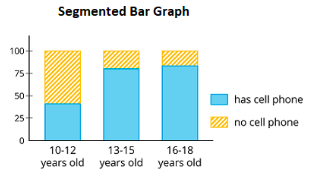
The Y axis (which is not labeled above) represents percent.
1
Estimate the percent of 10-12 year olds who have no cell phone.
1
Is there an association between age and having a cell phone, if so describe the association.
1
Complete the table below by filling in the relative frequencies of each row.
1
Using your frequency table from the previous problem, create your own segmented bar graph. (look at the example of the segmented bar graph prior to problem 17 to see a visual)*be sure each bar goes up to 100%*be sure to include a key
Using your frequency table from the previous problem, create your own segmented bar graph.
(look at the example of the segmented bar graph prior to problem 17 to see a visual)
*be sure each bar goes up to 100%
*be sure to include a key