Log in
Sign up for FREE
arrow_back
Library

Space Ch. 2 Test

star
star
star
star
star
Last updated about 7 years ago
20 questions
1
1
1
1
1
1
1
1
1
1
1
1
1
1
1
1
8
3
3
5
Question 1
1.

Question 2
2.

Question 3
3.

Question 4
4.

Question 5
5.

Question 6
6.

Question 7
7.

Question 8
8.

Question 9
9.

Question 10
10.

ROTATION or REVOLUTION: for 11 - 16, read the statements and decide whether the event described is because of the Earth'
Question 11
11.

Question 12
12.

Question 13
13.

Question 14
14.

Question 15
15.

Question 16
16.

Question 17
17.

For the Short Answer questions, use AT LEAST 3 full sentences with punctuation. Small spelling errors will not count against you, but if your wording is so scrambled up and I can't understand it, I will take points off. Check your spelling and grammar and read it out loud in your head to make sure it makes sense before you submit!
Question 18
18.

What is an eclipse? What is the difference between a lunar eclipse and a solar eclipse?

Question 19
19.
Question 20
20.

EXTRA CREDIT! Answer just like the above questions in at least 3 full sentences. This is a BONUS, so even if you're right, but don't use 3 full sentences, you won't get credit. The more parts of the question you answer, and the more you explain in detail, the higher your bonus points. WORTH UP TO 5 POINTS!

What causes night and day?
solar and lunar eclipses
the rise and fall of the tides
Earth orbiting the Sun
Earth spinning around its axis
Earth's orbit around the Sun and its 23.5 degree tilt on its axis cause __________?
phases of the Moon
solar eclipses
seasons
tides
Which statement about orbits is correct?
The Sun orbits the Moon.
The Moon orbits the Solar System.
Earth orbits the Moon.
The Moon orbits Earth.
Sydney, Australia, is in the Southern Hemisphere. Which choice describes the conditions there on or around December 21?
Summer begins.
Winter begins.
Spring begins.
Autumn begins.
When the Earth's axis is tipped directly toward or away from the Sun, it is called a(n) _________________.
penumbra
apogee
solstice
equinox
Why does a person on Earth always see the same side of the Moon?
The Moon turns on its axis and orbits Earth in the same amount of time.
The Moon turns on its axis in the same amount of time Earth orbits the Sun.
The Moon orbits Earth and Earth turns on its own axis in the same amount of time.
The Moon and Earth both turn on their axes in the same amount of time.
Impact craters are _________.
mountains of dry, lifeless soil
the north and south poles of the Moon
pits caused by volcanoes billions of years ago
round features caused by space objects hitting the Moon
Lunar maria are ________.
a light-colored mountain covered with craters
a dark-colored mountain formed from lava
a light-colored plain covered with craters
a dark-colored plain formed from lava
The Moon causes tides on Earth by producing ________.
a bulge of water on the side of Earth nearest the Moon
two bulges of water, one toward and one away from the Moon
four bulges of water evenly spaced around Earth
eight bulges of water evenly spaced around Earth
A Spring Tide occurs when ____________.
the moon, Earth, and Sun are in a straight line
the moon, Earth, and Sun are at a 90 degree angle
it is winter only
it is summer only
The seasons change as the earth orbits around the sun.
rotation
revolution
When one side of the world is having daytime, the other side is having nighttime.
rotation
revolution
The sun appears to rise in the east and set in the west.
rotation
revolution
Completed in a year
rotation
revolution
completed in 24 hours
rotation
revolution
Places near the equator (the center of the earth) don't have much change in season because those places are always close to the sun.
rotation
revolution
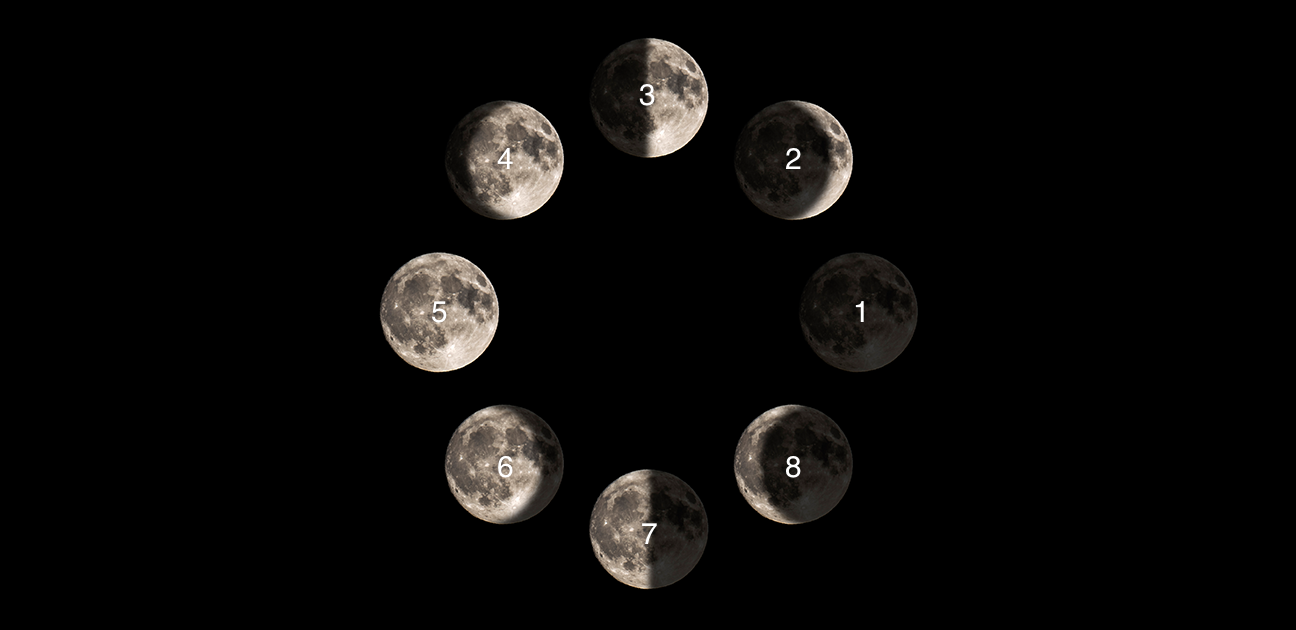
The images of the Moon Phases above are numbered IN ORDER from beginning to end. Drag the correct title from the left to match the right phase based on the numbers above.
First Quarter
Full Moon
New Moon
Third Quarter
Waning Crescent
Waning Gibbous
Waxing Crescent
Waxing Gibbous
1
2
3
4
5
6
7
8