Navigational Vectors #3: Wind Velocity
star
star
star
star
star
Last updated over 7 years ago
18 Nsɛmmisa
Hyɛ no nsow a efi ɔkyerɛwfo no hɔ:
Third lesson in Navigational Vectors lesson series. Adapted from CIESE
1
1
1
1
1
1
1
1
1
1
1
1
1
1
1
1
1
1
Third lesson in Navigational Vectors lesson series. Adapted from CIESE
at your back?
directly towards you?
from the side?
How can the wind affect a plane's flight? What does a pilot need to do to compensate for the wind?
Determining Wind Velocity
Winds in the northern hemisphere normally blow from west to east. This can change dramatically, however, when there is a front moving across the continent. Velocity is another example of a vector. Wind velocity is indicated by the wind speed and direction.
Pilots use wind maps that show the wind velocity at the altitude of the plane. A special symbol on the map called a wind barb shows both the speed and direction of the wind (wind velocity). Learn more about how to read wind speed and direction using the links below.
Practice drawing a wind barb to represent a wind velocity of 35 knots blowing from the southwest at an angle of 250 degrees (as measured from 0 degrees North).
Although wind barbs indicate the direction the wind is coming from, when using wind velocity vectors it is more common to indicate the direction that the wind is blowing towards. For the wind barb you drew above what is the direction that the wind is blowing towards?
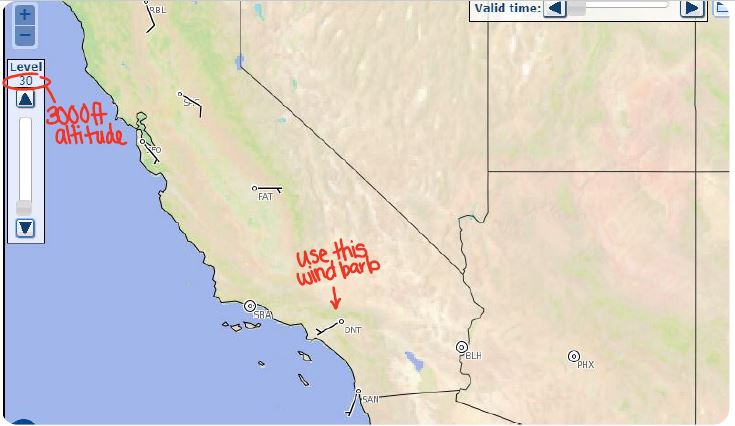
Look at the wind map below (obtained from aviationweather.gov). This map shows the upper air conditions at 3000 feet. This weather map has wind barbs that indicate wind speed and direction. Estimate the wind speed (knots, mph, and km/h to nearest hundredth) and direction the wind is blowing towards (degrees measured from 0 degrees North) in southern CA.
Use the compass rose to measure angles. Use google to help you with conversions between knots, mph, and km/h.
Wind speed at 3,000 feet (knots)
Wind speed at 3,000 feet (mph)
Wind speed at 3,000 feet (km/h)
Estimated direction the wind is blowing toward at 3,000 feet (degrees)
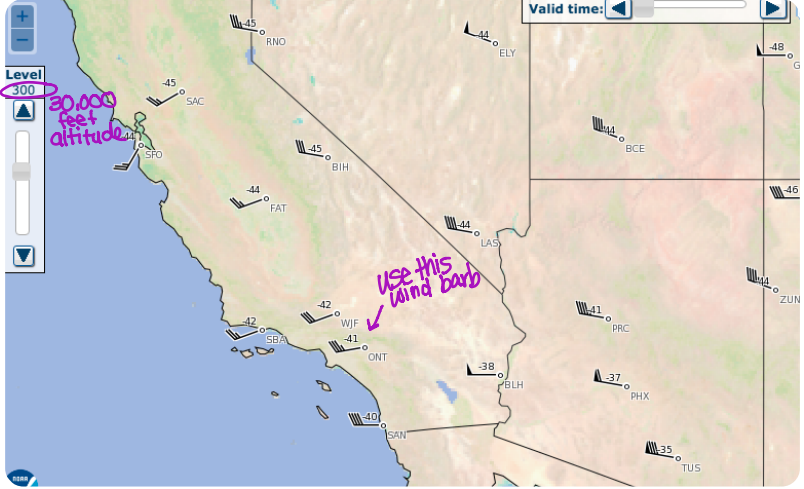
Now look at the wind velocity in CA at 30,000 feet in the map below (obtained from aviationweather.gov). This is a typical cruising altitude for a commercial plane. Estimate the wind speed (knots, mph, and km/h) and direction wind is blowing towards (degrees measured from 0 degrees North) in CA at this altitude.
Wind speed at 30,000 feet (knots)
Wind speed at 30,000 feet (mph)
Wind speed at 30,000 feet (km/h)
Estimated direction wind is blowing toward at 30,000 feet (degrees)
Imagine that you are flying a plane over your home state. Your altitude is 30,000 feet. The controls in the plane are set so that you are headed due North at 400 km/h. Draw a vector to scale to represent your plane's velocity. (Use the scale 20 km/h to 1 cm.)
Draw the wind velocity vector so that its tail is at the head of your plane's velocity vector. Make sure to draw it to scale.
Draw the resultant vector that is the sum of the wind velocity and plane's velocity. Measuring the resultant in cm, and using your scale factor, what is the plane's resultant velocity? (e.g. 400 km/h at 50 degrees). We call this resultant velocity vector the ground speed and bearing of the plane.
Do your results make sense? Why or why not?