Algebra 2 7-2 Guided Practice: Properties of Exponential Functions
star
star
star
star
star
Last updated over 3 years ago
27 Nsɛmmisa

3
10
A.CED.2
F.IF.7.e

3

3
3
10
A.SSE.1.b
F.BF.1.b
+2
10
A.SSE.1.b
F.IF.8.b
3
10
10
3
10

Video Check: Select all that apply with regards to the video embedded directly above this item.
Solve It! f and g are exponential functions with the same base.
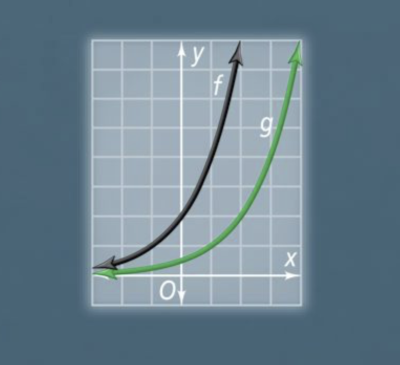
Is the graph of g a compression, a reflection, or a translation of the graph of f ? Or is it none of the above? Select all that apply.
Video Check: Select all that apply with regards to the video embedded directly above this item.

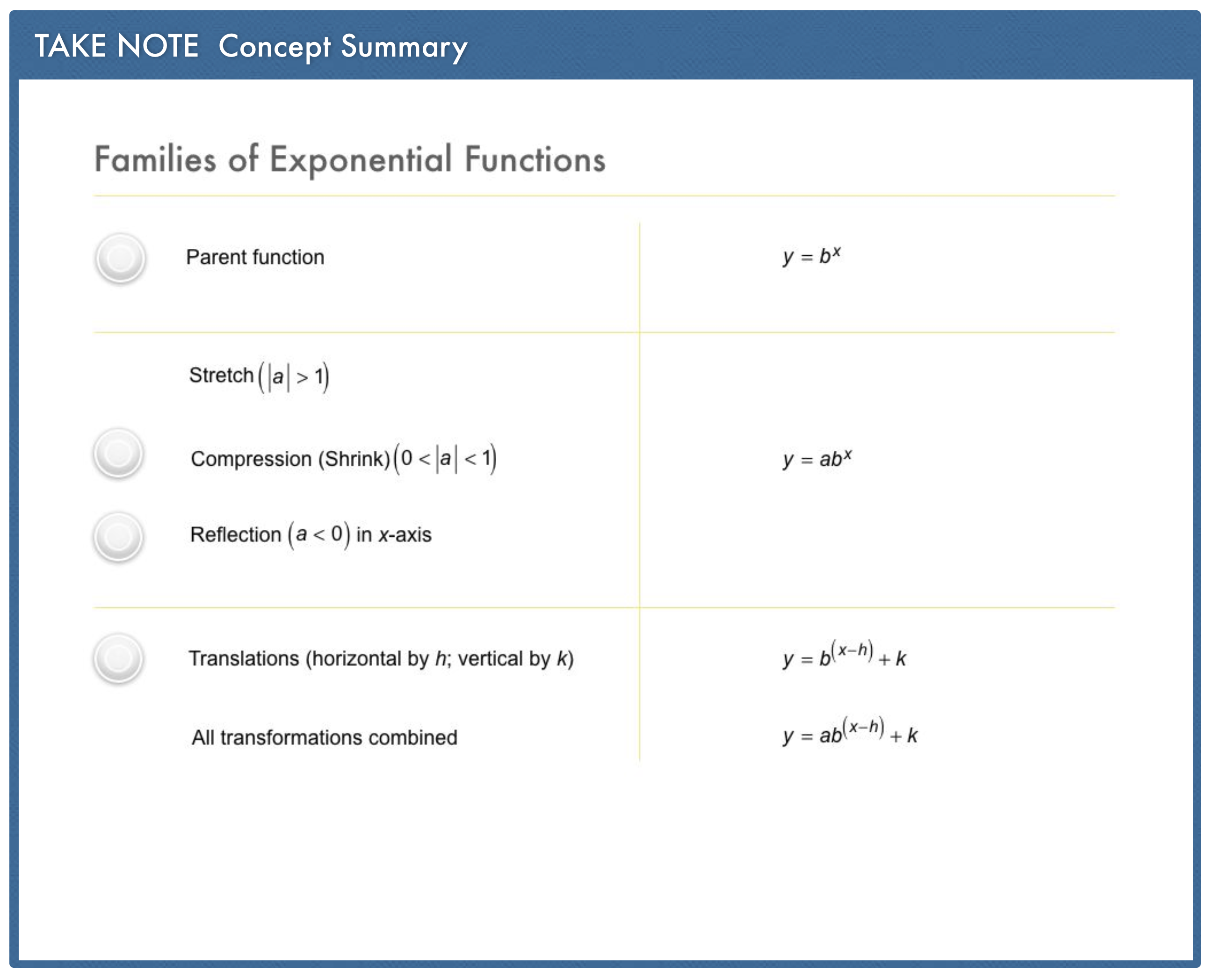
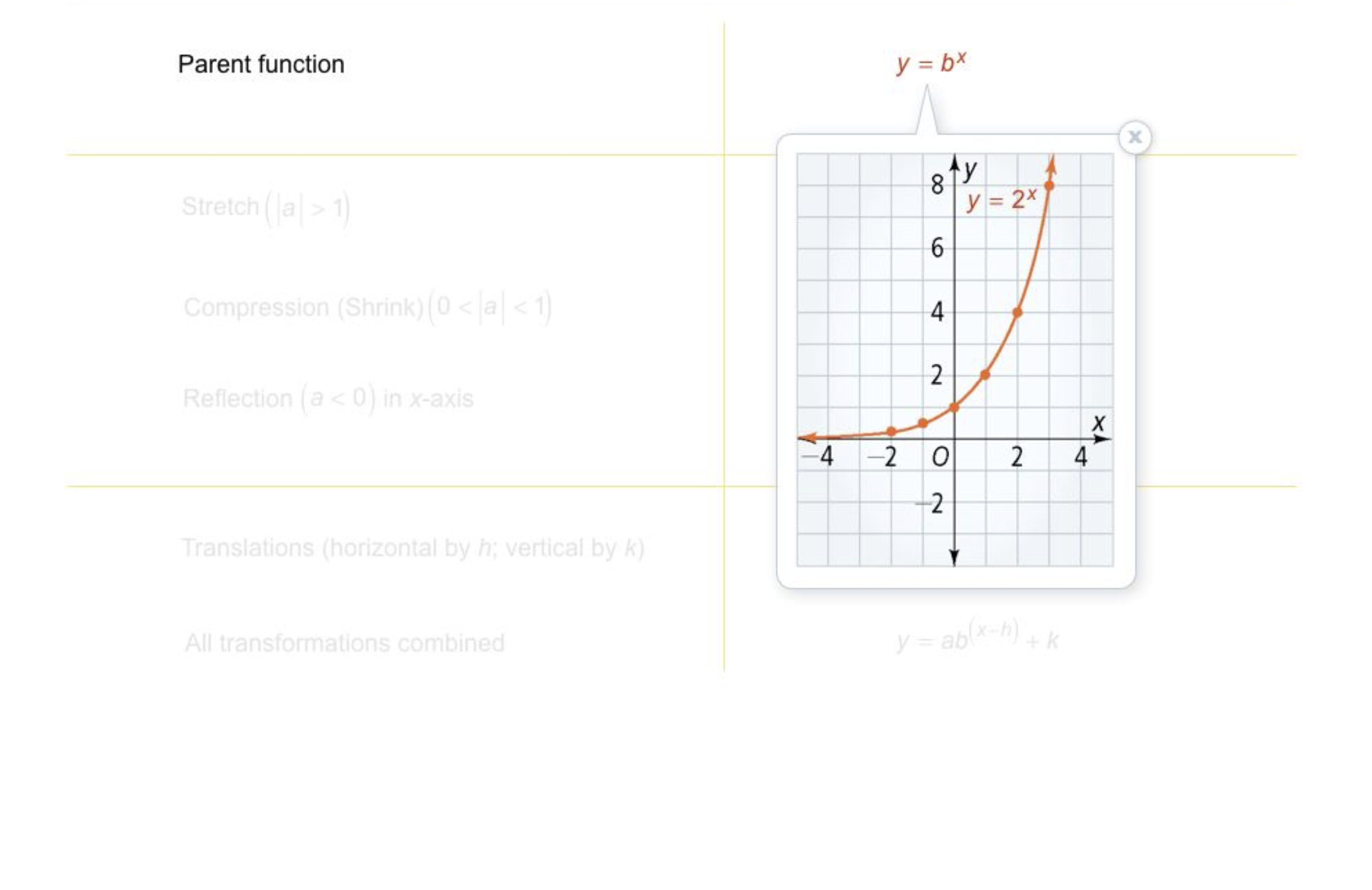
Take Note: Consider the exponential function
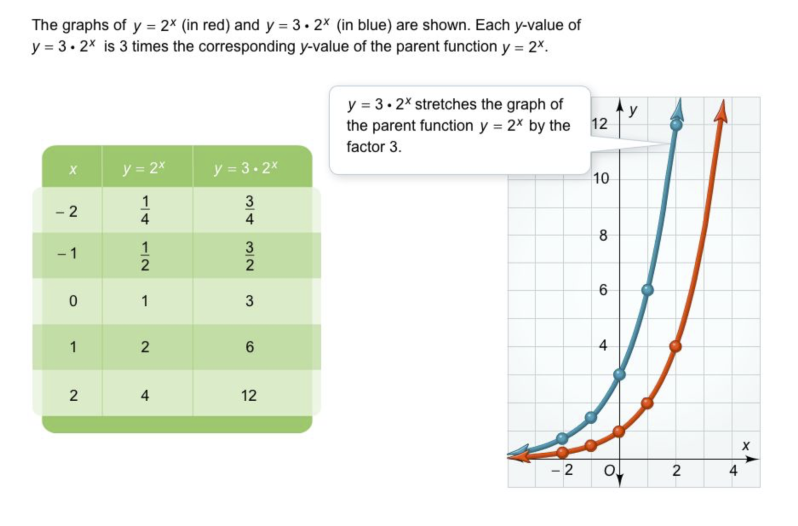
What function stretches

Problem 1 Got It?
Video Check: Select all that apply with regards to the video embedded directly above this item.

Take Note: Consider the general form of a translated exponential function below.
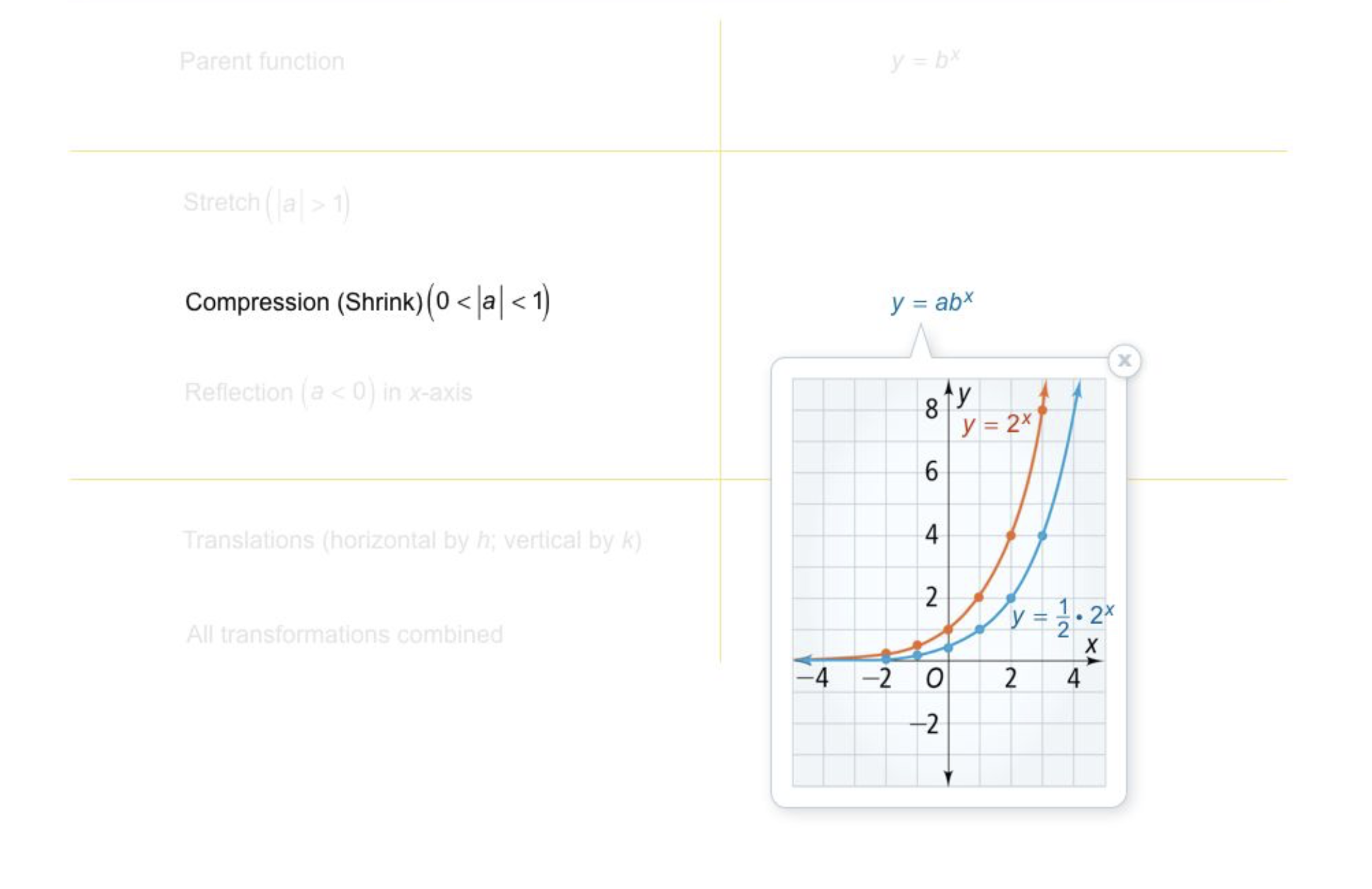
What impact does a have on the graph?
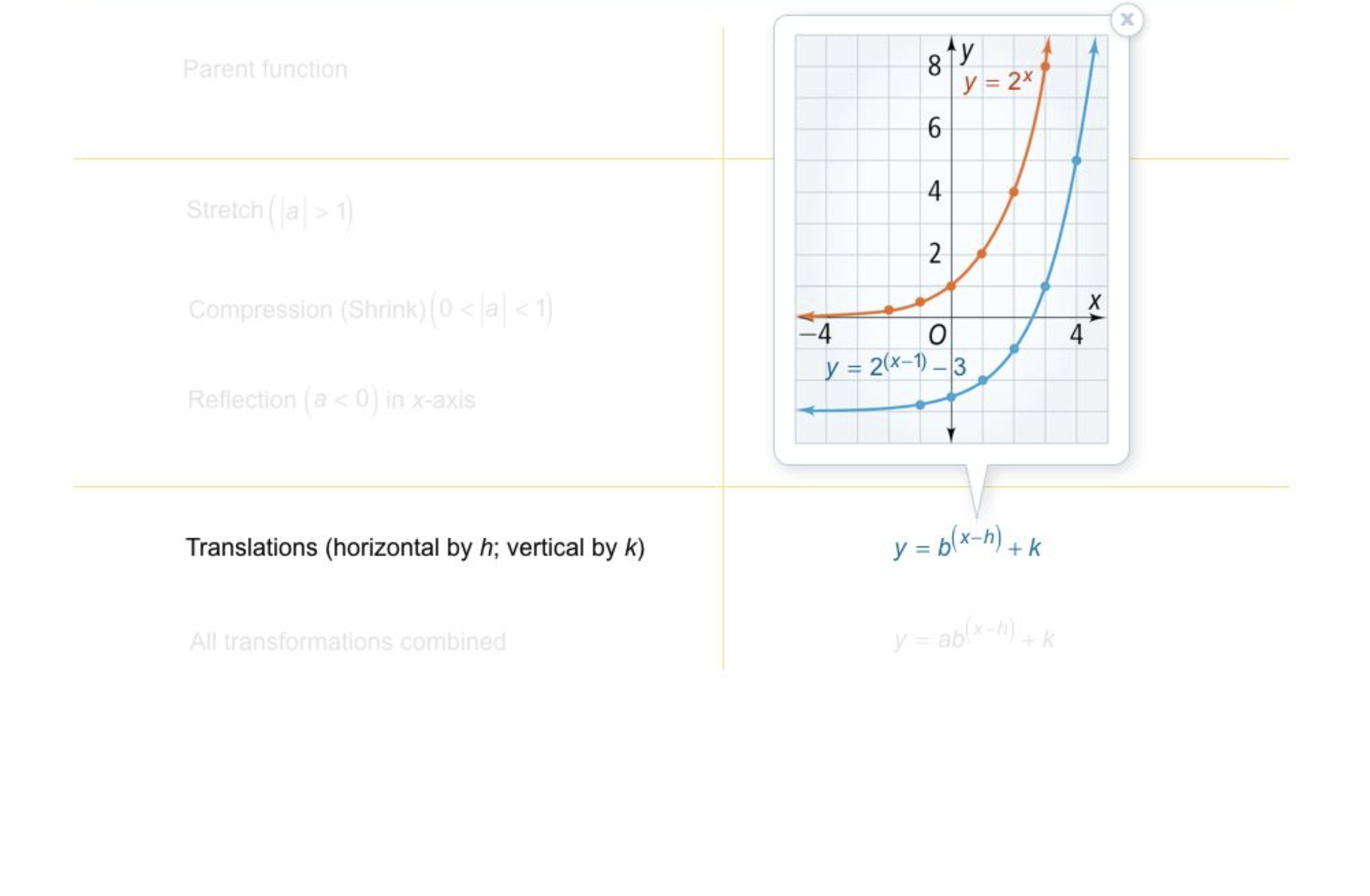
Take Note: Consider the general form of a translated exponential function below.
What impact does h have on the graph?
Take Note: Consider the general form of a translated exponential function below.
What impact does k have on the graph?

Problem 2 Got It?

Problem 2 Got It?
Video Check: Select all that apply with regards to the video embedded directly above this item.

Take Note: Consider the exponential function below.
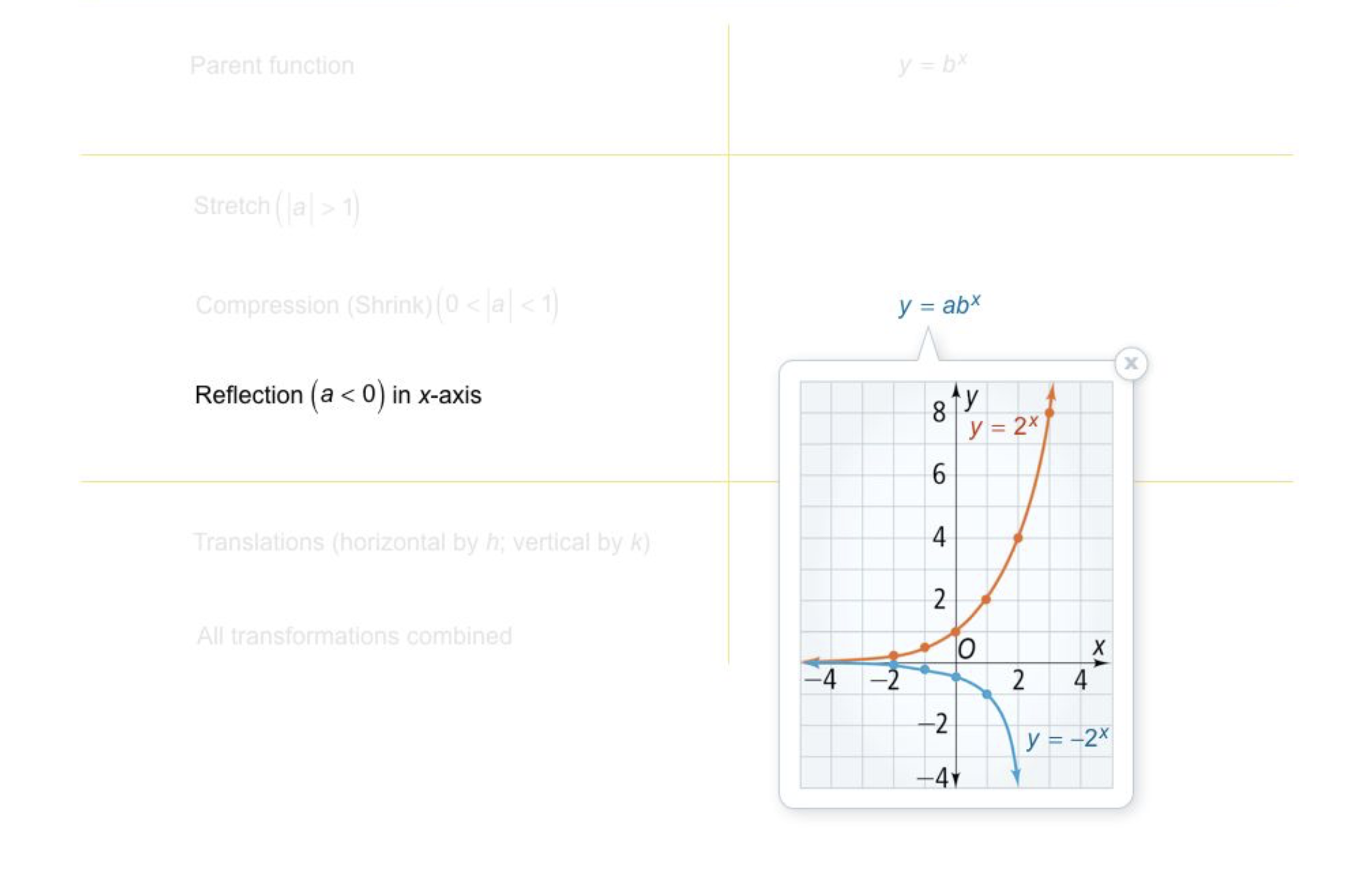
Where can a negative sign be placed to cause the graph to be reflected vertically (across the x-axis)?
Take Note: Consider the exponential function below.
Where can a negative sign be placed to cause the graph to be reflected horizontally (across the y-axis)?
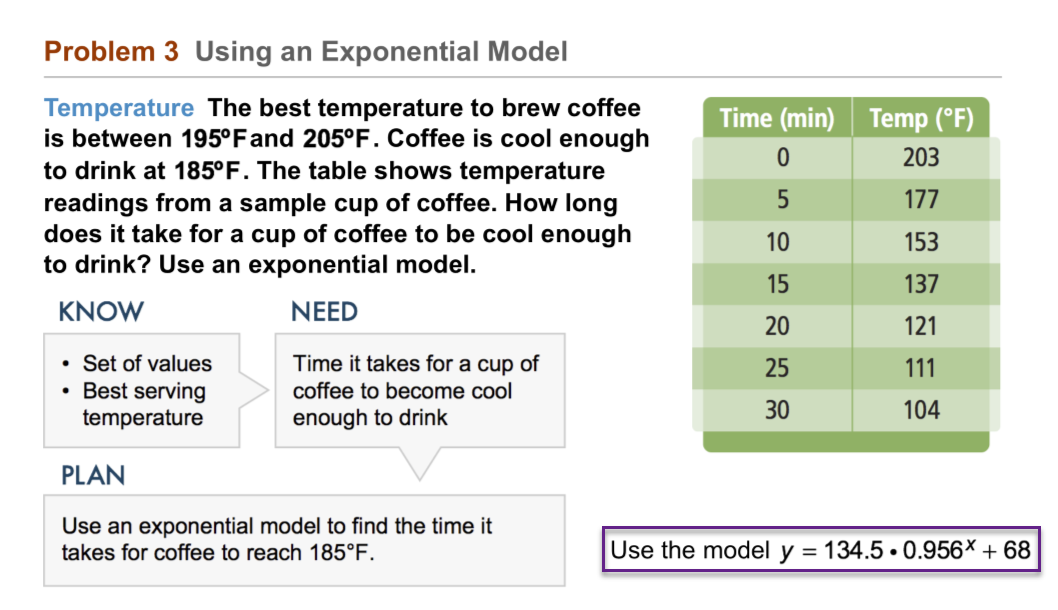
Problem 3 Got It? Use the exponential model from Problem 3.
How long does it take for the coffee to reach a temperature of 100 degrees?
Problem 3 Got It? Reasoning: In Problem 3, would the model of the exponential data be useful if you did not translate the data by 68 units? Explain.
Video Check: Select all that apply with regards to the video embedded directly above this item.

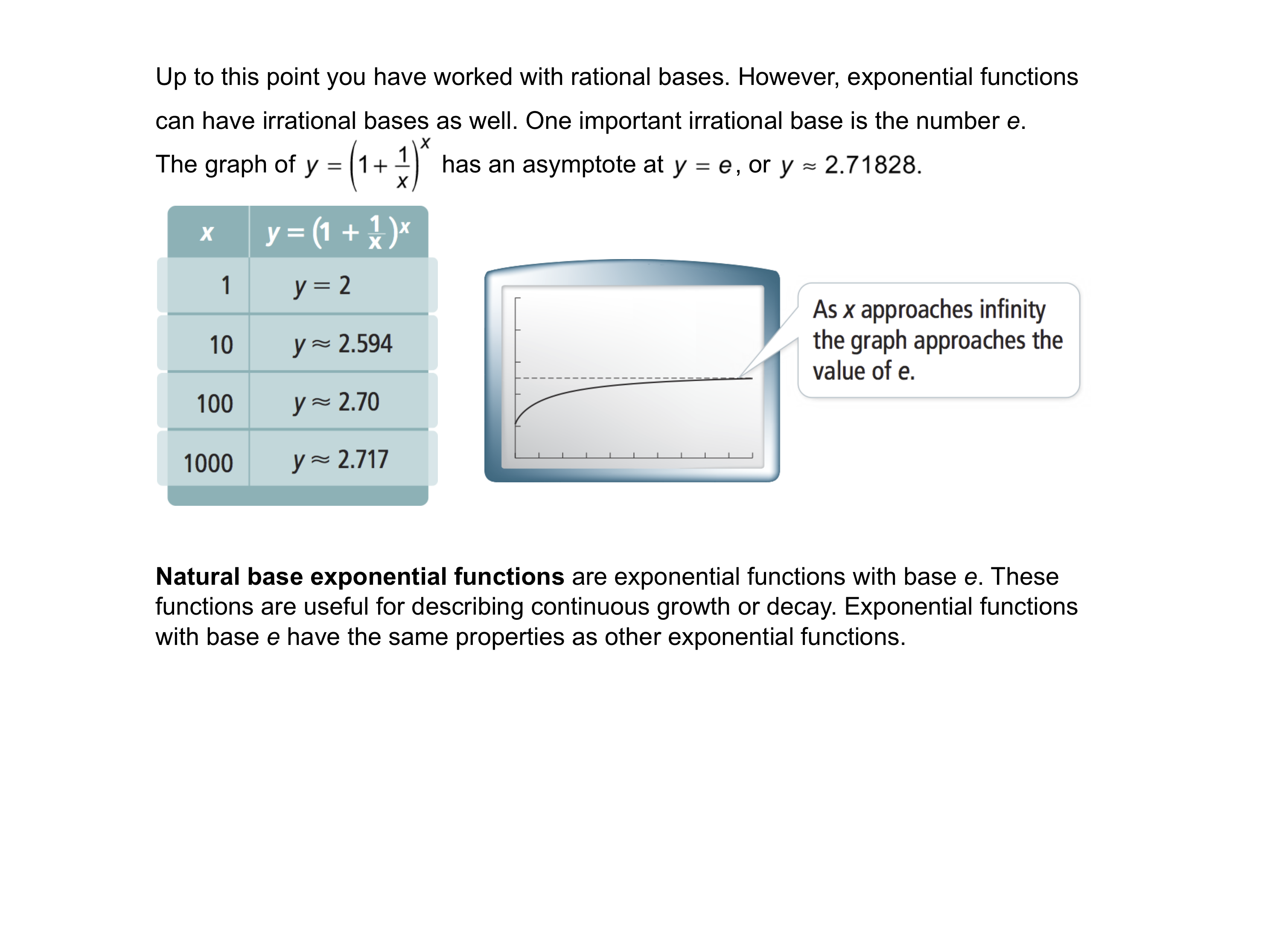
Take Note: What is the numerical value of e to the nearest hundredth? Enter only a number.
Take Note: What is a natural base exponential function ? What can they be used to model?
Problem 4 Got It? How can you use a graphing calculator to calculate e8?
Problem 4 Got It? Calculate e8. Round to 5 decimal places. Enter only a number with no commas or spaces. You may use the calculators at desmos.com.
Video Check: Select all that apply with regards to the video embedded directly above this item.

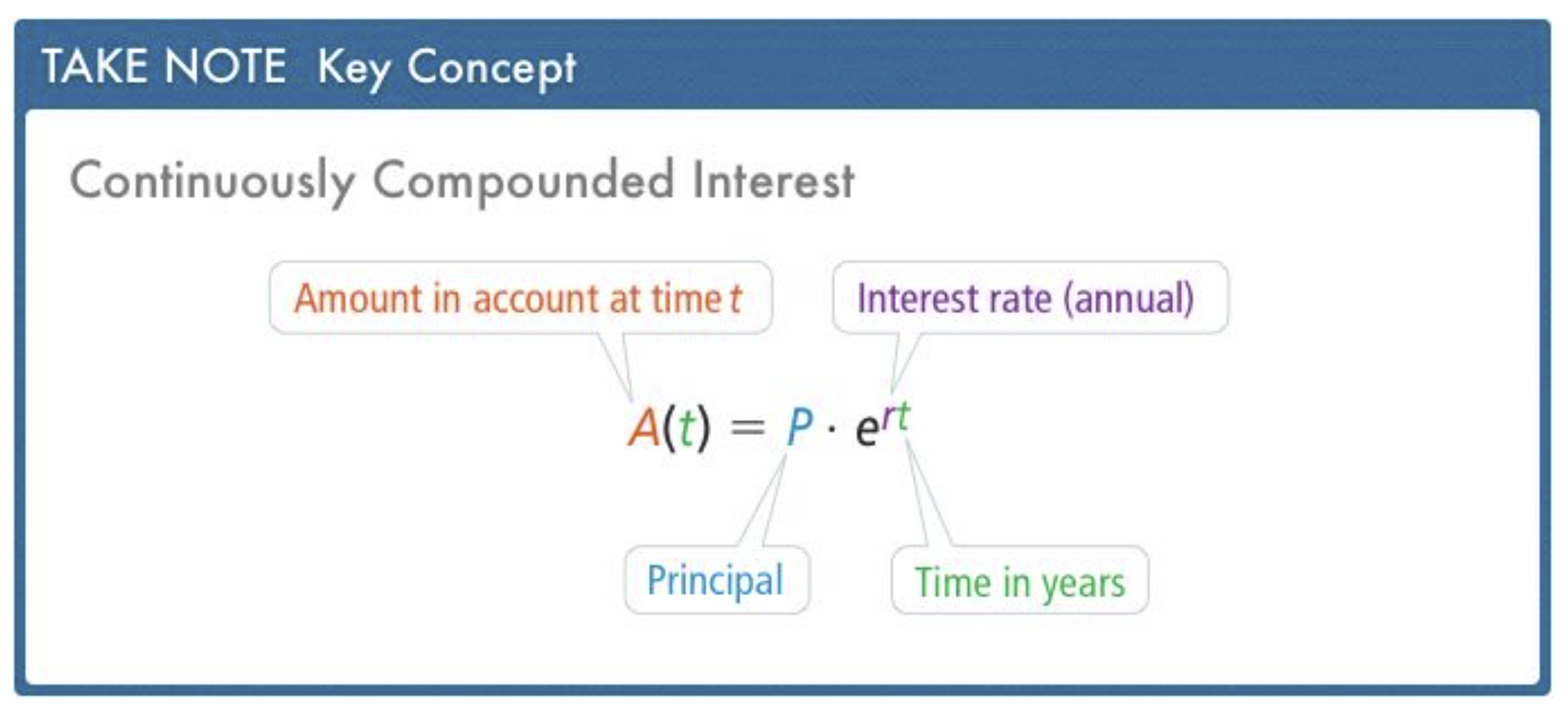
Take Note: What is the formula for continuously compounded interest? Enter only the formula. You may use either one of the special characters
Take Note: Consider the general formula for modeling continuously compounded interest below.
What does each part of the formula represent?
Match each element in the formula with its description.
| Draggable item | arrow_right_alt | Corresponding Item |
|---|---|---|
| arrow_right_alt | The amount in the account at time t | |
| arrow_right_alt | Principal - the initial amount in the account (in other words, the amount in the account at time 0) | |
| arrow_right_alt | An irrational constant approximately equal to 2.72 | |
| arrow_right_alt | The annual interest rate applied to the account | |
| arrow_right_alt | The time that interest has accrued in years |

Problem 5 Got It? Scholarships: Suppose you won a contest at the start of 5th grade that deposited $3000 in an account that pays 5% annual interest compounded continuously. How much will you have in the account when you finish high school 8 years later? Express the answer to the nearest dollar.

🧠 Retrieval Practice:
Summarize the mathematical content of this lesson. What topics, ideas, and vocabulary were introduced?
Take Note: Consider the exponential function
What function translates