Rock Cycle Test
star
star
star
star
star
Last updated over 7 years ago
31 Nsɛmmisa
Hyɛ no nsow a efi ɔkyerɛwfo no hɔ:
Geologic Processes
1
1
1
1
1
1
1
1
1
1
1
1
1
1
1
1
1
1
1
1
1
Geologic Processes
Which of the following is NOT a rapid (fast) change in Earth's surface?
Weathering is the breaking down of rock into ___________.
Weathering is the breaking down of rock into ___________.
_________is the movement of sediment from one place to another.
The dropping off of sediments in a new place is called __________.
Weathering, Erosion, and Deposition are examples of ________ changes in the Earth's surface.
Which of the following is NOT a cause of weathering, erosion, and deposition?
How does freezing water cause the weathering of rocks? The freezing water—
The process of breaking up, wearing away of rocks on Earth's surface by force is called...
What type of weathering is it when acid rain breaks down and changes the rock?
How do plants weather rocks?
Which type of rock results from melting and cooling of magma?
Which type of rock forms from extreme heat and pressure?
A metamorphic rock changes into an igneous rock by what two processes?
Wind, water, and ice breaking down rock is called
What is the MAIN way rocks are classified?
What characteristic can identify the rock with small, flat surfaces that are shiny or sparkly, like tiny mirrors.
What characteristic can identify the rock with shiny and smooth surface, like colored glass.
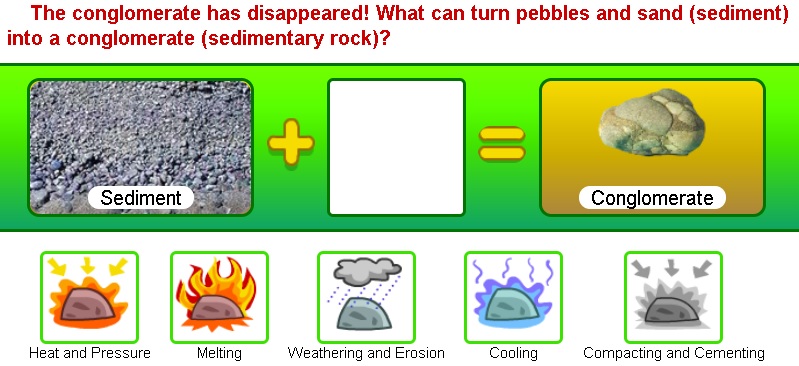
What process turns pebbles and sand into a conglomerate? Refer to above photo.
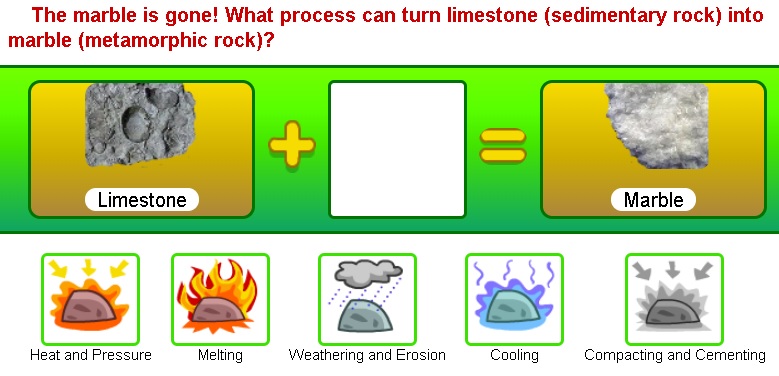
The marble is gone! What process can turn limestone (sedimentary rock) into marble (metamorphic rock)? Refer to above photo.
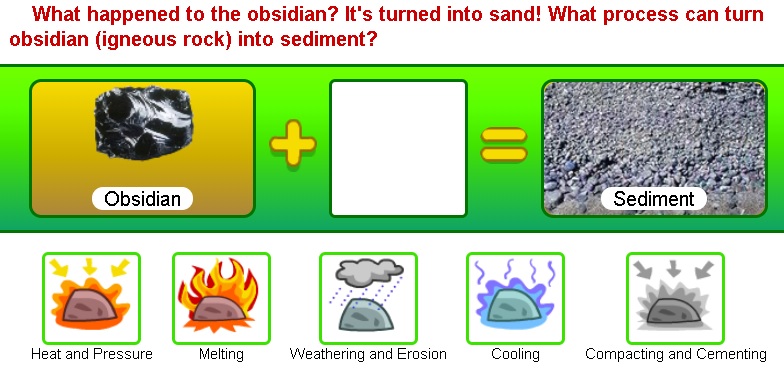
What process can turn obsidian into sediment? Refer to above photo.
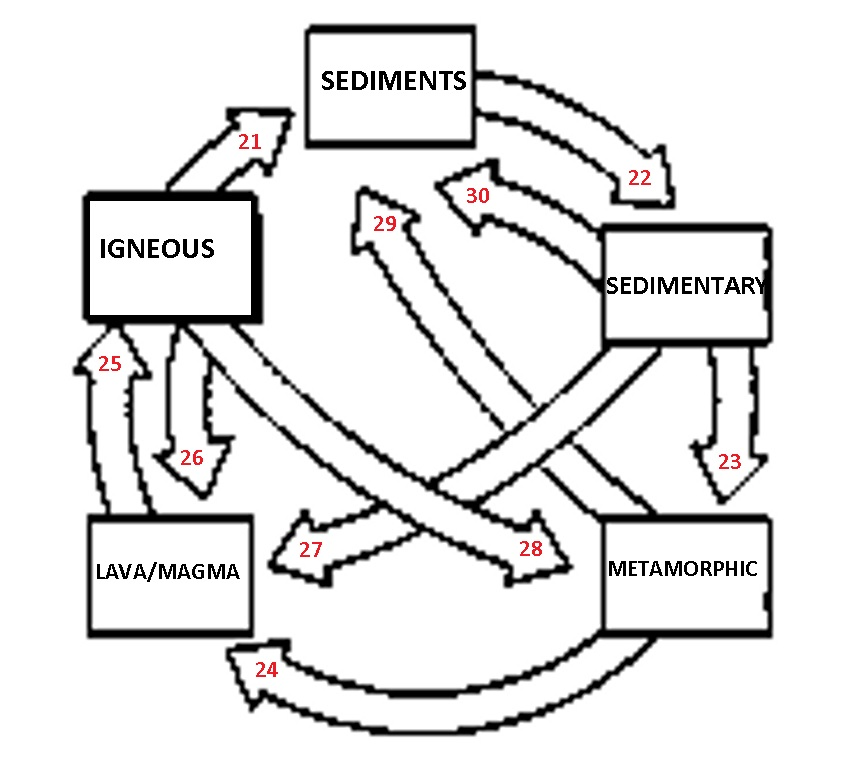
What process is used in #21. Copy/paste from below.
Erosion
Compacting/cementation
Heat and Pressure
Melting
Extreme heat and cooling
What process is used in #22. Copy/paste from below.
Erosion
Compaction/cementation
Heat and Pressure
Melting
Extreme heat and cooling
What process is used in #23. Copy/paste from below.
Erosion
Compaction/cementation
Heat and Pressure
Melting
Extreme heat and cooling
What process is used in #24. Copy/paste from below.
Erosion
Compaction/cementation
Heat and Pressure
Melting
Extreme heat and cooling
What process is used in #25. Copy/paste from below.
Erosion
Compaction/cementation
Heat and Pressure
Melting
Extreme heat and cooling
What process is used in #26. Copy/paste from below.
Erosion
Compaction/cementation
Heat and Pressure
Melting
Extreme heat and cooling
What process is used in #27. Copy/paste from below.
Erosion
Compaction/cementation
Heat and Pressure
Melting
Extreme heat and cooling
What process is used in #28. Copy/paste from below.
Erosion
Compaction/cementation
Heat and Pressure
Melting
Extreme heat and cooling
What process is used in #29. Copy/paste from below.
Erosion
Compaction/cementation
Heat and Pressure
Melting
Extreme heat and cooling
What process is used in #30. Copy/paste from below.
Erosion
Compaction/cementation
Heat and Pressure
Melting
Extreme heat and cooling