Hello Students! Below you will see some helpful videos to guide you through your Unit 1 EOC Review. These videos are optional, but should help you if you are stuck on a problem. Please use these videos as well as your notes and other resources to review topics from Unit 1: Transformations in the Coordinate Plane.
1 point
1
Question 1
1.
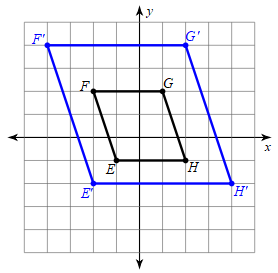
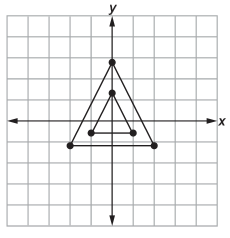
The smaller triangle is transformed to create the larger triangle . Which of these is the scale factor of the dilation centered at the point (0, 0)?
1 point
1
Question 2
2.
Select all the degrees of rotation that will carry an equilateral triangle onto itself.
1 point
1
Question 3
3.
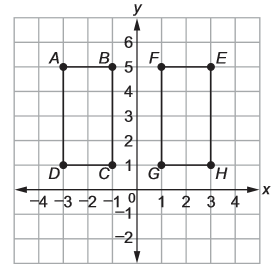
Describe a transformation that will map ABCD onto EFGH.
1 point
1
Question 4
4.
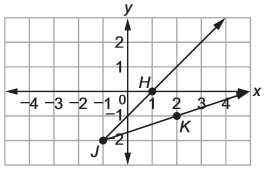
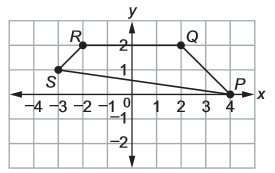
Determine K' using the translation (x, y) → (x – 3, y + 1) .
1 point
1
Question 5
5.
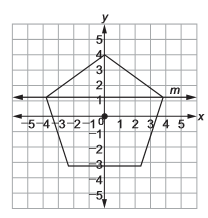
A regular pentagon is centered about the origin and has a vertex at (0, 4). Which transformation maps the pentagon to itself?
1 point
1
Question 6
6.
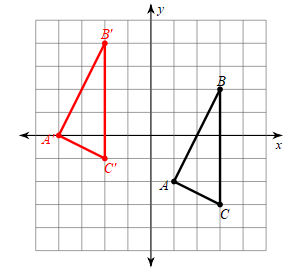
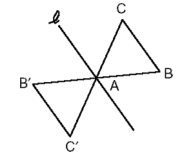
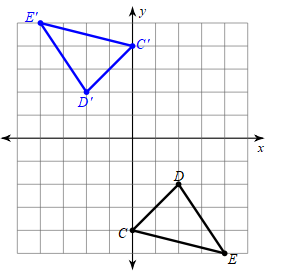
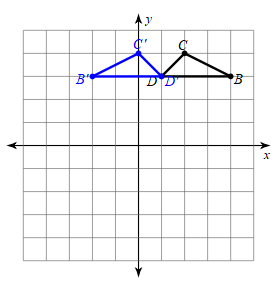
Which transformation is represented below?
1 point
1
Question 7
7.
Identify S' after a reflection over the x-axis.
1 point
1
Question 8
8.
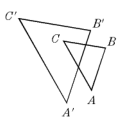
Triangle A'B'C' is the image of triangle ABC under the dilation (x, y) --> (2x, 2y). What must be true about these two triangles?
1 point
1
Question 9
9.
A translation maps A(-3, 2) to A'(0, 0). Find B', the image of B(5, 4) under the same translation.
0 points
0
Question 10
10.
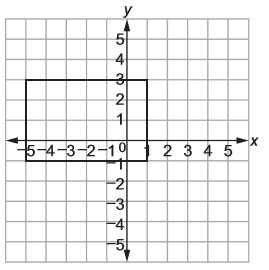
Describe a transformation that maps the given figure onto itself.
1 point
1
Question 11
11.
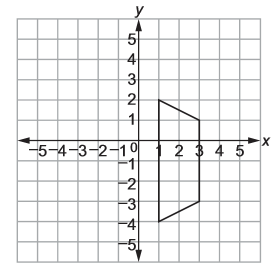
Graph the image after a reflection over the y-axis.
1 point
1
Question 12
12.
Select all transformations that will map the given figure onto itself.
1 point
1
Question 13
13.
Which rule describes the transformation shown below?
1 point
1
Question 14
14.
Graph the image using the following translation: (x, y) --> (x-4, y-6)
1 point
1
Question 15
15.
What degree of rotation will carry a regular octagon onto itself?
1 point
1
Question 16
16.
Which transformation does NOT preserve distance?
1 point
1
Question 17
17.
Point A(3, -1) is reflected over the x-axis and then translated right 2 and up five. What are the coordinates of A'?
1 point
1
Question 18
18.
The point (-2, 1) is rotated 180 degrees. What are the coordinates of its image?
1 point
1
Question 19
19.
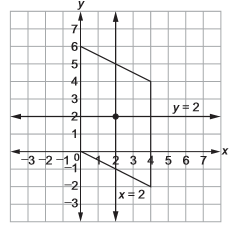
A parallelogram has vertices at (0, 0), (0, 6), (4, 4), and (4, –2). Which transformation maps the parallelogram to itself?
1 point
1
Question 20
20.
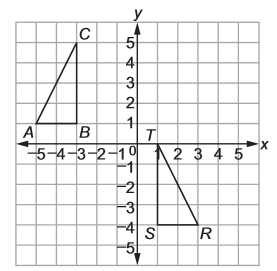
Which sequence of transformations maps △ABC to △RST?
1 point
1
Question 21
21.
What are the coordinates of the image P(-2, 5) after a clockwise rotation of 90 degrees about the origin?
1 point
1
Question 22
22.
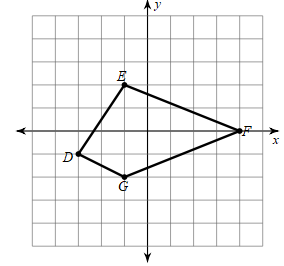
Identify the coordinates of E' after a dilation by a scale factor of 2.
1 point
1
Question 23
23.
Identify the scale factor of the given dilation.
1 point
1
Question 24
24.
If a dilation maps (3, -2) to (x, -8), what is the value of x?
1 point
1
Question 25
25.
The transformation from ABC to A'B'C' is shown below. This transformation is an example of a
1 point
1
Question 26
26.
A triangle has side lengths of 12, 14, and 18. Find the perimeter of a similar triangle after a dilation of 1/2.
1 point
1
Question 27
27.
The image of P(6, -9) after a dilation is P'(4, -6). What is the scale factor?
1 point
1
Question 28
28.
Which rule describes the transformation shown below?
1 point
1
Question 29
29.
Which transformation does NOT preserve congruency?
1 point
1
Question 30
30.
Which transformation is shown below?
1 point
1
Question 31
31.
What shape does NOT have rotational symmetry?
1 point
1
Question 32
32.
If point R'(6, 3) is the image of point R'(2, 1) under a dilation with respect to the origin, what is the constant of the dilation?
1 point
1
Question 33
33.
Point P(3, -2) is transformed according to the rule (x, y) --> (-y, x). What are the coordinates of P'?
1 point
1
Question 34
34.
Which type of transformation is (x, y) --> (x-2, y+2)?
1 point
1
Question 35
35.
After a dilation with respect to the origin, the image of point A(12, 16) is A'(3, 4). What are the coordinates of the image of point B(8, 4) after the same dilation?
1 point
1
Question 36
36.
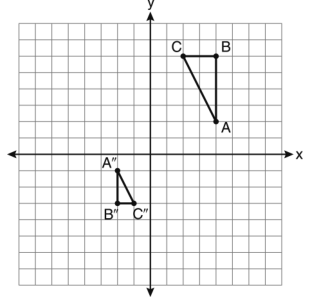
Which sequence of transformations is shown below?
1 point
1
Question 37
37.
What are the coordinates of K(4, 5) after a reflection over the line y=2?
1 point
1
Question 38
38.
Mark the diagram with congruency marks to show an example of vertical angles.
1 point
1
Question 39
39.
Mark the diagram to show an example of a linear pair.
1 point
1
Question 40
40.
Mark the diagram to show an example of non-adjacent supplementary angles.
1 point
1
Question 41
41.
Mark the diagram to show an example of corresponding angles.
1 point
1
Question 42
42.
Mark the diagram to show an example of alternate interior angles.
1 point
1
Question 43
43.
Mark the diagram to show an example of alternate exterior angles.
1 point
1
Question 44
44.
Mark the diagram to show an example of same side interior angles.
1 point
1
Question 45
45.
Mark the diagram to show an example of same side exterior angles.