Select all that could be used to show that u || v.

Select all that could be used to show that u || v.
In this unit, we learned how to write proofs about congruence, similarity, and other geometric concepts. We learned how to construct some geometric figures with just a straightedge and compass. We also explored angle pair relationships, parallel lines cut by a transversal, triangles, quadrilaterals, proportionality in triangles and more! Here are a few resources to help you answer the questions below. Happy studying!!
Which angle pairs are congruent and which are supplementary?
adjacent
vertical angles
linear pair
complementary
corresponding
same-side interior
alternate interior
alternate exterior
Congruent
Supplementary
Select all that could be used to show that u || v.
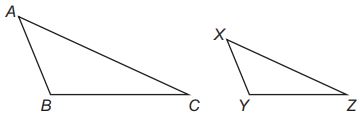
In the triangles shown, △ABC is dilated by a factor of 2/3 to form △XYZ.
Given that m∠A = 50° and m∠B = 100°, what is m∠Z?
Parallelogram FGHJ was translated 3 units down to form parallelogram F′G′H′J′. Parallelogram F′G′H′J′ was then rotated 90° counterclockwise about point G′ to obtain parallelogram F″G″H″J″.
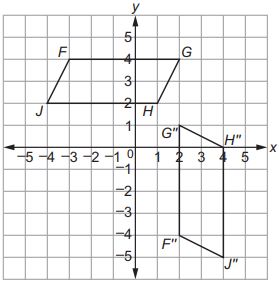
Which transformation results in a figure that is similar to the original figure but has a greater
area?
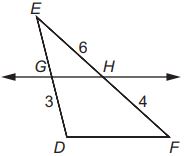
In the triangle shown, GH || DF.
What is the length of GE?
Use this triangle to answer the question.
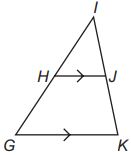
This is a proof of the statement “If a line is parallel to one side of a triangle and intersects the
other two sides at distinct points, then it separates these sides into segments of proportional
lengths.”
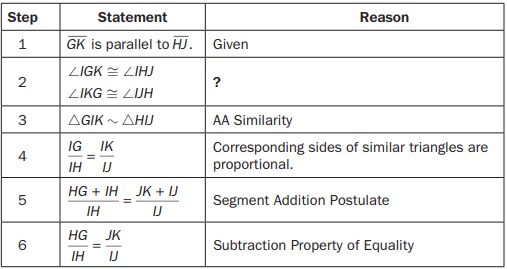
Which reason justifies Step 2?
Which of the theorems apply to Triangle Congruence and Triangle Similarity?
SSS
SAS
AA
SSA
ASA
AAS
HL
Congruence Theorems
Similarity Theorems
Consider the triangles shown.
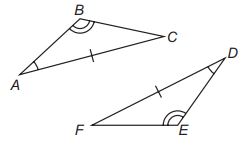
Which can be used to prove the triangles are congruent?
In this diagram, STU is an isosceles triangle where ST is congruent to UT . The two-column proof shows that ∠S is congruent to ∠U.

Which reason is missing in the proof?
In this diagram, CD is the perpendicular bisector of AB. The two-column proof shows that AC is congruent to BC.

Which of the following would justify Step 6?
Given: AB and AC are congruent; AD is a perpendicular bisector of BC
Prove: ∠B ≅ ∠C

Put the proof in order.
ΔABD ≅ ΔACD by SSS.
AD is a shared side so AD ≅ AD by the reflexive property.
If ΔABD ≅ ΔACD, then ∠B ≅ ∠C by CPCTC.
2. D is the midpoint of BC, so BD ≅ CD.
It is given that AB ≅ AC and that D is the midpoint of BC.
Consider the construction of the angle bisector shown.
Which could have been the first step in creating this construction?
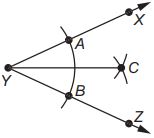
A student used a compass and a straightedge to bisect ∠ABC in this figure.
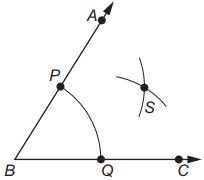
Which statement BEST describes point S?
Consider the beginning of the construction of a square inscribed in circle Q.
Step 1: Label point R on circle Q.
Step 2: Draw a diameter through R and Q.
Step 3: Label the point where the diameter intersects the circle as point T.
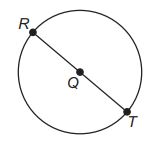
What is the next step in this construction?
Triangle ABC is similar but not congruent to triangle DEF.
Which series of transformations could map triangle ABC onto triangle DEF?
Triangle ABC is similar but not congruent to triangle DEF.
Which equation must be true about triangle ABC and triangle DEF?
In this figure, l||n. Jessie listed the first two steps in a proof that shows m∠1 + m∠2 + m∠3 = 180°.
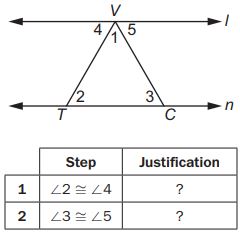
Which justification can Jessie give for Steps 1 and 2?
Given: ∆ABC
Prove: m∠1 + m∠2 + m∠3 = 180° (This is the Triangle Sum Theorem)
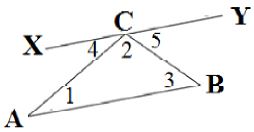
Put the proof in the correct order.
4. m∠1 = m∠4 and m∠3 = m∠5 because congruent angles have equal measures.
m∠1 + m∠2 + m∠3 = 180° by substitution.
2. Draw XY through C and parallel to AB.
m∠4 + m∠2 + m∠5 = 180°because if adjacent angles form a straight angle, their sum is 180.
∆ABC is given.
∠1 ≅ ∠4 and ∠3 ≅ ∠5 by the alternate interior angles theorem.
Solve for x.
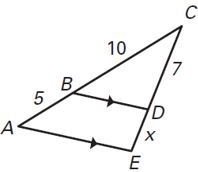
Solve for x.
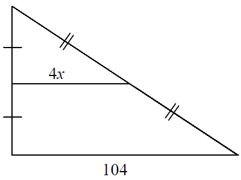
Solve for x.
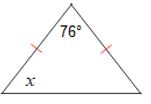
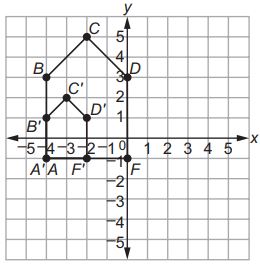
Figure A′B′C′D′F′ is a dilation of figure ABCDF by a scale factor of 1/2 . The dilation is centered
at (–4, –1). Which statement is true?
In this diagram, DE ≅ JI and ∠D ≅ ∠J.
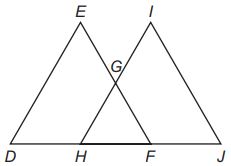
Which additional information is sufficient to prove that △DEF is congruent to △JIH?
Look at the triangle.
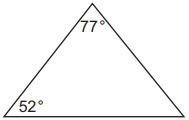
Which triangle is similar to the given triangle?