Let's refresh your memory:
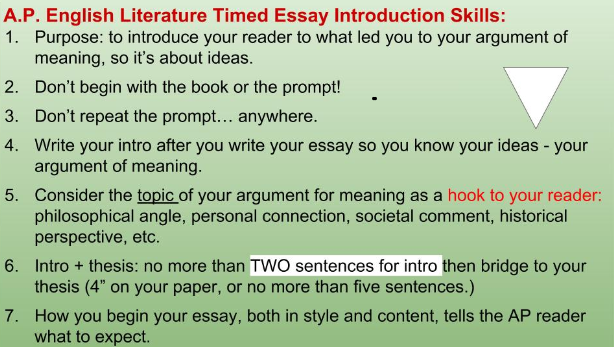
Read the AP English Literature Timed Essay Introduction Skills tips in the image below:
Write your first attempt at responding to the 2015 AP Poetry Prompt with just comprehensive reading:
"In the following poem by Caribbean writer Derek Walcott, the speaker recalls a childhood experience of visiting an elderly woman storyteller. Read the poem carefully. Then, in a well-developed essay, discuss the speaker's recollection and analyze how Walcott uses poetic devices to convey the significance of the experience. "
Without looking at your first attempt, write your 2nd attempt at responding to the 2015 AP Poetry Prompt now that you've analyzed a portion of the poem:
"In the following poem by Caribbean writer Derek Walcott, the speaker recalls a childhood experience of visiting an elderly woman storyteller. Read the poem carefully. Then, in a well-developed essay, discuss the speaker's recollection and analyze how Walcott uses poetic devices to convey the significance of the experience. "
Now look at your first response to the poetry prompt and compare it to your 2nd response. What do you see that improved after some analysis of the poem? Why do you think that you improved in this area? What did not improve? Do you think it needs to improve? Why/why not?
Let's refresh your memory:
Read the AP English Literature Timed Essay Introduction Skills tips in the image below:
Is the title of the poem and author written in your FIRST sentence?
Did you write an introduction to your thesis?
Does the first and/or second sentences say something about the prompt (synonyms count)?
Is the first sentence about the poem at all?
Is your first sentence a question?
Is your first paragraph, intro & thesis, longer than a 1/4 of your piece of paper?
Is your first sentence a simple sentence (subject-verb-predicate)?
Is your first sentence a compound sentence (two simple sentences joined with and, or, nor, for but)?
Is your first sentence a complex sentence (an independent clause + a dependent clause)?
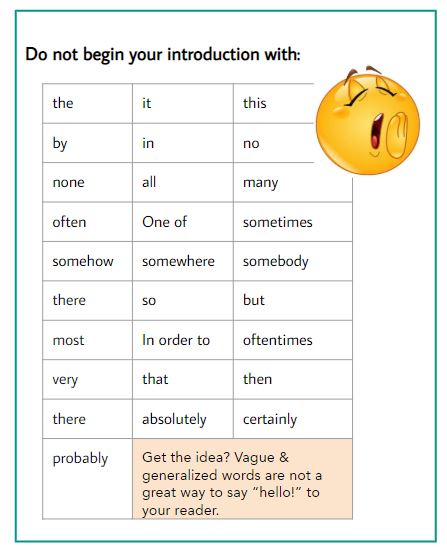
Look at the first word in your essay. Is it on this list (or, is it vague or general)?
Your turn to practice an interesting introduction with your 2nd attempt!