
What is the Volume of the Rock (1pt) round to the nearest tenth (1pt) show all work (1pt).
What is the Volume of the Rock (1pt) round to the nearest tenth (1pt) show all work (1pt).
What is the balance used to measure?
When using the balance, which of these activities should be done first?
When measuring the mass of an object, you measure the
When measuring the volume of an object, you measure the
When measuring the volume of a liquid, you would use
How many milliliters make up one full liter?
The basic unit of measurement for length is
When you measure the speed of particles that make up something, you are measuring its?
The following is a list of steps involved in the Scientific Method which scientists use to solve problems. Choose the correct sequence (order) of the steps then choose the answer that corresponds to that sequence
Research
Form conclusions
Form a hypothesis
Perform a experiment
Identify a problem or ask a question
Collect or Analyze Data
What two things must you measure to find density?
Any factor that affects the results of an experiment is called a
What is the Volume of the Rock (1pt) round to the nearest tenth (1pt) show all work (1pt).
The diagram below shows an experiment conducted to see how quickly water moves through different-sized particles of the same substance.
List two variables that were held constant in this experiment.

The diagram below shows an experiment conducted to see how quickly water moves through different-sized particles of the same substance.
What was the one variable that changed in this experiment?

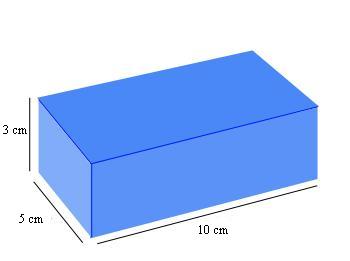
The diagram below shows the dimensions of length for a block of wood that has a mass of 45g. Using the measurements of length and mass given, DETERMINE THE VOLUME of the block. Don’t forget to:(1) Write out the formula (V=LxWxH) (1pt)(2) Show your work (plug #’s into the formula) (1pt)(3) Label your answer with proper units (1pt)(4) Round the final calculation to the nearest 10th (2pts)
A student conducted an experiment to find out if air temperature affected the total number of seeds that germinate. Two groups of 100 identical seeds were used. One group was kept at an air temperature of 10°C and the other at an air temperature of 20°C. All other conditions were held constant. Observations made during the experiment are shown in the data table below.
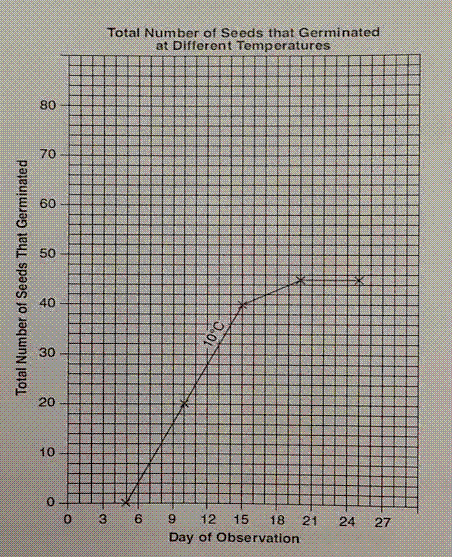
Using the graph below, determine how many seeds would have germinated at 10°C by day 12. (write the number only)
A student is given a ruler and hand lens and asked to make observations and inferences about rock samples collected on a field trip. The student wrote the 3 statements below:
1) The rock is mostly gray, with white speckles on the surface.
2) If the rock probably formed in a watery environment.
3) The rock has a smooth surface.