Log in
Sign up for FREE
arrow_back
Library

Biology Final Spring 2019 Master

star
star
star
star
star
Last updated almost 7 years ago
127 questions
0
0
1
3
5
1
1
1
1
1
1
1
1
1
1
1
1
1
1
1
1
1
1
1
1
1
1
1
1
1
1
1
1
1
1
1
1
1
1
1
1
1
1
1
1
10
1
5
1
1
1
1
1
1
1
1
1
1
1
1
1
1
1
1
1
1
1
1
1
1
1
1
1
1
1
1
1
1
1
8
0
1
1
1
1
1
1
1
1
1
1
4
8
1
1
1
4
8
1
6
1
1
1
1
1
1
1
1
1
1
1
1
1
1
1
1
1
1
1
1
1
1
1
1
1
1
1
Question 1
1.

Last Name, First Name

Question 2
2.

Class Period

Question 3
3.

Question 4
4.

Based on your knowledge of food webs, food chains, and trophic levels in ecosystems, insert the three organisms in this study (Redbud Tree (r), Beetles (b), Wasps (w)) into the Energy Pyramid. Only the abbreviations given to you to insert into the pyramid will be accepted for credit.

Question 5
5.

Insert the organisms in this study into the bubbles in this Conceptual Model of Carbon Flow Through the Redbud-Bruchid Beetle-Chalcid Wasp Ecosystem. The 5 terms you will insert are: Atmosphere (A), Bruchid beetles (B), Chalcid wasps (C), Decomposers (D), and Redbud tree (R). To make this easier abbreviate the terms by using the letter provided after each term.

Question 6
6.

Question 7
7.

Question 8
8.

Question 9
9.

Question 10
10.

Question 11
11.

Question 12
12.

Question 13
13.

Question 14
14.

Question 15
15.

Question 16
16.

Question 17
17.

Question 18
18.

Question 19
19.

Question 20
20.

Question 21
21.

Question 22
22.

Question 23
23.

Question 24
24.

Question 25
25.

Question 26
26.

Question 27
27.

Question 28
28.

Question 29
29.

Question 30
30.

Question 31
31.

Question 32
32.

Question 33
33.

Question 34
34.

Question 35
35.

Question 36
36.

Question 37
37.

Question 38
38.

Question 39
39.

Question 40
40.

Question 41
41.

Question 42
42.

Question 43
43.

Question 44
44.

Question 45
45.

Question 46
46.

Question 47
47.

Question 48
48.

Question 49
49.

Question 50
50.

Question 51
51.

Question 52
52.

Question 53
53.

Question 54
54.

Question 55
55.

Question 56
56.

Question 57
57.

Question 58
58.

Question 59
59.

Question 60
60.

Question 61
61.

The pedigree chart on the left shows the phenotypic expression of the alleles for hair color in this family.
Dad has brown hair and is heterozygous for the hair color allele, therefore brown hair color must be dominant.
The pedigree chart on the right isn't complete yet because it doesn't show the genotypes of all the family members.
The Dad's square is shown as 1/2 filled in to represent the 1 dominant brown allele, B.
The Mother's circle is shown empty because she doesn't have any dominant brown alleles.
Question 62
62.

Question 63
63.

Question 64
64.

Question 65
65.

Question 66
66.

Question 67
67.

Question 68
68.

Question 69
69.

Question 70
70.

Question 71
71.

Question 72
72.

Question 73
73.

Question 74
74.

Question 75
75.

Question 76
76.

Question 77
77.

Question 78
78.

Question 79
79.

Question 80
80.

Question 81
81.

Question 82
82.

Question 83
83.

Question 84
84.

Question 85
85.

Question 86
86.

Question 87
87.

Question 88
88.

Question 89
89.

Question 90
90.

Question 91
91.

Question 92
92.

Question 93
93.

Question 94
94.

Question 95
95.

Question 96
96.

Question 97
97.

Question 98
98.

Question 99
99.

Question 100
100.

Question 101
101.

Question 102
102.

Question 103
103.

Question 104
104.

Question 105
105.

Question 106
106.

Question 107
107.

Question 108
108.

Question 109
109.

Question 110
110.

Question 111
111.

Question 112
112.

Question 113
113.

Question 114
114.

Question 115
115.

Question 116
116.

Question 117
117.

Question 118
118.

Question 119
119.

Question 120
120.

Question 121
121.

Question 122
122.

Question 123
123.

Question 124
124.

Question 125
125.

Question 126
126.

Question 127
127.

(Select the best answer). A Redbud tree can be classified as a
A producer.
B consumer.
C producer and autotroph.
D consumer and heterotroph.
(Select the best answer). A Bruchid Beetle can be described as a
A herbivore and primary consumer.
B herbivore and secondary consumer.
C carnivore and primary consumer.
D carnivore and secondary consumer.
(Select the best answer.) A Chalcid Wasp can be described as a
A carnivore and primary consumer.
B carnivore and secondary consumer.
C carnivore, primary consumer and a parasite.
D carnivore, secondary consumer and a parasite.
The Bruchid Beetle and Chalcid Wasp each go through
A complete metamorphosis.
B incomplete metamorphosis.
C different types of metamorphosis - beetle complete and wasp incomplete.
D different types of metamorphosis - beetle incomplete and wasp complete.
What happens to a food web's energy as it moves up into each level?
A Some energy is stored within the organism; the rest is lost to the environment as heat.
B All energy is stored within the organism.
C All energy is dissipated (lost) into the environment as heat.
D Some energy is stored within the organism; the rest reverts back to the producer.
Explain why all living things depend on the cycling of matter.
A Living things are part of the cycles.
B Living things need the energy that comes from cycling of matter.
C Living things create new matter, which is then added to the cycle.
D Matter cannot be created, so resources must be recycled to support continued life processes.
You are a roadrunner as seen in the animation at your textbook website and you have survived during the day by staying in the shelter of the bush to avoid the heat of the desert. This animation distinguishes between habitat and niche by......
A observing the hunting behavior of the roadrunner in its habitat.
B watching the roadrunner in its native habitat.
C observing that the roadrunner won't fit inside the burrow for shelter.
D watching the roadrunner in the bushes during the day.
This completed food web from classzone (your textbook website) shows that beetles are prey for......
A frogs.
B blackbirds.
C frogs and blackbirds.
D bulrushes.
Use the same food web from classzone. What would happen if a herbicide was used to kill all the cattails?
Select the answer that isn't true.
A competition for food between the muskrat, snail, beetle and duck would increase.
B the caterpillars would die without their only food source.
C the caterpillars would die and then the blackbirds would die because they didn't have any food..
D the blackbirds would have to compete more with the frog for beetles.
Continue to use the same food web from classzone. A correct food chain could be shown from the food web as....
A bulrushes--> snail --> heron
B cattails-->muskrat--> heron
C snail --> frog --> water snake
D caterpillar --> frog --> heron
Continuing to use the same food web from classzone, what important group of organisms isn't shown in the food web?
A producers
B herbivores
C omnivores
D detrivores
Continue to use the same food web from classzone. Who is/are Teritary Consumer(s) in this food web?
A heron
B water snake
C heron and water snake
D heron, water snake and frog
Continuing to use the food web from classzone, if there is an omnivore in the food web who is it?
A there are no omnivores shown in this food web
B duck
C frog
D muskrat
Keystone species like the groundhog in the figure above increase the amount of biodiversity in an ecosystem.
True
False
List one of the biotic factors in a groundhog's ecosystem.
A gravel and sand
B moisture of the soil
C temperature of the soil
D soil bacteria
(Select the best answer.) Which of the following types of biomes is most likely to have the greatest amount of biodiversity?
A tropical rain forests
B coral reefs
C tropical rain forests and coral reefs
D coral reefs, tropical rain forests, and tall grass prairies
The origin of energy in most ecosystems orginates from ...
A the plants that grow there.
B the sun.
C the chemicals used to make food.
D inside the earth as chemicals are released into waters or the atmosphere.
The process of ___________________________is what most producers use to obtain energy.
A fermentation
B respiration
C chemosynthesis
D photosynthesis
Why are consumer specialists more susceptible to extinction than generalists?
A Specialists have poorer health because their diet is limited.
B Specialists depend on endangered organisms for food.
C There are fewer specialists than generalists.
D If the one species that a specialist eats should disappear, the specialist would most likely die without a food source.
Select the organism that isn't paired correctly with its feeding relationship.
A millipede - detritivore
B some humans - herbivore
C mushroom - decomposer
D rabbit - carnivore
How does energy flow in a food chain or an energy pyramid?
A From the lowest trophic level to the highest
B From the highest tropic level to the lowest
C From the sun to the producer
D From the consumer to the producer
What organism is in the second tropic level in the following food chain:
producer--> herbivore--> omnivore--> carnivore
A owl
B most humans
C rabbit
D pine tree
Why is so much energy lost from one tropic level to another?
A Organisms must use energy to warm their bodies.
B Organisms stop growing as adults, so they don't need all the energy they take in.
C Cellular respiration is an efficient process.
D The conversion of biomass from one organism to another is inefficient.
If producers in a food chain take in 1000 kcal of energy, how much energy will likely be passed on to the second trophic level?
A more than 900 kcal
B about 100 kcal
C 1000 kcal
D less than 10 kcal
Which of the following is usually found in the largest number in a pyramid of numbers?
A primary consumers - phytoplankton
B primary consumers - zooplankton
C secondary consumers - herring or mackerel
D tertiary consumers - tuna
What type of pyramid would show how many grass plants can support a population of grasshoppers?
A energy pyramid
B pyramid of numbers
C biomass pyramid
D pyramid of matter
(Select the best answer.) Humans can contract lime disease from ticks. Ticks are __________________.
A a parasite.
B an endoparasite.
C an ectoparasite.
D a parasite and autotroph.
Dandelions competing with grasses is an example of....
A interspecific competition.
B intraspecific competition.
C a predator - prey relationship.
D a parasite - host relationship.
These giant redwoods are an example of
A interspecific competition.
B intraspecific competition.
C a predator - prey relationship.
D a parasite - host relationship.
The picture above of a spider and grasshopper is an example of
A interspecific competition.
B intraspecific competition.
C a predator - prey relationship.
D a parasite - host relationship.
The picture above of a fungus growing on the side of a tree is an example of
A interspecific competition.
B intraspecific competition.
C an ectoparasite - host relationship.
D an endoparasite - host relationship.
(Select the best answer.) This bird nest in a tree is an example of a .........
A mutualistic relationship.
B commensalistic relationship.
C predator - prey relationship.
D symbiotic relationship.
The picture above of a honeybee on a flower is an example of....
A a mutualistic relationship.
B a commensalistic relationship.
C a parasite - host relationship.
D a predator - prey relationship.
(Select the best answer) Populations increase in size due to ________________________________
A births.
B births and immigrations.
C births and emigrations.
D births, immigrations and emigrations.
Using the information from the animated biology "What limits population growth?" Fire is a
A density-dependent limiting factor.
B density-independent limiting factor.
Using the information from the animated biology "What limits population growth? Disease is a
A density-dependent limiting factor.
B density-independent limiting factor.
Population growth can be shown in two different types of graphs.
What type of population curve is shown in the picture above?
A Exponential Growth Curve (also called a J curve)
B Logistic Growth Curve (also called an S curve)
Select the statement that best describes the Type III Reproductive Stragety shown in the graph above.
A Organisms take care of their young, giving them protection, food and shelter so they can grow to adulthood. Few young die. Adults start dying as they approach their maximum life span.
B Almost 80% of the young die very early in life. Only a few live long enough to grow to adulthood and live their life span.
C Organisms have a 50/50 change of living or dying at any age in their life.
The dispersion pattern shown in the picture above benefits organisms by_________
A providing protection from predators.
B stopping intraspective competition so adults don't get hurt.
C not competing for food resources.
D not having a top of the food chain predator.
Mitosis is the process where cells make exact copies of themselves ...
A to repair damaged cells.
B to grow.
C to maintain homeostatis.
D All of the choices are correct.
Asexual reproduction in prokaryotes and eukaryotes is called binary fission.
True
False
Put the biological levels in order from the largest unit to the smallest unit.
Organism
Tissues
Organ System
Organ
Population
Biosphere
Cell
Ecosystem
Biome
Community
The distinction between community and ecosystem is that the community includes all abiotic things and ecosystem includes all biotic organisms.
True
False
Put the phases of mitosis in order starting with the first phase after interphase.
anaphase
metaphase
cytokinesis
telophase
prophase
Select the incorrect statement about meiosis.
A There are two series of divisions in meiosis compared to mitosis.
B Meiosis produces diploid cells compared to haploid cells in mitosis.
C Meiosis is also called gameteogensis because it makes male and female gametes for sexual reproduction.
D Meiosis produces genetically unique cells compared to mitosis that makes identical copies of cells.
E Meiosis only occurs in sex/germ cells vs mitosis occurring in somatic cells.
Figure A is Mitosis at Metaphase and Figure B is Meiosis at Metaphse I.
Select the incorrect statement about these two comparisons.
A Sister chromatids align along the metaphase plate in mitosis.
B Homologous pairs of chromosomes align along the metaphase plate in meiosis.
C Crossing over and the exchange of genetic material occurs during metaphase in both mitosis and meiosis.
D Sister chromatids are exact copies of the same chromosome while homologous pairs are different because one chromosome came from Dad and one chromosome came from Mom.
Find the incorrect statement about the human karyotype shown above.
A Karyotypes are used to identify genetic disorders. Each pair has a chromosome that came from the mother and one chromosome that came from the father.
B Humans have 46 chromosomes.
C Humans have 23 pairs of chromsomes called autosomes.
D Karyotypes organize the chromosomes from the largest to the smallest ones.
E. The sex chromosomes are listed last. This karyotype is a male because the sex chromosomes are XY.
F. Chromosomes are stained to help identify genes and to match up homologous pairs of chromosomes.
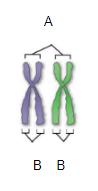
Correctly identify the terms for "A" and "B" in this figure above.
1. Both are chromosomes
2. A is a homologous pair of chromosomes and B is a chromosome
3. A is a homologous pair of chromosomes and B is a sister chromatid
4. Both are sister chromatids
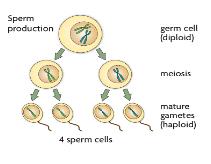
The figure above is of spermogensis. Find the incorrect statement about this process.
1. This occurs only during a specific time in an organisms life.
2. This results in 4 diploid sperm cells.
3. The resulting sperm cells are all the same size which is different than oogensis.
4. Sperm cells grow a fagella that allows them to move.
Mendel is recognized as the Father of Genetics because his Law of Segregation and Law of Independent Assortment explains how organisms inherit traits.
True
False
Mendel was a Austrian monk. He used pea plants in his experiments. His work was not known or recognized during his lifetime.
True
False
Each autosomal pair of chromosomes can have either homozygous or heterozygous alleles that either express a dominant or recessive trait.
True
False
A monohybrid cross is done with only one trait at a time. A dihybrid cross is done with two traits at a time.
True
False
The figure above is a punnett square which can be used to calculate the probability of traits in offspring.
True
False
Cross a heterozygous pair of parents with an allele for eye color as shown above.
What is the genotypic ratio of possible offspring?
A 1:2:1 75% chance of brown eyes and 25% chance for blue eyes
B 1:2:1 25% homozygous dominant : 50% heterozygous : 25% homozygous recessive
C 3:1 75% homozygous dominant : 25% homozygous recessive
D 3:1 75% heterozygous dominant : 25% homozygous recessive
Using the same heterozygous cross with an allele for eye color, give the phenotypic ratio of possible offspring.
A 3:1 75% chance of brown eyes and 25% chance for blue eyes
B 3:1 75% chance for blue eyes and 25% chance for brown eyes
C 3:1 75% homozygous dominant : 25% homozygous recessive
D 3:1 75% heterozygous dominant : 25% homozygous recessive
Continuing to use the same alleles for eye color, if the Dad was homozygous dominant is there a probability that he could have any blue eyed children?
A Yes
B No
Dad and Mom had two children. One son with blonde hair and one daughter with brown hair.
True
False
Since their son has blonde hair, then he must be homozygous bb.
This means he received one recessive allele from Dad and one recessive allele from Mom.
Therefore, the square representing the son on the right is correct so it shouldn't be shaded in.
True
False
Since their daughter has brown hair, then she must be heterozygous.
This mean she received Dad's dominant, B, allele and one of Mom's recessive allele, b.
Therefore, the circle representing the daughter on the right should be half filled in like Dad's.
True
False
Their brown-haired daughter married a brown-haired man.
They had two children, a blonde haired daughter and a brown haired daughter.
True
False
For them to have had a blonde haired daughter, the daughter would have to get a recessive allele from both Mom and Dad. Therefore, her Dad must be heterozygous, Bb, like her mother. That means his square box on the right should also be half filled in.
True
False
What was the probability of getting a blonde haired child from the two heterzygous parents?
A 25%
B 50%
C 75%
Since both parents are heterozygous, the daughter with brown hair could be either homozygous (BB) or heterozygous (Bb) for the hair color allele.
True
False
What was the probability of getting a homozygous dominant brown-haired daughter (BB)?
A 25%
B 50%
C 75%
What was the probability of getting a heterozygous dominant brown-haired daughter (Bb)?
A 25%
B 50%
C 75%
Watson and Crick became famous after they figured out the structure of DNA and won a Nobel Prize for it.
True
False
Select the incorrect statement about the structure of DNA.
A The overall shape is that of a twisted double helix.
B The backbone consists of nucleotides which are made up of a base, sugar and phosphate.
C The DNA strands are antiparallel.
D The base pairing rule pairs A with C and G with T.
Select the incorrect statement about the process of copying a DNA strand.
A The nitrogen bases in the middle are held together with either 2 or 3 hydrogen bonds which allows the strand to "unzip" easily to be copied.
B The backbone is held together with strong covalent bonds which helps hold the strand in place while being copied.
C Replication can only move from the 5' to the 3' direction. This results in one strand being filled in backwards. This means it gets copied slower and so it is called the leading strand. The strand that is copied straight forward is called the lagging strand.
D Purines match up with pyrimidines.
The process of copying DNA strands is called replication.
True
False
The full name for DNA is ribonucleic acid.
True
False
Only your sex cells have DNA in them. All of your other cells don't have any DNA in them.
True
False
DNA can only be seen in a cell when it isn't tightly wound up.
True
False
The Central Dogma states that DNA is the blueprint for making a single stranded RNA through transcription which is then translated at ribosomes into proteins.
True
False
RNA bases are A C G and U.
True
False
Put the correct characteristics with either DNA or RNA strands.
Single strand
Double strand
Bases A C G T
Bases A C G U
located inside nucleus of cell
made in nucleus and moves to cytoplasm
genetic information to make whole organism
genetic code to make proteins
process to copy is replication
process to make is transcription
DNA Strand
RNA Strand
Assemble the correct order for the process of translation, when proteins are made at the ribosome.
tRNA is made in nucleus and moves to cytoplasm and picks up amino acids to carry to the ribosome
rRNA is made in nucleus and moves to cytoplasm to organize a ribosome
ribosome breaks apart
mRNA attaches to the small subunit of the ribosome to be translated (read)
the first triplet is a "Start" codon
the mRNA code is read in triplets called a codon
the assembled string of amino acids are folded into the protein
after all the codons for the protein are read on the mRNA, there is a "Stop" codon
mRNA is made in nucleus and moves to cytoplasm and goes to an assembled ribosome
tRNA brings the amino acids into the large subunit of the ribosome to match up with the code on the mRNA
Proteins are strings of amino acids held together by a special bond called....
A ionic.
B covalent.
C peptide.
D hydrogen.
If a mutation occurs on the mRNA causing a subsitution, insertion or delection, then the protein will not be assembled correctly and therefore will not function.
True
False
The top three stimuli that organisms respond to are thirst, hunger, and pain.
True
False
Circadian rhythm means that an organism functions on a 24 hour biological clock.
True
False
Hibernation and migration are both cyclical behaviors that organisms use to avoid seasonal changes in weather that affect the amount of food, water and shelter available for an organism.
True
False
Innate behaviors are extremely important because they promote safety and health for an organism.
True
False
Habituation, imprinting, imitation, and learning are forms of behavior used by organisms to make food.
True
False
Phermones allow organisms to communicate with others of their species without being present.
True
False
Camoflauge is an adaptation that helps organisms stand out in their environment so others can see them easily.
True
False
Find the statement that is incorrect about Darwin.
A Darwin went on the ship, HMS Beagle, around the world and collected information about animals and habitats.
B A major part of the information Darwin used to support his theories were from the animals on the Galapagos Islands - two different tortoises and the many different finches.
C Darwin is given the credit for the theory of evolution because he had a mechanism for it to occur: natural selection
D Darwin's theory about evolution was popular and accepted by the public during his life.
Natural Selection has 4 principles. Put them in the correct order for evolution to occur.
members of that population who have a slight advantage due to genetics over others in the population survives - called adaptation
a population of organisms has to have genetic diversity/variation
a population has to grow in size enough to create competition for resources
members of the population with the trait that allowed them to survive live long enough to pass that gene on to the next generation, called descent with modification
Put the items in the correct category of either supporting the theory of evolution or not supporting it.
similar embryonic development
similar anatomy
vestigial structures like tail bone in humans
analogous structures - flight in birds and insects
homologous structures
molecular evidence
fossils
geography and tetonic plates
Supports theory for Evolution
Doesn't suport theory of evolution
Fossils can be dated by the Law of Superposition which states that what is on top is the most recent and layers underneath get progressively older.
True
False
Fossils can also be dated using radiometric dating. This is when sound waves are measured as they travel through the rocks.
True
False
Triobites are an example of an index fossil that helps identify the age of sediments because they only lived at a specific time so they aren't found in other sediment layers.
True
False
Put these in order from the oldest to the most recent in the Geological Time Scale.
Paleozoic
Cenozoic
Mesozoic
Precambria
Construct the correct order for the Linnaean classification system starting with the largest grouping to the smallest grouping.
Domain
Kingdom
Family
Class
Phylum
Species
Order
Genus
Select the correct format for writing our (humans) scientific name according to the rules of Linnaea's system?
Homo
Homo sapien
Homo s.
Homo Sapien
H. Sapien
Put these Kingdoms in their correct domains.
Kingdom Bacteria
Kingdom Archaea
Kingdome Fungi
Kingdom Protista
Kingdom Animalia
Kingdom Plantae
Bacteria
Archaea
Eukarya
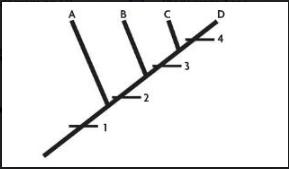
Select the incorrect statement about the above cladogram.
A Echinoderms are the closest related branch to chordates. This is one of the reasons we used the starfish for dissectoin and study.
B The deuterostome development trait is the node that separates Echinoderms and Chordates from the rest of the other organisms.
C Only Cnidarians have radial symmetry.
D Mollusks and Annelids are more closely related than Mollusks and Arthropods.
The coelom is the digestive system inside the starfish.
True
False
The starfish is unusal in that it has three stomachs.
True
False
Starfish can reproduce sexually by excreting sperm and eggs into the water where fertilization occurs or asexually through the process of regeneration.
True
False
The mouth of a starfish is located on the dorsal side while the anus is located on the ventral side.
True
False
Starfish have a water vascular system instead of a heart and blood.
True
False
Starfish start their lives in a larvae state and then go through metamorphosis to become an adult.
True
False
Starfish only grow when resources are available; so they start and stop growth dependent on food. This is called
a. habituation.
b. assimulation.
c. hibernation.
d. asexual reproduction.
Select the incorrect statement about the cycling of nutrients.
1. All cycles have a gaseous, liquid and solid state.
2. All cycles have a reservior where most of the nutrient is stored.
3. Nutrients have to be recycled for life on earth because matter cannot be made or destroyed.
4. There is a biological process associated with each nutrient that is recycled.
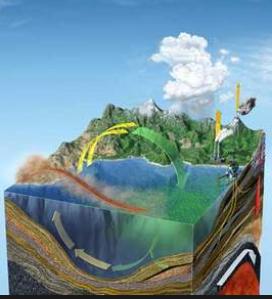
Select the incorrect statement about the cycling of carbon.
1. Carbon dioxide is converted into sugars used by organisms through the process of photosynthesis.
2. Carbon dioxide is released by all organisms as a waste product of cellular respiration.
3. Carbon dioxide is stored only in plants, especially woody plants like trees.
4. Humans add to the carbon dioxide in the atmosphere when organic products are burned.
Select the incorrect statement about the cycling of nitrogen.
1. Bacteria are required to fix atmospheric nitrogen into a solid.
2. Bacteria are required to denitrofy nitrogen from decaying matter back into a gas in the atmosphere.
3. The atmosphere contains approximately 80% nitrogen.
4. Animals get the nitrogen they need by breathing it from the atmosphere.
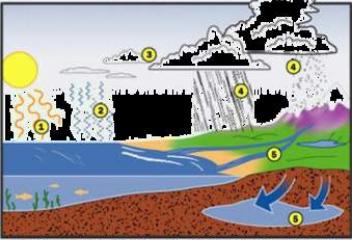
Select the incorrect process that doesn't apply to the cycling of water.
a. percipitation
b. transpiration
c. evaporation
d. cellular respiration
Select the incorrect term that doesn't apply to the oxygen cycle.
1. photosynthesis
2. cellular respiration
3. ozone layer
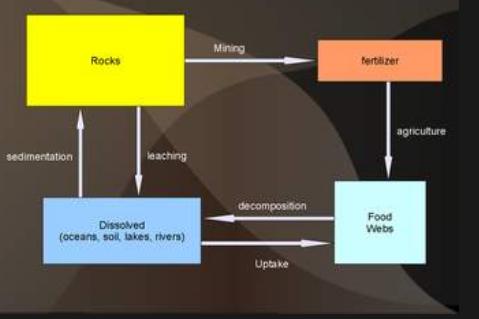
Select the incorrect statement about the phosphorus cycle.
1. It is the slowest cycle of nutrients.
2. Phosphorus is unstable as a gas.
3. Animals get the phosphorus they need through eating plants.
4. Phosphorus is often used in fertilizers to increase plant production.
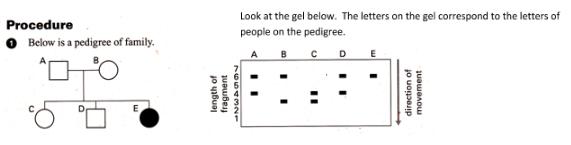
What type of data is displayed in the figure above?
1. cladogram DNA data
2. gel electrophoresis DNA data
3. pedigree DNA data
4. microscopic DNA data
Organize the DNA fragments in order by size from the largest to the smallest.
3, 4, 6
4, 6, 3
6, 3, 4
6, 4, 3
Continue to use the Pedigree Chart/Genetic Screening figure. If the 3 allele carries a dominant trait, then who in the family has the condition?
A and B
B and C
C, D and E
A, B, C, D and E
Continue to use the Pedigree Chart/Genetic Screening figure above. Is the person E
heterozygous for the #6 allele.
homozygous for the #6 allele.
heterozygous for the #6 and #3 alleles.
homozygous for the #6 and #3 alleles.
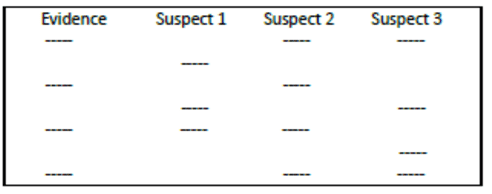
Using the DNA fingerprinting data above. Who can be shown to be present at the time of the crime?
suspect 1
suspect 2
suspect 3
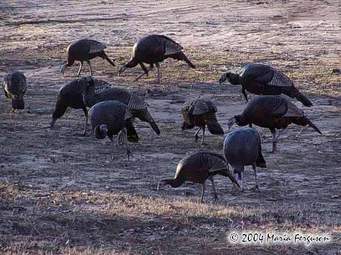
This flock of turkeys is called a
population.
community.
ecosystem.
Given a set of cytochrome C data with only 1 difference between two organisms, where would they be placed on the cladogram?
A and B
B and C
C and D
A and D
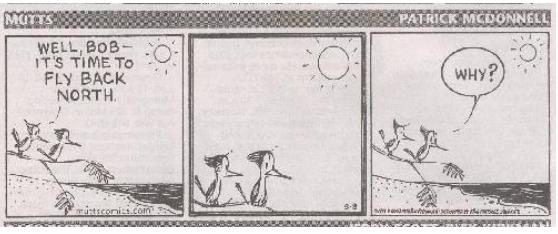
Use the cartoon above. It is funny because it is nice and warm where the birds are located and so they are questioning why they should ____________________ like others of their species.
hibernate
migrate
leave phermone scrapes
change their circadian rhythm
Select the incorrect form of a fossil.
amber and trace
petrified and hieroglyphics
molds and casts
frozen and mummified
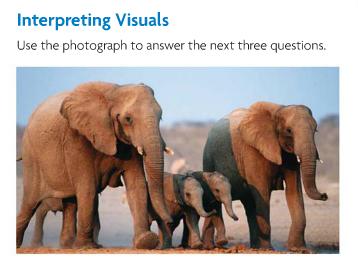
Using the picture of the elephants above, what is a cost to the parents due to their behavior of placing their young inside surrounded by the herd?
1. The babies are safe.
2. The adult elephants would be attacked first by a predator and could be hurt or killed.
3. The baby elephants get shade from the parents.
4. The adult elephants can touch and guide their babies during their migrations.
Using the picture of the elephants above, what is a benefit for the baby elephants?
1. The baby elephants are safer with parents guarding them.
2. The baby elephants could get trampled.
3. The baby elephants can't see as well where they are going during migrations.

Use the picture above of the elephants. Based on evolutionary principles, does the cost for the adult elephants outweight the benefit for the baby eleplants?
1. No, if the adults are killed, then the babies do not have a parent.
2. No, if the adult is wounded, then it won't be able to care for its baby adequately.
3. Yes, the baby survives and the adult elephant has passed its genes on to the next generation. A predator is unlikely to attack a full grown elephant.
4. Yes, the babies and adults both survive because predators are unlikely to attack a full grown elephant.
When introduced species out-compete native species, they are called invasive and are not good for the endemic habitat.
True
False