Log in
Sign up for FREE
arrow_back
Library
Unit 5 PRETEST - Functions - 8.F.2
By Nina Slefo
star
star
star
star
star
Share
share
Last updated about 2 hours ago
10 questions
Add this activity
1
1
1
1
1
1
1
1
1
1
Question 1
1.
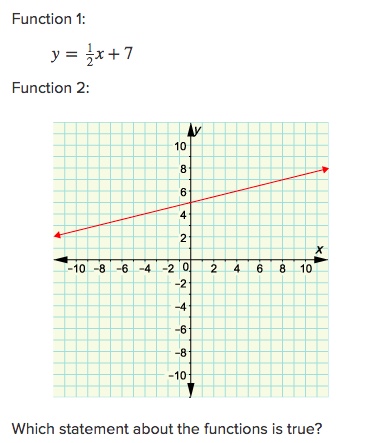
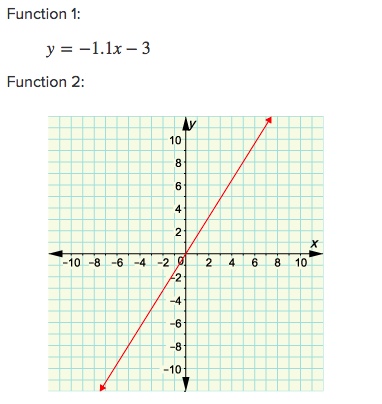
Function 1 and Function 2 have a negative rate of change.
Function 1 has a greater rate of change than Function 2.
Question 2
2.
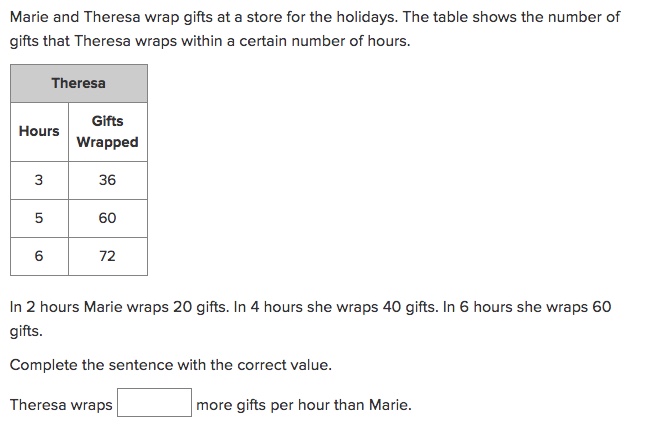
Enter a number like 12
Question 3
3.
{(−20,8), (−17,1), (1,−3), (9,0), (21,−3)}
Question 4
4.
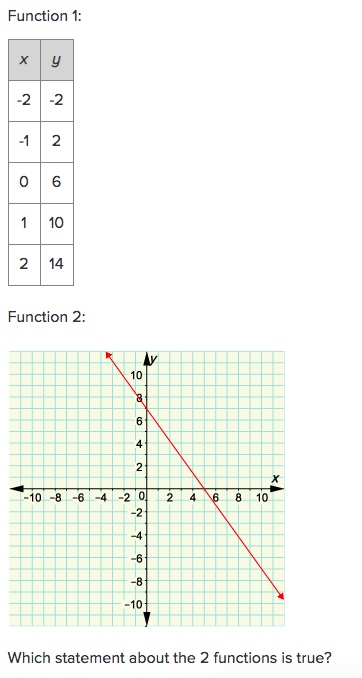
Function 1 and Function 2 have the same rate of change.
Function 1 and Function 2 are both nonlinear functions.
Function 1 intersects the
x
-axis at (0, 6).
Question 5
5.
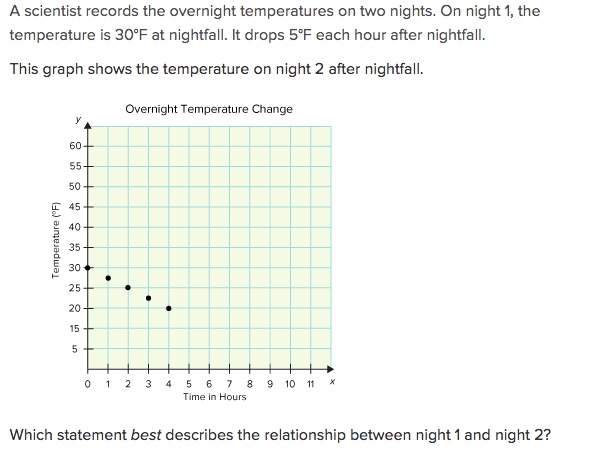
The temperature for night 1 decreases more quickly than for night 2.
The temperature for night 1 decreases less quickly than for night 2.
The temperature for night 1 increases more quickly than for night 2.
The temperature for night 1 increases less quickly than for night 2.
Question 6
6.
A relation is given.
{(-4, 5), (-1, 0), (3, -9), (7, -21)}
Choose the correct domain (input values) and range (output values) for this relation.
Domain: {-4, -1, 3, 7}; Range: {-9, -21}
Domain: {-4, -1}; Range: {-9, -21}
Domain: {-4, -1, 3, 7}; Range: {-21, -9, 0, 5}
Question 7
7.
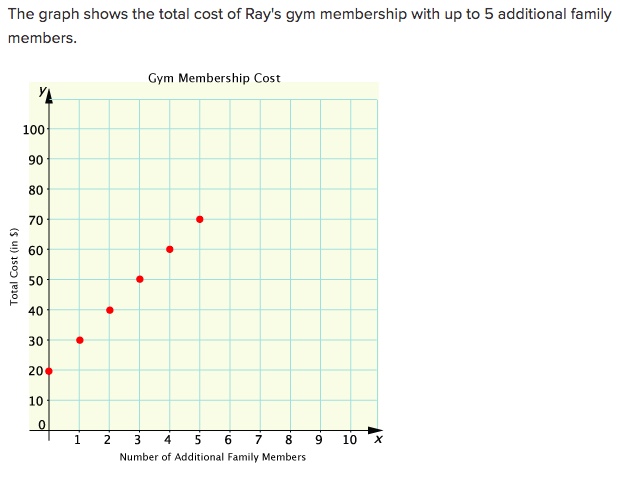
Write the ordered pair that represents Ray's gym membership with 3 additional family members.
Enter an ordered pair like (8, 65)
Question 8
8.
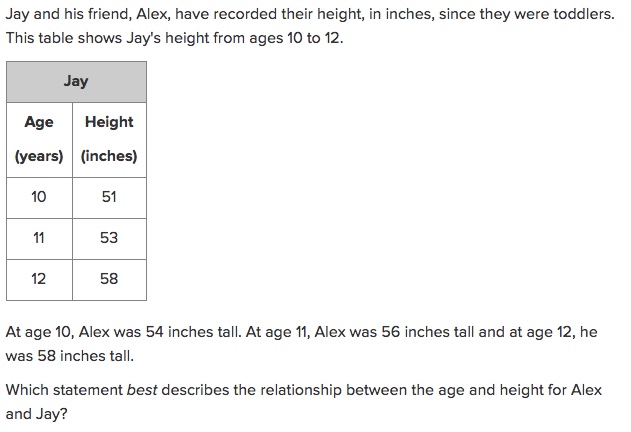
Jay and Alex grew at the same rate between ages 10 and 11.
Jay and Alex grew at the same rate between ages 11 and 12.
Jay grew at a faster rate than Alex between ages 10 and 11.
Jay grew at a slower rate than Alex between ages 11 and 12.
Question 9
9.
It is correct because each value in the domain maps to exactly one value in the range.
It is correct because each value in the domain is the opposite of each value in the range.
It is incorrect because each value in the range is negative.
Question 10
10.
Select the true statements.
The
y
-intercept for Function 1 and Function 2 is the origin.
Function 1 and Function 2 have the same
x
-intercept.
Function 1 has a negative rate of change and Function 2 has a positive rate of change.
The
y
-intercept of Function 1 is the same as the
y
-intercept of Function 2.
The
x
-intercept of Function 1 is the same as the
x
-intercept of Function 2.
{(−10,2), (−7,1), (5,−3), (19,0), (29,−5)}
{(−3,1), (−4,1), (0,−3), (7,0), (19,11)}
{(−1,1), (−6,−3), (2,−1), (3,0), (2,−6)}
{(5,3), (−17,1), (3,−3), (4,0), (5,−3)}
Function 2 has a negative rate of change.
Domain: {-21, -9, 0, 5}; Range: {-4, -1, 3, 7}
It is incorrect because the values in the domain are not the same as the values in the range.