Log in
Sign up for FREE
arrow_back
Library

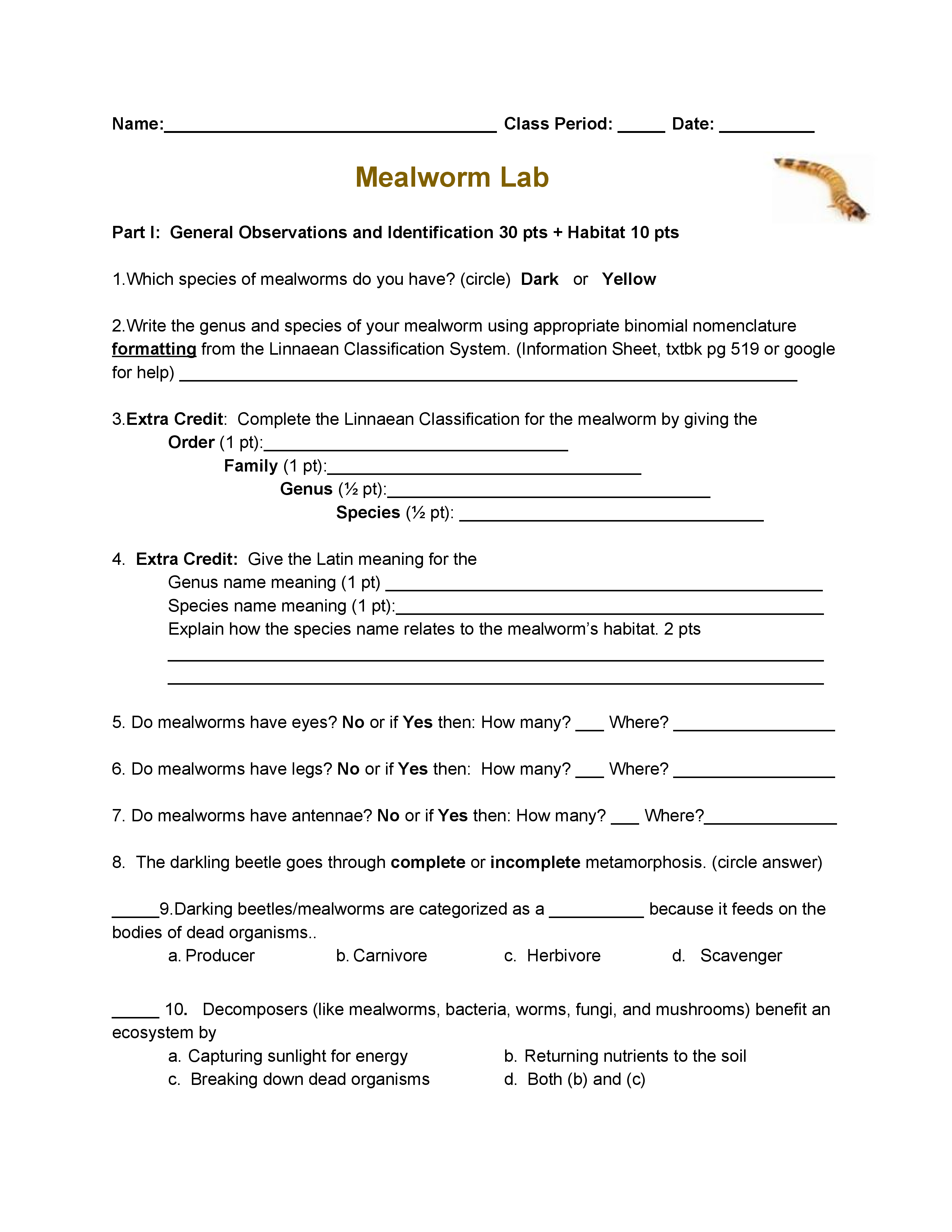
Mealworm Lab Part 1: Observation & Identification

star
star
star
star
star
Last updated almost 7 years ago
36 questions
Note from the author:
Ottawa High School Curriculum 2019 Biology textbook McDougal Littell ed 2008
1
1
1
1
1
1
1
1
1
1
2
1
1
1
1
1
1
1
1
1
1
1
1
1
4
1
1
1
1
1
1
1
1
1
1
1
Question 1
1.
Question 2
2.
Question 3
3.

Question 4
4.

Question 2.

Remember that all scientific names for organisms are written in italics, which may or may not be a font option for you when answering.
Question 5
5.

Question #3 Order - Extra Credit - you don't have to answer this unless you want to take time to look up the information.

Question 6
6.

Question #3 Family - Extra Credit - you don't have to answer this unless you want to take time to look up the information.

Question 7
7.

Question #3 Genus - Extra Credit - you don't have to answer this unless you want to.

This information is in your general information handout.
Question 8
8.

Question #3 Species - Extra Credit - you don't have to answer this unless you want to.

This information is in your general information handout.
Question 9
9.

Question #4 - Extra Credit - you don't have to answer this unless you want to take time to look up the information.

Question 10
10.

Question #4 - Extra Credit - you don't have to answer this unless you want to take time to look up the information.

Question 11
11.

Question #4 - Extra Credit - you don't have to answer this unless you want to take time to look up the information. You have to relate how the genus and species names relate to a mealworm's habitat.

Question 12
12.

Question 13
13.

Question 14
14.

Question 15
15.

Question 16
16.

Question 17
17.

Question 18
18.

Question 19
19.

Question 20
20.

Question 21
21.

Question 22
22.

Question 23
23.

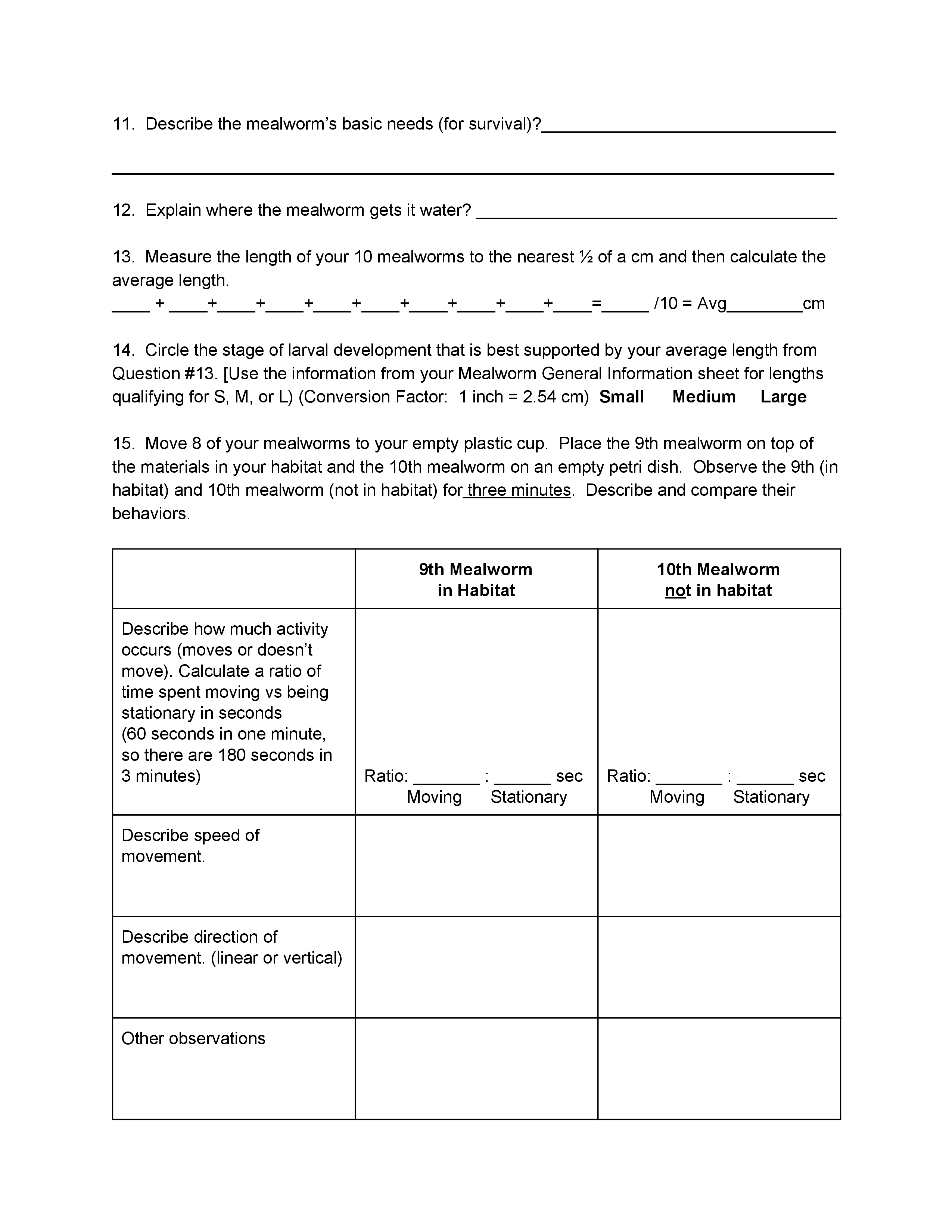
Question #11.

Question 24
24.
Question 25
25.

#13 Calculating the average length of your mealworms. Be sure to measure in cm. Estimate length to the nearest 1/10 of a centimeter.

Question 26
26.

Question 27
27.

#15 Table - moving in habitat - measure in seconds

#27 & #28 should add up to 180 seconds
Question 28
28.

#15 Table - stationary in habitat - measure in seconds

#27 & #28 should add up to 180 seconds
Question 29
29.

#15 Table - moving not in habitat - measured in seconds

#29 & #30 should add up to 180 seconds
Question 30
30.

#15 Table - stationary not in habitat - measured in seconds

#29 & #30 should add up to 180 seconds
Question 31
31.
Question 32
32.
Question 33
33.

Question 34
34.

Question 35
35.
Question 36
36.
Question #1
A Dark
B Yellow
Question #5
A No
B Yes
Question #5
A 1
B 2
C 3
D 4
Question #5
A head
B prothorax
C mesothorax
D metathorax
Question #6
A No
B Yes
Question #6
A 2
B 4
C 6
D 8
Question #6
A thorax
B 1 pair on each of the 3 thorax segments
C 1 pair on each of the first 3 segments of the abdomen
D abdomen
Question #7
A No
B Yes
C They do not have true antennae, however, they have 2 short, horn-like appendages that function like antennae.
D
Question #7.
A 1
B 2
C 3
D 4
Question #7.
A head
B thorax
C abdomen
D spine
Question #8.
A complete
B incomplete
Question #9.
A herbivores - eating plants (grains)
B carnivore - eating other animals
C scavengers - eating decaying matter
D decomposers - eating dead animals & their secretions
E A and C
F A, C, and D
A from the food it eats
B from its moist environment
C directly from drinking water in its habitat
D none of the answers are correct
#14 - categorizing the size of your mealworms based on your results
A small
B medium
C large
Table - direction of movement in habitat
A linear movement (horizontal)
B vertical, trying to climb over edge
C both linear and vertical
D no movement
E linear and no movement
F vertical and no movement
G both linear, vertical & no movement
Table - direction of movement not in habitat
A linear, horizontal
B vertical, trying to climb over edge
C both linear and vertical
D no movement
E linear and no movement
F vertical and no movement
G both linear, vertical and no movement