
0
Last Name First Name
Last Name First Name
0
0
1
1
2
2
These are worksheets and labs that accompany the Ottawa High School Biology curriculum 2019.
Last Name First Name
Read the facts about song sparrows in the Field Guide. Based on the information in the Field Guide, explain why the male song sparrows may have responded in different ways to the "local" and "foreign" songs.
Describe an investigation to test one of the reasons why you think the male song sparrows may have responded in different ways to the local and foreign bird songs. Mimic your investigation on classical or operant conditioning (offering a treat or a threat).
Class Period
Date
Describe how you think a male song sparrow will react when it hears the song of another male song sparrow from its same territory.
Describe how you think a male song sparrow will react when it hears the song of another male song sparrow that is farther away and not within its own territory. Note: The term "foreign" is used to represent distance in this experiment, not a different species of birds.
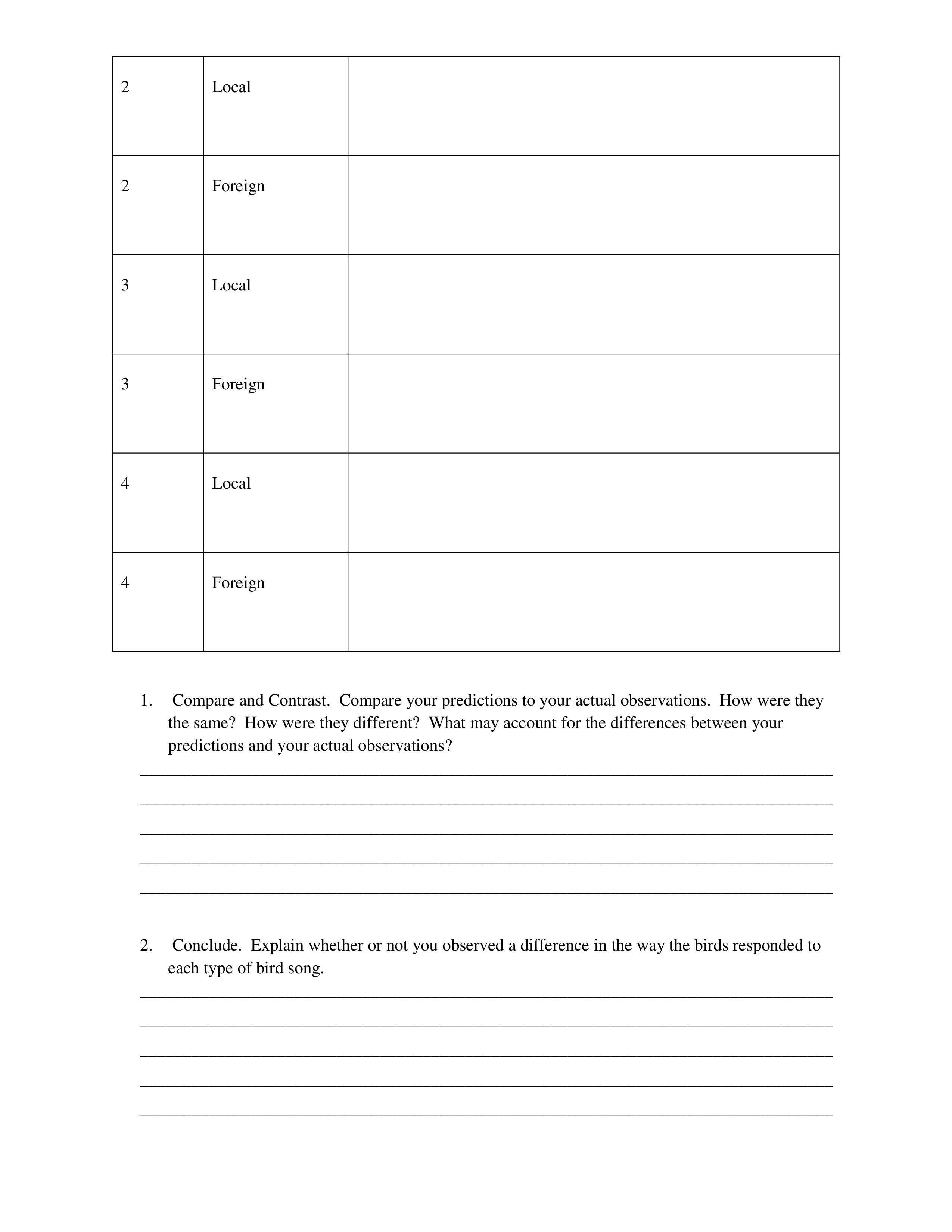
Be careful when completing the Table. The recordings are random, so make sure you are recording the male's response in the correct Test Area (row) on the correct day. There are 3 different locations and times used for testing. I've numbered the Tests 1-8 to help you keep your results placed in the correct location.
Describe the bird's behavior as well as how far away the bird is from the speaker and what side of the speaker it is on.
Test Area 1: Local: 1st Test Day #1 Test
Test Area 1: Foreign: 2nd Test Day #5 Test
Note: The term "foreign" is used to represent distance in this experiment, not a different species of birds.
Test Area 2: Local: 2nd Test Day #6 Test
Test Area 2: Foreign: 1st Test Day #2 Test
Note: The term "foreign" is used to represent distance in this experiment, not a different species of birds.
Test Area 3: Local: 2nd Test Day #7 Test
Test Area 3: Foreign: 1st Test Day #3 Test
Note: The term "foreign" is used to represent distance in this experiment, not a different species of birds.
Test Area 4: Local:1st Test Day #4 Test
Test Area 4: Foreign: 2ndTest Day #8 Test
Note: The term "foreign" is used to represent distance in this experiment, not a different species of birds.
Compare and Contrast. Compare your predictions to your actual observations.
a) How were they the same?
b) How were they different?
c) What might explain your prediction vs observation?
Explain whether or not you observed a difference in the way the birds responed to each type of bird song (local and foreign).
Why were the songs played randomly within the four different locations and over two different days? What type of behavior was the experimentors trying to avoid?
If the song birds were protecting their territory, how does it "benefit" the song birds?
If the song birds were spending too much time defending their territory, what consequence (cost) might occur for the birds?