Log in
Sign up for FREE
arrow_back
Library

Trace Fossils - Relative Dating

star
star
star
star
star
Last updated almost 7 years ago
17 questions
1
1
1
1
1
1
1
1
1
1
1
1
1
1
1
1
1
Question 1
1.

Last Name First Name

Question 2
2.

Class Period:

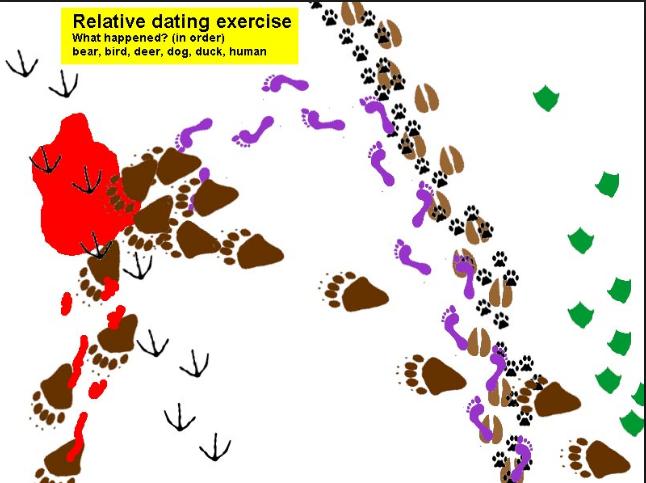
Scientists get excited when they have the opportunity to find trace fossils that show foot prints of organisms. This allows scientists to predict or theorize about the weight/height/etc of organisms, predator-prey relationship, and mating or daily feeding routines. Study this picture carefully and determine who went through this area first, second, third, etc.
Question 3
3.

Question 4
4.

Question 5
5.

Question 6
6.

Question 7
7.

Question 8
8.

Question 9
9.

Question 10
10.

Question 11
11.

Question 12
12.

Question 13
13.

Question 14
14.

Question 15
15.

Question 16
16.

Question 17
17.

Who was in the area first?
A bear
B bird
C deer
D dog
E duck
F human
Who entered the area next?
A bear
B bird
C deer
D dog
E duck
F human
Who entered the area next?
A bear
B bird
C deer
D dog
E duck
F human
Who entered the area next?
A bear
B bird
C deer
D dog
E duck
F human
Who entered the area next?
A bear
B bird
C deer
D dog
E duck
F human
Who entered the area last?
A bear
B bird
C deer
D dog
E duck
F human
Who got eaten/killed/or carried away?
A bear
B bird
C deer
D dog
E duck
F human
Which animal did the attacking causing the pool of blood?
A bear
B bird
C deer
D dog
E duck
F human
What was the dog tracking?
A No one. The dog was the human's pet.
B Bird
C Duck
D Deer
The stride of the duck foot prints indicates that most likely it
A was feeding and got startled and then ran until it took flight.
B was slowly feeding in the water and then it swam away speedily.
C was caught by the dog and killed.
D was caught by the bear and killed.
E was shot by the human and the human was carrying it home for dinner.
The bear's stride changed several times. What is the most likely explanation for the bear's change in strides?
A It smelled the dog and increased its speed to catch the dog.
B It caught the scent of the deer and increased its stride to catch the deer.
C It caught the scent of the human and increased its stride to intersect the human.
D It caught the scent of the bird and changed direction to catch the bird for dinner.
The human's stride shows he/she was
A walking.
B running.
C standing still.
D walking and running.
The bird must have come through
A before the human and bear because it's foot prints are covered up by blood.
B soon after the human and bear interacted because there is blood on its foot prints.
C a long time after the human and bear interacted because the blood was dry and there wasn't any blood on the bird's foot prints.
D while the human and bear were interacting because it turned around and left.
The deer's stride most likely indicates that it
A was running away from the dog.
B was running away from the human.
C was walking, stopping and eating at an even gait.
D was walking at an even gait.
The dog's stride most likely indicates that it
A increased its stride due to the scent of the deer.
B decreased its stride due to the scent of the bear.
C stopped several times while tracking the deer.
D stayed the same because it didn't catch the scent of any animal.