Linnaean Classification System - 40 pts
star
star
star
star
star
Last updated over 7 years ago
42 Nsɛmmisa
1
1

1
1
1
1
1
1
1
1
1
1
1

1

1
1

1
1
1

1
1
1

1
Last Name, First Name
Class Period

Which two species are more closely related: Ursus maritimus, Ursus americanus, or Bufo americanus?
The purpose of cladistics is to arrange groups of species in the order in which they diverged from a common ancestor.
Today, present time, _____________________ is the determining factor about how closely related two species are to one another.
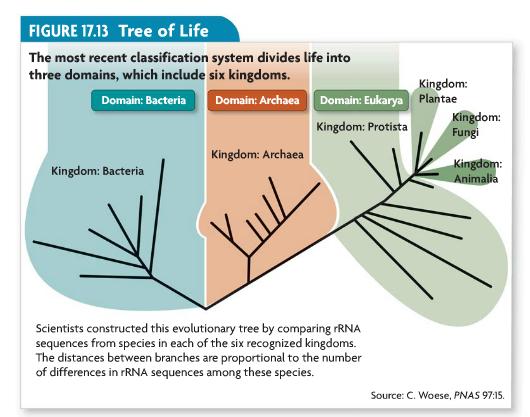
Place the six Kingdoms in order alphabetically that belong to the 3 domains. (do not capitalize first letter, do not put a comma between kingdom names, only a space)
If you come across an unusual single-celled organism, what parts of the cell would you study in order to classify it into one of the three domains?
The traditional definition of species is difficult to use to classify bacteria and archaea because they do not breed to produce offspring, instead they reproduce by binary fission.
The Archaea lineage may include the first life on Earth, which began under much different environmental conditions from those present today. What characteristics of archaea help to support this statement?
The scientific name for humans is Homo sapiens. What genus do humans belong to?
Two species with similar adaptations are found to have key differences at the molecular level. Scientists conclude that these species are not as closely related as prevously thought. Why should the molcular evidence outweigh the physical similarities that the species share?
The distinguishing characteristics that define the three domains are whether there is a nucleus or not in the cell and the chemical make-up of the cell wall/membrane.
Which Domain doesn't have any organisms in it that are harmful to humans (or as far as we know anyway)?
Refer to the cladogram above. Are crocodiles and alligators more closely related to snakes or to birds? Explain your answer using the terms common ancestor and derived characters.
Review: How many clades are represented in the above cladogram?
Review: Which two organisms are the most closely related?
Use the Table above to determine how many species belong to the family Ursidae.
In the past 150 years, the classification of life has changed through the addition and restructuring of kingdoms and domains. The system is always changing because
Birds and snakes share a common ancestor from over 250 million years ago, but now they show many physical differences. These differences are most directly the result of
Scientists isolate the organism shown above from marsh water. Based on this illustration, the organism would most likely be classified as a
Mammals are multicellular organisms with about 3 billion base pairs in their genome. Yeasts are single-celled organisms with aobut 13 million base pairs in their genome. Both of these groups are classified as eukaryotes because they
Scientists notice very few differences in the DNA sequence of individual cheetahs. This indicates that modern cheetahs likely descended from only a few individuals because
The DNA sequences above show a conserved gene among four related plants. The highlighted differences are most directly the result of
Use the ppts to complete the definition for Taxonomy:
Use the ppts to put in the definition of Binomial Nomenclature:
Use the ppts to enter what language that is used for the name.
Use the ppts to enter how the name is presented in written text:
Use the ppts to enter what the 2-parts represent:
Use the ppts to show what Genus usually represents:
Use the ppts to enter the proper way to write the genus:
Use the ppts to show the proper way to write the species part:
Use the ppts to explain how genus is used when identifying an organism:
Use the ppts to state the main advantage of using scientific names versus common names for organisms.
1) it has seven levels
2) hierarchical order
3) each level is included in the level above it, and
4) levels get increasingly specific from the kingdom to species level.
Use my mnemonic or make up your own to help you remember the sequence: King Philip Came Over for Green Spaghetti
Use the ppts to enter the first level
Use the ppts to enter the second level
The next level is
The next level is
The next level is
The next level is
And the last level is
Use the ppts to show the main limitation of the Linnean classificaiton system