Cytochrome C Comparison Lab
star
star
star
star
star
Last updated over 7 years ago
29 Nsɛmmisa
Hyɛ no nsow a efi ɔkyerɛwfo no hɔ:
Ottawa High School Curriculum 2019 Biology textbook McDougal Littell ed 2008
Ottawa High School Curriculum 2019 Biology textbook McDougal Littell ed 2008

Last Name First Name
Count the number of differences between each of the organisms cytochrome C amino acid sequence and place the number in the appropriate box in the table. See Instructions--> Method--> A--> numbers 1-4 for an example. We will count these as a class and put them on a shared google document. It will be easier for you to enter the data at one time after you have it on the class shared document.
type the organism's name in lower case letters, use the organism name that is listed in Table 1
type the organism's name in lower case letters, use the organism name that is listed in Table 1
type the organism's name in lower case letters, use the organism name that is listed in Table 1
type the organism's name in lower case letters, use the organism name that is listed in Table 1
type the organism's name in lower case letters, use the organism name that is listed in Table 1
type the organism's name in lower case letters, use the organism name that is listed in Table 1
type the organism's name in lower case letters, use the organism name that is listed in Table 1
type the organism's name in lower case letters, use the organism name that is listed in Table 1
type the organism's name in lower case letters, use the organism name that is listed in Table 1
this is a node, enter the number of differences from your Table 1 between these organisms (#10 and #11)
this is a node, enter the number of differences from your Table 1 between these organisms
this is a node, enter the number of differences from your Table 1 between these organisms (#7 )
this is a node, enter the number of differences from your Table 1 between these organisms (#8 & #9)
this is a node, enter the number of differences from your Table 1 between these organisms (#6 & #7)
this is a node, enter the number of differences from your Table 1 between these organisms (#5 & #6)
this is a node, enter the number of differences from your Table 1 between these organisms (#3 & #5 or #4 & #5); there is more than one correct answer, however, enter only one of the numbers
enter the animal's name that goes on this branch; use lower case letters
enter the name of the animal that goes on this branch; use only lower case letters
enter the name of the organism that belongs on this branch; use only lower case letters
enter a number
enter a number
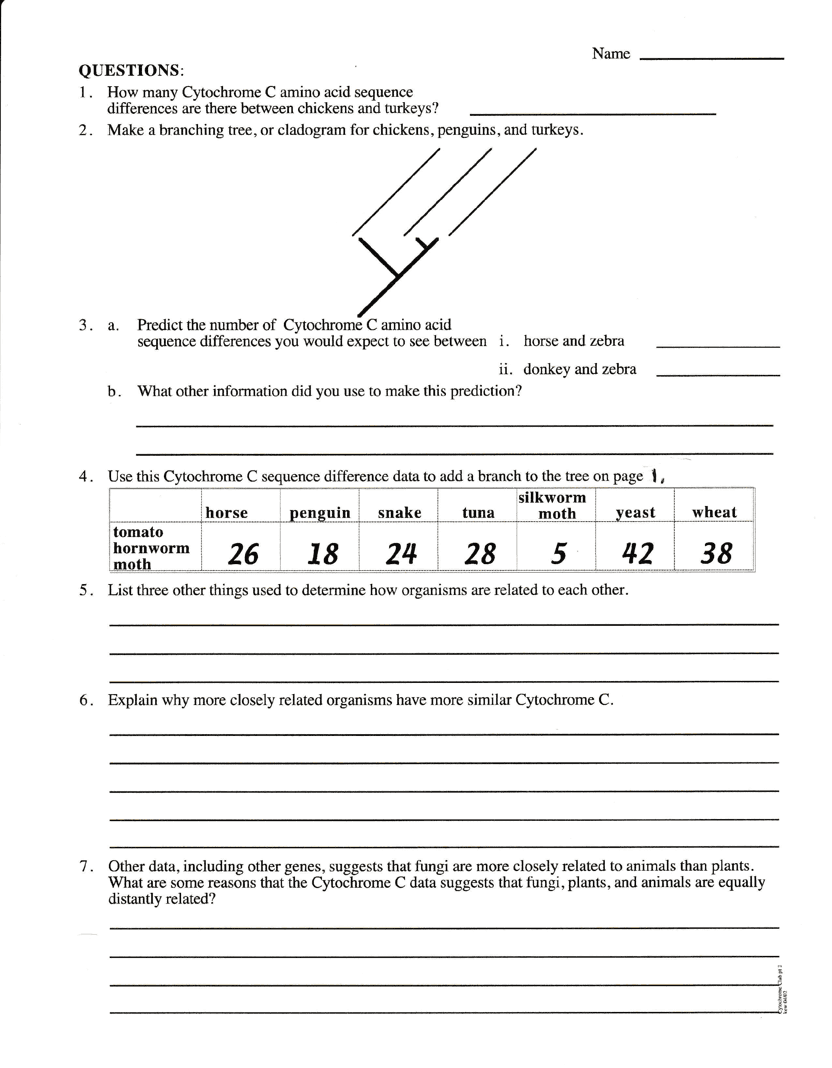
I used personal knowledge. I have seen a picture of a live horse, donkey and zebra. All of them have similar body structures and look and act "horsey."
The branch should be added
List 3 things you used to determine how organisms are related to each other.
Select whether this a true or false statement to answer Question #6:
More closely related species have more recent common ancestors, therefore there has been less time for DNA mutations to occur and so their DNA is very similar and has less differences.
Select whether this is a true or false answer to Question #7:
This cytochrome C data indicates that plants and fungi originated off of the same node because they both have similar differences in sequences compared to all of the other animals. Animal life begins off of the next node (more recent) on the cladogram, so both plants and fungi are equal distance from the first node/branch of animals.
