Redi and Pasteur Experiments to disprove the theory of spontaneous generation
star
star
star
star
star
Posljednje ažuriranje about 7 years ago
23 questions
1
1

1
1
1
1
1
1
1
1

1
1
1
1
1
1
1
1
1
1
1
1
1
Last Name First Name
Class Section
Origins of the Scientific Method
Redi's Experiment in 1668 and
Pasteur's Experiment in 1860
For over 2,000 years spontaneous generation was thought to be the process by which organisms came into existence. People thought that frogs arose from the spring mud around ponds (not knowing that frogs hiberated during the winter in the mud) or that rats grew out of hay stacks in their barns. People didn't realize that all organisms are born from other living organisms of their same species until scientists proved that the theory of spontaneous generation was false.
For those that the video didn't load, here is the actual URL and you can try it on your phone or when you are at home: https://www.youtube.com/watch?v=WNByRghR6sw
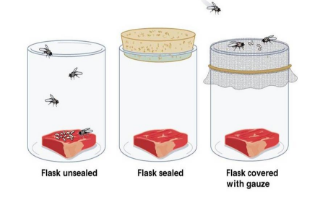
Redi's question was simply, "Where do maggots come from?"
Redi converted his question into a hypothesis so he could test where flies come from. To use the format:
"If (independent variable)...then..(dependent variable)."
His hypothesis was most likely something like:
If maggots originate from meat, then maggots will be found on the meat under all conditions."
Independent Variable:
Dependent Variable:
Examples of "controls" in this experiment included: the same style of jars, flies, exposure time, same temperature, light, and surroundings during the experiment
The "constant" in this experiment was the jar that was closed and sealed from exposure to the flies.
Redi had to use a gauze covered jar in his experiment because...
Redi's Conclusion: Spontaneous generation was not true. Life comes from other life.
The supposed development of living organisms from nonliving matter such as maggots from rotting meat was disproved by Redi's experiment. The theory of spontaneous generation for larger organisms that could be seen with the naked eye was easily shown to be false. However, the theory of spontaneous generation was not fully discredited until the mid-19th century with the demonstration of the existence and reproduction of microorganisms, most notably by Louis Pasteur. Pasteur proves that all organisms including microorganisms come from other living organisms.
Pasteur's Question was probably something like, "What do bacteria which can't be seen with the naked eye grow from?"
Pasteur's Hypothesis was something like: If bacteria grow from the sterilized broth, then they will grow in any condition.
Independent Variable: exposure to the microorganisms in the air
Dependent Variable: growth of microorganisms in the broth
Constants in this experiment included the sterlized broth.
The word "sterlized" means that the broth was heated enough to kill all organisms living in it.
The clever use of the swan-neck flask allowed Pasteur to let microorganisms enter the flask, but not air.
Pasteur's conclusion was that all life, including microorganisms not seen by the naked eye, grow from other life forms. This conclusively disproved the theory of spontaneous generation.
Give an example of how "pasteurization" has improved life for us.
The dependent variable was (type it exactly like what is in the animation):
The independent variable was (type it exactly like what is in the animation);
Control (type it exactly like what is in the animation):
Constant (type it exactly like what is in the animation):