IV - Microscopes - Determining Field of View
The area (called Field of View) you can see through the microscope lens gets smaller and smaller with greater magnification.

Here is another image showing how the field of view changes with greater magnification. Notice that the depth of the field of view also decreases greatly with an increase in magnification.

Definition of Field of View
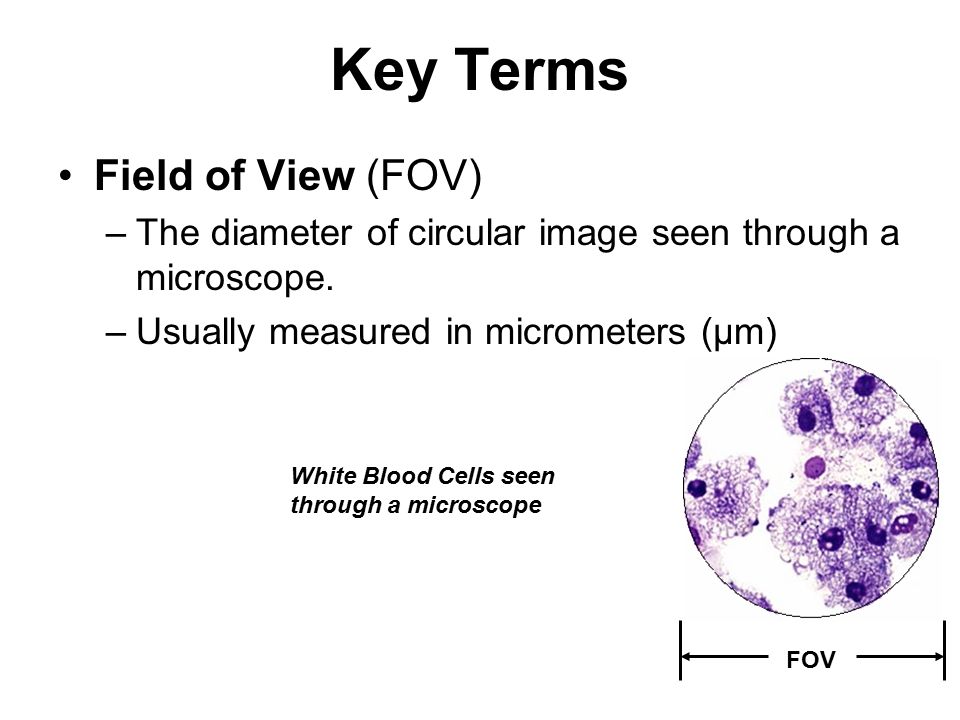
Because the microscope measures things that are small, we use a smaller unit of measurement to make measurements more accurate. The unit of measurement is called the micrometer. You need to know how to convert millimeters into micrometers.

Metric System Review

You will need to convert millimeters (mm) into micrometers

Calculating Field of View
You are now ready to begin measuring and calculating the field of view on your microscope and completing your table. Every microscope can have a slightly different field of view, so it will be important that you continue using the same microscope for measuring the field of view in this worksheet.

Practice Measuring Diameter

You now have the FOV for all three objective lens (4x, 10x, and 40x) on your microscope because you have recorded them in Table 1, boxes g, h, and i -- Now, let's put that information to work
Another tidbit of knowledge: Like FOV (Field of View), light intensity also decreases with higher magnification; observe how the light intensity changes in the schematic below. This is one of the reasons that you may have to change the amount of light coming in through the diaphragm.
