Macromolecules/Biochemistry Assessment
star
star
star
star
star
Last updated about 7 years ago
31 Nsɛmmisa
1
1
1
1
1
1
1
1
1
1
1
1
1
1
1
1
1
1
1
1
1
1
1
1
1
6
1
1
3
2
12
Fats, oils, and waxes are all:
Which statement describes carbohydrates, lipids, and proteins?
Which of the following macromolecules is a prominent part of animal tissues that forms cell membranes and functions in insulation and long-term energy storage?
Both lipids and carbohydrates are important in animal cells because both:
What are the basic building blocks of proteins?
The monomers that make up carbohydrates are:
Which of the following is a good source of carbohydrates?
Which of the following is a good source of proteins?
The main source of energy for living things comes from:
Which of the following macromolecules are hydrophobic and don’t dissolve in water?
Which of the following is true of polymers?
Proteins are used for:
Various enzymes in our bodies are:
Enzymes only work with specific substrates because each enzyme:
Structural changes in an enzyme can affect its ability to function correctly. This denaturation can occur as a result of _______________.
From entry to exit, which is the correct order of the structures food passes through in the digestive system?
Enzymes with an optimal pH of 3 would most likely be found in the ___________.
Food is pushed through the digestive system by muscle contractions known as ________________.
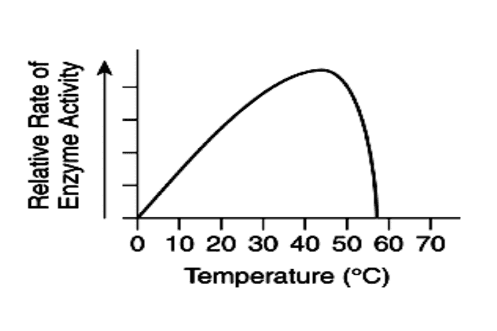
What is the optimal temperature for this enzyme?
The four most common elements in organisms are:
Which letter indicates the independent variable (IV) of this experiment?
What letter indicates the enzyme?
What letter indicates the substrate?
Under which condition would you expect the enzyme to be denatured?
Under which condition would you expect the rate of reaction to be the fastest?
Complete the following chart on the major categories of organic macromolecules:
Molecules with an "ose" ending are classified as which type of organic macromolecule?
What is the name of the protein which speeds up a chemical reaction without being used up in the reaction?
Label the parts of this diagram showing the catalyzed reaction breaking down hydrogen peroxide into water and oxygen using the terms (A) enzyme, (B) substrate, and (C) products.
Label the following diagrammes as CARBOHYDRATE or LIPID.
I. Label the following parts of the digestive system. (8pts)II. Circle the organ name where most absorption of nutrients takes place. (1pt) III. Underline TWO organ names where mechanical digestion takes place. (2pts) IV. Star the organ name where most water absorption takes place. (1pt)