Polar or Non-Polar Solutes Lab
star
star
star
star
star
Last updated about 7 years ago
20 Nsɛmmisa
0
0
1
1
1
1
1
1
8
1
1
1
1
1
9
1
1
1
1
1
Class Period
LastNameFirstName
Do Not put any of the lab materials into your mouth!
Remember - Lab Rules Apply - No Goofing Around
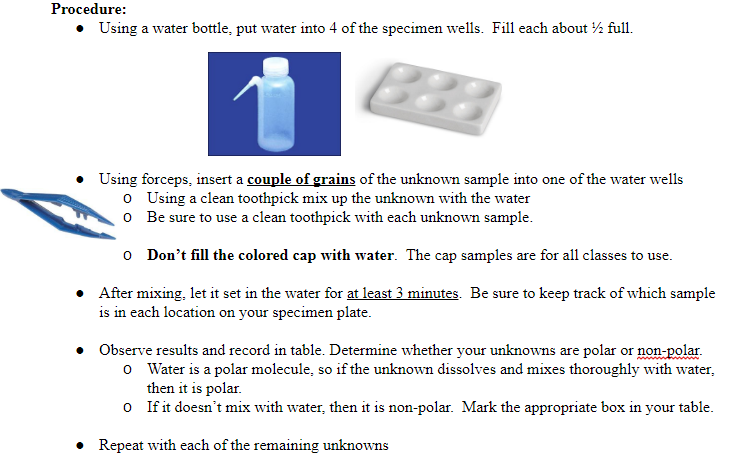
Materials: plastic tray with sample wells, water, forceps, toothpicks, pipette
There are enough materials for everyone to do this lab. As partners you share the tub materials, however each of you uses a plate to evaluate the solutes.
Solutes to Test: Pick up the 4 color coded solute samples from the Teacher Demo Table. These have to be shared by you and your partner and students from other classes. Do not put water into the colored sample containers. You use the forceps to take just one granule out to place on your specimen plate. When finished with the samples they are to be returned to the Teacher Demo Table and placed in the correct location.
Question addressed in this lab: Are these unknown solute samples polar or non-polar?
An example of a constant in this lab is...
Complete the "then" portion of the Hypothesis:
If the unknown sample is polar, then the sample will ...
Your results for #1 Unknown Solute (blue cap)
Your results for #2 Unknown Solute (pink cap)
Your results for #3 Unknown Solute (green cap)
Your results for #4 Unknown Solute (yellow cap)
Cleaning specimen plate:
1st - use a paper towel to wipe the substance(s) off of the plate into the trash can - don't put them in the sink
2nd - dry the plate and return it to your tub ready for the next class
Improve the validity of your results by increasing the "Sample Size". One way to do this is to include your classmate's results. As instructed by the teacher, collect data from the whole class. Add your individual data to the table along with the class data.
Complete the table with your results and the results from the class prior to graphing the data.
How did your individual results compare with the majority of the class results for Unknown Solute #1?
How did your individual results compare with the majority of the class results for Unknown Solute #2?
How did your individual results compare with the majority of the class results for Unknown Solute #3?
How did your individual results compare with the majority of the class results for Unknown Solute #4?
Were the results determined by a quantitative or a qualitative procedure?
* Graph and Analyze the Class Data * Complete the graph by filling in the X axis label * Make a scatter plot graph using the data from the class google sheet
The independent variable in this experiment is
Explain whether the class results show the possibility of “experimenter error”. If yes, be sure to refer to the specific data.
Rate your class (1 to 5 scale) on the accuracy of the class results.
When water is the solvent in a solution we call it aqueous.
Air is an example of an homogeneous mixture of gases.