Lab Practicum Fall 2017 - Labs 1,2,3,5,12-14

Last updated over 6 years ago
86 questions
Location #1: Word Bank - use the following to answer questions 1-7; terms can be used more than once or not at all; need to use exact words or it won't count your answer correct
  • aerobic respiration
  • anaerobic respiration
  • carbon dioxide
  • control
  • constant
  • dependent variable
  • glass beads
  • hypothesis
  • independent variable
  • KOH
  • oxygen
  • pea seeds dry and hydrated
  • pipette
  • qualitative data
  • quantitative data
  • tray
  • water
1

Chapter 5's lab required you to measure respiration using a respirometer. The control had ______________in the tube.

1

Name one of the constants in this respiration experiment.

1

The independent variable in this experiment was the...

1

The dependent variable in this experiment was the amount of _________that was used by the peas.

1

The type of data collected was quantitative or qualitative?

1

The cotton ball soaked with KOH was designed to absorb ______________ produced by the pea seeds.

1

A hypothesis for this experiment could be: If germination is initiated in the hydrated peas, then the amount of oxygen uptake will increase due to cellular respiration.

1

You learned how to measure volume by using water displacement in a graduated cylinder. Use the materials in your tub to measure the volume of the plastic plunger: large graduated cylinder, water, plastic plunger. Give your answer in ml. [Do not type ml, type only the volume amount.]

1

Practice your conversion skills and convert the volume you just measured in the previous question to microliters. [Do not type microliters or its abbreviation, type only the volume amount.]

1

Use your microscope to view the slide "Tilia Stem" located in your tub. Using your knowledge about calculating field of view to measure the "pith" in this stem under "scanning". There is a clear plastic ruler in your tub to assist with this measurement. What is the diameter of the pith inside the Tilia stem?

1

Using the same microscope: What is the total magnification of the specimen under scanning?

1

Using the same microscope: What is the magnification of the ocular lens (eyepiece)?

1

Using the same microscope: What type of cells are represented in this prepared slide of Tilia?

1

Using the same microscope: What can you use to focus the specimen under this lens objective?

5

Use the materials in your tub to take a pH reading of the solutions in jars 1 and 2. Complete a pH scale by putting in the start and end values, the neutral value, and the 2 pH readings of the solutions you just measured.

1

The solution in Jar #1 is a base.

1

The solution in Jar #2 is a base.

1

Using the materials at your lab station, place an Elodea leaf on a slide and treat it with the solution in your Jar#3. Be sure to use a cover slip. Let this stand for 3 to 5 minutes before you look at it under the microscope. Determine whether the unknown solution is

2

Use the materials at your lab station to look at a drop of pond water under the microscope. Locate a living organism and identify it in general. Raise your hand and have the teacher confirm that you found something livig.

1

Use the materials at your lab station to measure diffusion rates of 3 different inks. The inks (red, black and blue) have been placed on the edge of a piece of filter paper. Put water in the beaker to cover the bottom. The filter paper should be placed in the beaker so the inks are at the top. Allow the water to wick up the filter paper. Let this work for at least 5 minutes. Select the best answer, fastest to slowest.

1

A possible conclusion to the diffusion experiment is that the molecules in the black ink are much larger than the red and blue, so black moves much slower through the filter paper.

3

Use the materials in your tub to do a stomatal peel on the leaf in the snack-sized zip-lock bag. Take your sample from the backside (bottom) of the leaf. Bring your specimen into focus and move the pointer so that it points to one of the stomata and then raise your hand so the teacher can verify your work. Count the number of stomata and give that number followed by the total magnification used.

1

Study the leaf you have used for the stomatal peel. Select the true observation.

5

Use the materials at your lab station to make a wet mount of an onion cell (use some of the thin skin that lines each one of the layers of the onion). Use the blue water when making the wet mount to stain the cells slightly so you will be able to see them better under the microscope. Can you identify any organelles inside the cell? If so, include them here. Also, raise your hand so I can look at your specimen and give you credit.

1

Use the materials at your lab station to view the roots of the onion plant. (Light or dissecting microscope) You could try some of the blue water on the roots to stain them slightly. It may help you see them better when magnified. Identify root hairs and then raise your hand so I can check your work and give you credit for this skill.

There are several identification stations along the back south counter. Please rotate in and out in a timely manner so everyone will have an opportunity to complete this part of your final. The questions start on the east wall and goes to the west wall. You will place your answers here inside Formative.

Here is a word bank for the next identification questions on Labs 12 and 13. The words may or may not be used, or used multiple times.

angiosperms
anther
black bread mold
bread mold
dicot
eucot
female cone
ferns
fern sporangia
filament
gymnosperms
male cone
monocot
moss
mushroom spore print
ovary
petal
plasmodial slime mold
pollen
sorus
slime mold
sperm
spore
sporangia
stamen
stigma
style
1

Lab #12 - A - Give the group of organisms that this specimen belongs to.

1

Lab #12 - B - Give the group of organisms that this specimen belongs to.

1

Lab #12 - C - Describe what this is.

1

Lab #13 - A - This is an example of a

1

Lab #13 - A The green vegetation you see is gametophyte or sporophyte?

1

Lab #13 - B - This is an example of a

1

Lat #13 - B The green vegetation you see is gametophyte or sporophyte?

1

Lab #13 - C - The small round disks are called ___________and house the sporangia and spores.

2

Put a square around the part of the picture that begins the sporophyte generation and then put a circle around the picture that begins the gameophyte generation.

1

Lab #13 - D - This is a respresentative of the group called

1

Lab #13 - D The green vegetation you see is gametophyte or sporophyte?

1

Lab #13 - E - Thisis an example of a

1

Lab #13 - F - The seeds from this organism have "wings" which helps it disperse away from the mother plant.

1

Lab #13 - G - This is an example of a

1

Lab #13 - H - This is an example of the group of plants called

1

Lab #13 - H The green vegetation you see is gametophyte or sporophyte?

1

Lab #13 - I - The longest yellow structure inside the flower is the

1

Lab #13 - I - The female structures of a flower include, stimga, style and ovary.

1

Lab #13 - J - The five shorter structures in the middle of the flower are

1

Lab #13 - J - The male structures of the flower are composed of the stamen, anther, filament, and pollen.

1

Lab #13 - J - Pollen is female eggs.

1

Lab #13 - K - The large yellow structures surrounding the male and female parts of the flower are petals which can help attract pollinaters.

1

Lab #13 - L - How many ovules are in this model? [type the number, do not write out the number]

1

Lab #14 - A - The specimen in jar B is an example of a

1

Lab #14 - A - Give one of the physical characteristics of this group of plants that allowed you to identify it.

1

Lab #14 - A - The specimen in jar D is an example of a

1

Lab #14 - A - Give one of the physical characteristics of this group of plants that allowed you to identify it.

1

Lab #14 - B - 1 - The top green painted portion of this specimen is referred to as the _________________system.

1

Lab #14 - B - 2 - The bottom brown portion of this specimen is referred to as the ___________________system.

1

Lab #14 - B - 3 - This specimen is an example of this type of root, ......

1

Lab #14 - C - 1 - Identify the structure at the tip of this branch. It is the _______________bud.

1

Lab #14 - C - 2 - Identify the structure along the side of the stem (colored white). It is a ______________bud.

1

Lab #14 - C - 3 Identify the term used to identify this space.

1

Lab #14 - D - 1 What is the outer darker edge of this specimen called?

1

Lab #14 - D - 2 What is this inside area of the specimen called?

1

Lab #14 - D - 3 The very center of this specimen is called the ______________________

1

Lab #3 - A This thistle tube set-up is an example of the process of

1

Lab #3 - A Movement of particles and water always move from a location of higher concentration to an area of lower concentration.

1

Lab #3 - B Look carefully at these test tubes of chicken blood and solutions. The solution in Test tube #2 is fairly clear, however, you can see a thick sediment at the bottom of the test tube. This is the case because

1

Lab #5 - A This experiment was measuring

1

Lab #5 - B In this experiment we used germinating peas to measure

1

Lab #5 - B Carbon dioxide and oxygen were the two gases that were involved in this experiment.

1

Lab #5 - B To separate the gases in this experiment, KOH was used to fix carbon dioxide. This allowed the measurement of oxygen uptake which then implied cellular respiration was happening.

3

Locate the mitochondrion in this picture of a cell and draw a circle around it. Then, type/write out the equation for cellular respiration next to it.

1

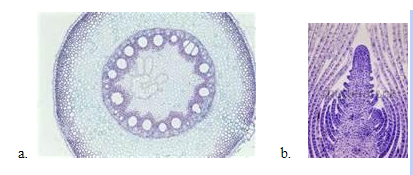
Use the picture above. Which is an example of a cross-section of a specimen?

1

The higher the magnification the smaller the field of view becomes when looking at a specimen through the microscope.

2

Give two characteristics that can be used to distinguish between a prokaryote and eukaryote cell.

2

Give two characteristics that can be used to distinguish between an animal and a plant cell.

1

Which of the following pairs incorrectly matches a cell structure with its function?

1

Which of the following pairs incorrectly matches a cell structure with its function?

1

What characteristics are shared by most cells?

1

Warmer temperatures usually cause diffusion rates to decrease.

1

Diffusion rates are affected by the type of medium. Usually rates are higher in gases than in liquids.

1

As pH increases, [H+] ion concentration decreases.

1

Buffers are important in living cells because they help maintain the correct pH.

1

Xylem cells transport water and phloem cells transport nutrients throughout a plant.

1

Stomata have to be open to take in the oxygen they need for cellular respiration and to rid itself of the waste product of this reaction, carbon dioxide.

1

Use the color plates numbered 1 - 9 in your work tub to help you answer the following question. There are three shapes used to organize bacteria. Find the incorrect answer.

1

Bacteria are also classified by whether they cause disease or not and whether they are aerobic or anaerobic.

1

Use the color plates numbered 1 - 9 in your work tub to help you answer the following question. Protists have 3 modes of locomotion. Find the incorrect answer.

1

Use the color plates numbered 1 - 9 in your work tub to help you answer the following question. Plate #1 is an example of a photosynthesizing algae called Spirogyra.