1
1
1
1
1
1
1
1
1
Infiltration: The water cycle begins with infiltration, as precipitation, such as rain or snow, seeps into the ground through the soil and porous rocks. This process replenishes and contributes to the formation of aquifers, which serve as underground reservoirs that store and supply water to wells, springs, and rivers.
Runoff: When precipitation falls on impermeable surfaces like pavement or compacted soil, it infiltrate, resulting in runoff. Runoff occurs when water flows over the , forming streams, rivers, and eventually reaching larger bodies of water like lakes and oceans. Runoff plays a crucial role in shaping the landscape, eroding soil, and creating intricate river systems.
Evaporation: Evaporation is the process by which water transforms from a , rising into the atmosphere. The Sun's heat provides the energy needed for water molecules to gain sufficient energy and escape from bodies of water, such as lakes, rivers, and the ocean. This conversion of liquid water to water vapor is an essential step in the water cycle.
Transpiration and Evapotranspiration: Transpiration is the process by which water vapor is released into the atmosphere from the leaves of . The combined process of evaporation from the land and transpiration from plants is known as , contributing to the water vapor content in the atmosphere.
Condensation: As water vapor rises into the atmosphere, it encounters cooler temperatures at higher altitudes. The cooling causes the water vapor to condense into tiny water droplets, forming clouds. These clouds are visible collections of water droplets or ice crystals suspended in the air, signifying the transition of water from a gaseous state back to a liquid state.
Precipitation: Precipitation occurs when condensed water droplets or ice crystals within clouds grow larger and become too heavy to remain suspended. They fall from the clouds to the Earth's surface as rain, snow, sleet, or hail. Precipitation replenishes water sources on the Earth's surface, continuing the water cycle's cycle.
Porosity and Permeability: Porosity refers to the measure of or pores in a material, such as soil or rock. These spaces can be filled with air or water. Permeability, on the other hand, refers to how easily water can flow through a material. Materials with high porosity have empty spaces, while materials with high permeability allow water to pass through them more easily. Think of a sponge: it has high porosity and permeability, as it can hold water and let it flow through.
Impermeable Materials: Some materials, like compacted clay, have low porosity and are considered impermeable. This means they have very few or no empty spaces for water to pass through. When water encounters impermeable materials, it infiltrate into the ground but instead runs off the surface, leading to increased runoff rates.
Capillary Action: Capillary action refers to the ability of water to move through narrow spaces, such as spaces between soil particles or the small tubes in a plant's roots and stems. Capillary action is possible due to the cohesive and adhesive properties of water. Through capillary action, water can move gravity, allowing plants to draw water from the ground and creating a process of water retention within soil.
Infiltration and Runoff Rates: Infiltration refers to the process of water soaking into the ground. The rate of infiltration depends on the porosity and permeability of the material. Soils with high porosity and permeability, such as sandy soils, have a high infiltration rate, as they can quickly absorb water. In contrast, soils with low porosity and permeability, such as clayey soils, have a low infiltration rate, causing water to pool on the surface and increase runoff rates.


Climate plays a crucial role in shaping landscapes and influencing the dominant type of weathering that occurs. Different climates have distinct characteristics, such as temperature, rainfall, and freeze-thaw cycles, that impact how rocks and landforms change over time. In wet and warm climates, chemical weathering tends to be more dominant. The combination of high temperatures and abundant rainfall promotes the breakdown of rocks through reactions, causing minerals to and rock structures to weaken. On the other hand, in cold and dry climates, weathering takes center stage. The cycle, where water seeps into cracks in rocks, freezes, expands, and then thaws, exerts pressure on the rocks, leading to their fragmentation and breakdown.
Furthermore, the resistance of certain rock layers to weathering is influenced by their and physical properties. Some rocks, like igneous and metamorphic rocks, are generally resistant to weathering due to their dense and durable nature. They are composed of minerals that are susceptible to chemical reactions and have strong interlocking crystal structures, making them more to physical breakdown. In contrast, sedimentary rocks, which are formed from the accumulation of sediments, can vary in their resistance to weathering. Some sedimentary rocks, like sandstone and limestone, are relatively resistant due to their compacted and cemented nature. Others, like shale, can be more prone to weathering due to their layered structure and the presence of minerals. These variations in rock resistance contribute to the development of unique landforms, such as cliffs, mesas, and valleys, as different layers of rock erode at different rates.

Match the word and the definition
| Draggable item | arrow_right_alt | Corresponding Item |
|---|---|---|
Delta | arrow_right_alt | a flat area of land adjacent to a river that is periodically flooded when water spills over the river's banks during times of heavy rainfall or snowmelt. |
V-Shaped river valley | arrow_right_alt | landforms formed at the mouths of rivers where they meet larger bodies of water, such as oceans or lakes. As rivers reach their destination, they slow down, losing energy and depositing sediment carried from upstream. Over time, this sediment accumulates and builds up, creating a fan-shaped landform with intricate channels and marshy areas. |
Floodplain | arrow_right_alt | As water flows downhill, it picks up sediment and gradually wears away the land, creating a channel. Over time, the repeated erosive forces of the river deepen and widen the channel, carving out a valley. The shape of the valley can be influenced by factors such as the type of rock, the gradient of the land, and the strength of the river's flow. |


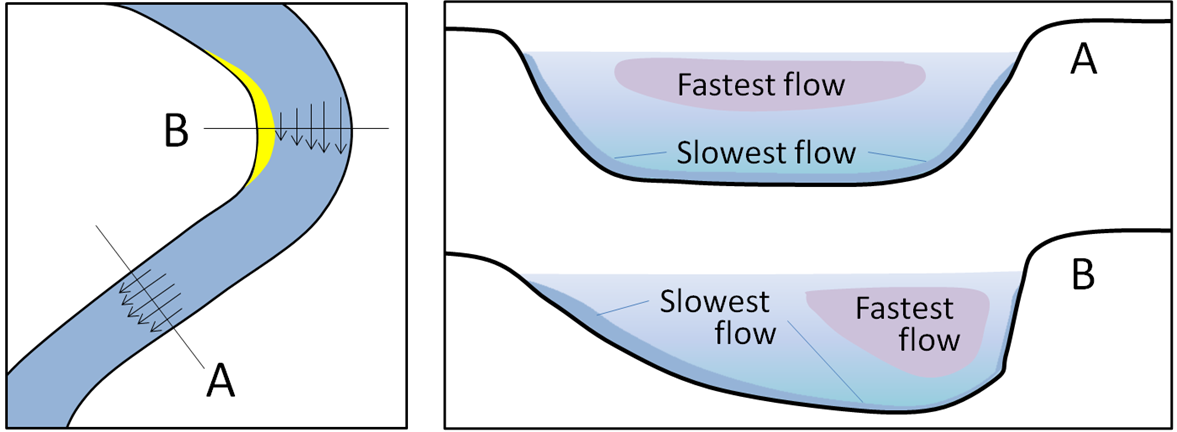
Match the location within a meandering river to a process.
| Draggable item | arrow_right_alt | Corresponding Item |
|---|---|---|
outside of the meander | arrow_right_alt | deposition |
Inside of the meander | arrow_right_alt | erosion |

When sediment, like sand and rocks, is deposited by water or wind, it can be in different ways. Horizontal sorting happens when sediments of different sizes settle out in separate layers. The larger and heavier particles, like pebbles, settle at the bottom, while the smaller and lighter particles, like sand or silt, settle on top. This creates distinct layers of different-sized sediment. On the other hand, vertical sorting occurs when sediments of the same size are deposited on top of one another. So, in vertical sorting, you would have a layer of just pebbles, then a layer of just sand, and so on. Both horizontal and vertical sorting help scientists learn about how sediments were deposited and understand the history of Earth's surface.


Infiltration and runoff can be influenced by various factors, leading to changes in how water moves through the ground. For example, during a heavy rainstorm, the rate of infiltration may decrease as the soil becomes and unable to absorb water quickly. This can result in increased runoff, causing water to . Similarly, when a grass field is paved, the surface water from infiltrating into the ground, leading to higher runoff rates. Additionally, when the ground freezes, the water in the soil turns into , reducing the infiltration rate and increasing runoff as the frozen ground becomes impermeable.
The shape and size of particles can undergo changes through the process of weathering. Weathering refers to the and alteration of rocks and minerals over time. As rocks are exposed to weathering agents like wind, water, and temperature changes, their particles can be physically broken down. As particles spend more time being weathered, their shapes become and their sizes become
Weathering can occur through both chemical and physical processes. weathering involves the mechanical breakdown of rocks without changing their chemical composition. This can happen through processes like where water seeps into cracks in rocks, freezes, and expands, causing the rock to break apart.
weathering, on the other hand, involves the alteration of rocks through chemical reactions. For example, when rainwater combines with carbon dioxide in the atmosphere, it forms a weak called carbonic acid. This acid can dissolve minerals in rocks, leading to their breakdown and eventual transformation. Acid rain that comes into contact with rocks containing the mineral , like the rock , will dissolve and leave behind a large opening underground called a .