Algebra 1 1-3 Guided Practice: Real Numbers and the Number Line
star
star
star
star
star
Last updated over 3 years ago
31 questions
3
3
10
10
10
3
10
3
10
10
10
10
10
3
10
3
10
10
Question 1
1.
10
Question 3
3.
10
Question 4
4.
Take Note: What is a square root of a number?
10
10
Question 7
7.
Question 8
8.
Question 9
9.
Question 10
10.
10
Question 11
11.
Take Note: What is a perfect square?
10
Question 13
13.
Question 14
14.
Question 15
15.
10
Question 16
16.
Take Note: What is a terminatingdecimal? Provide an example.
10
10
Question 19
19.
Question 20
20.
Question 21
21.
Question 22
22.
Question 23
23.
10
Question 24
24.
Take Note: Define inequality.
10
Question 26
26.
10
Question 28
28.
Question 29
29.
Problem 5 Got It? Graph and label the following numbers on a number line.
Label units on the number line and be precise.
Question 30
30.
10
Question 31
31.
🧠 Retrieval Practice:
Summarize the mathematical content of this lesson. What topics, ideas, and vocabulary were introduced?
Video Check: Select all that apply with regards to the video embedded directly above this item.
🕵️ I carefully watched the entire video.
📵 I removed distractions from my field of view while watching the entire video.
🎧 I used headphones (or earbuds) to listen to the entire video as I watched it.
✋ I sought clarification, as needed, to understand each concept in the video.
🎓 I understand each concept in the video and feel ready to move on.
🎯 I feel prepared to complete challenging problems related to the video.
❌ None of these statements apply.
Question 2
2.
Video Check: Select all that apply with regards to the video embedded directly above this item.
🕵️ I carefully watched the entire video.
📵 I removed distractions from my field of view while watching the entire video.
🎧 I used headphones (or earbuds) to listen to the entire video as I watched it.
✋ I sought clarification, as needed, to understand each concept in the video.
🎓 I understand each concept in the video and feel ready to move on.
🎯 I feel prepared to complete challenging problems related to the video.
❌ None of these statements apply.
Question 5
5.
Take Note: Use the math input tool to type the radical expression:
\sqrt{5x}.
Question 6
6.
Take Note: What is a radicand?
Problem 1 Got It? What is the simplified form of the expression?
6
32
8
12
Problem 1 Got It? What is the simplified form of the expression?
12.5
5
50
625
Problem 1 Got It? What is the simplified form of the expression?
11/3
3/11
11/9
3/2
Video Check: Select all that apply with regards to the video embedded directly above this item.
🕵️ I carefully watched the entire video.
📵 I removed distractions from my field of view while watching the entire video.
🎧 I used headphones (or earbuds) to listen to the entire video as I watched it.
✋ I sought clarification, as needed, to understand each concept in the video.
🎓 I understand each concept in the video and feel ready to move on.
🎯 I feel prepared to complete challenging problems related to the video.
❌ None of these statements apply.
Question 12
12.
Problem 2 Got It? What is the value of the expression to the nearest integer?
6
17
5
36
Video Check: Select all that apply with regards to the video embedded directly above this item.
🕵️ I carefully watched the entire video.
📵 I removed distractions from my field of view while watching the entire video.
🎧 I used headphones (or earbuds) to listen to the entire video as I watched it.
✋ I sought clarification, as needed, to understand each concept in the video.
🎓 I understand each concept in the video and feel ready to move on.
🎯 I feel prepared to complete challenging problems related to the video.
❌ None of these statements apply.
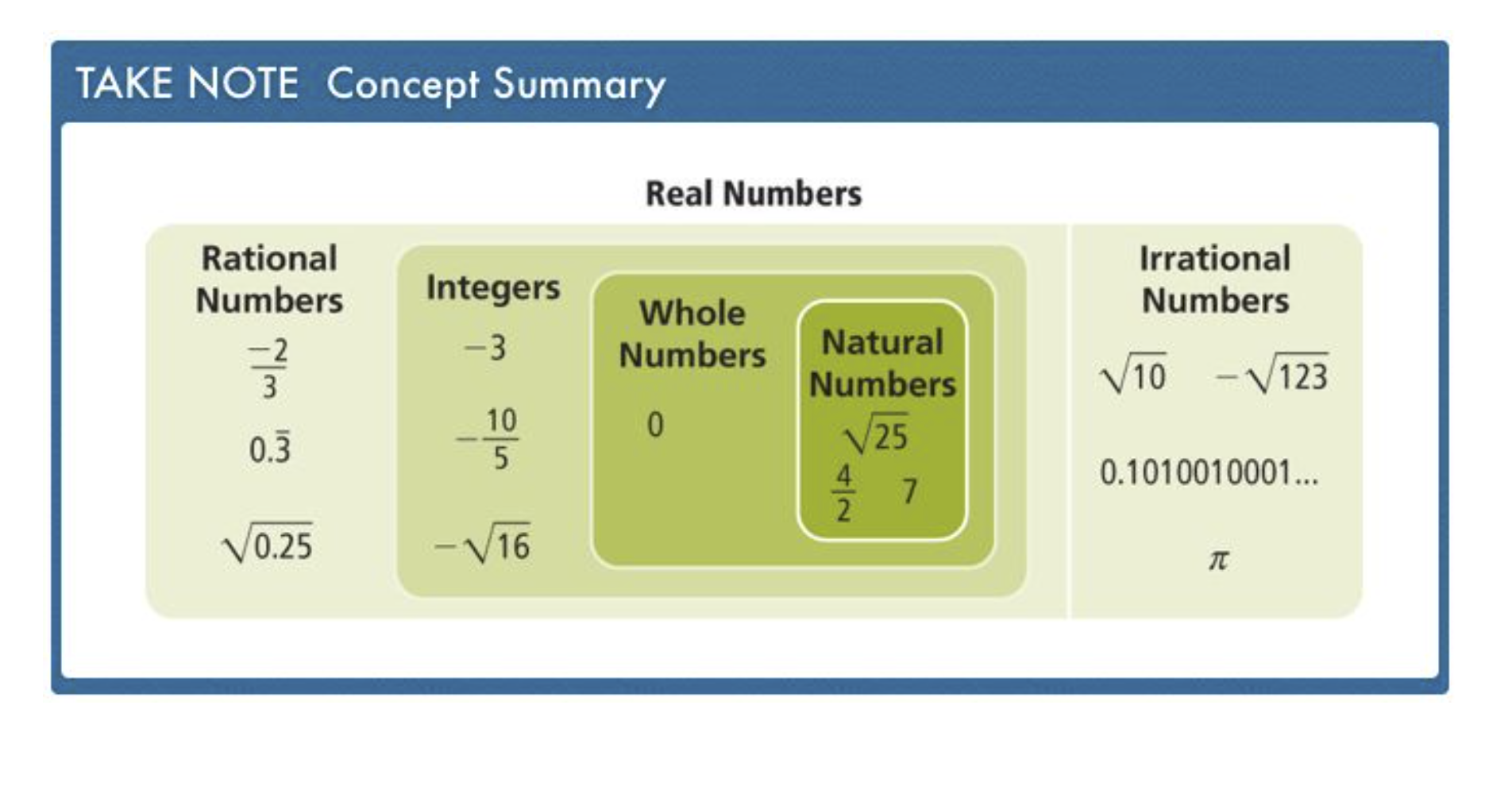
Take Note: Some sets of numbers are subsets of other number sets.
Categorize the number sets on the left based on whether or not they are subsets of the sets listed on the right.
Sets may belong in one category, in multiple categories, or in no categories.
The set of irrational numbers
The set of integers
The set of natural numbers
Subsets of the real numbers:
Subsets of the rational numbers:
Subsets of the whole numbers:
Question 17
17.
Take Note: What is a repeating decimal? Provide an example.
Question 18
18.
Take Note: How can you determine whether a number written in decimal form is a rational number or an irrational number?
Problem 3 Got It? To which subsets of the real numbers does the number belong?
Integers and rational numbers
Rational numbers
Natural numbers, whole numbers, integers, and rational numbers
Irrational numbers
Problem 3 Got It? To which subsets of the real numbers does the number belong?
Irrational numbers
Rational numbers
Natural numbers, whole numbers, integers, and rational numbers
Integers and rational numbers
Problem 3 Got It? To which subsets of the real numbers does the number belong?
Rational numbers
Whole numbers, integers, and rational numbers
Natural numbers, whole numbers, integers, and rational numbers
Irrational numbers
Problem 3 Got It? To which subsets of the real numbers does the number belong?
Integers and rational numbers
Rational numbers
Irrational numbers
Natural numbers, whole numbers, integers, and rational numbers
Video Check: Select all that apply with regards to the video embedded directly above this item.
🕵️ I carefully watched the entire video.
📵 I removed distractions from my field of view while watching the entire video.
🎧 I used headphones (or earbuds) to listen to the entire video as I watched it.
✋ I sought clarification, as needed, to understand each concept in the video.
🎓 I understand each concept in the video and feel ready to move on.
🎯 I feel prepared to complete challenging problems related to the video.
❌ None of these statements apply.
Question 25
25.
Take Note: Use the math input tool to provide an example of an inequality that uses the symbol for less than or equal to.
Pro Tip: Many modern math input fields automatically convert combinations of math characters into their single-character equivalent. For example, Typing a "<" and then an "=" will result in a "≤" as long as you don't pause too long between typing the two characters.
Problem 4 Got It? Fill in the circle to complete the inequality.
>
=
<
Question 27
27.
Video Check: Select all that apply with regards to the video embedded directly above this item.
🕵️ I carefully watched the entire video.
📵 I removed distractions from my field of view while watching the entire video.
🎧 I used headphones (or earbuds) to listen to the entire video as I watched it.
✋ I sought clarification, as needed, to understand each concept in the video.
🎓 I understand each concept in the video and feel ready to move on.
🎯 I feel prepared to complete challenging problems related to the video.
❌ None of these statements apply.
Problem 5 Got It? Order the numbers from least to greatest.
-\frac{7}{2},-2.1,\sqrt{5},\sqrt{9},3.5
-\frac{7}{2},-2.1,3.5,\sqrt{5},\sqrt{9}
-2.1,-\frac{7}{2},\sqrt{9},\sqrt{5},3.5
-\frac{7}{2},-2.1,\sqrt{9},\sqrt{5},3.5
Solve It! If the pattern continues, which will be the first figure to contain more than 200 square units? Explain your reasoning.
Each square has a side length that corresponds to the number of that figure. Therefore, the 15th figure will be the first to contain more than 200 square units.
Each square has a side length that corresponds to the number of that figure. Therefore, the 201st figure will be the first to contain more than 200 square units.
Each square has a side length that corresponds to the number of that figure. Therefore, the 10th figure will be the first to contain more than 200 square units.
Take Note: Which of the following are perfect squares? Select all that apply.
1
9
8
12
121
Problem 4 Got It?Reasoning: In Problem 4, is there another inequality you can write that compares the two numbers? Explain.
No;
is the only inquality that compares the two numbers.