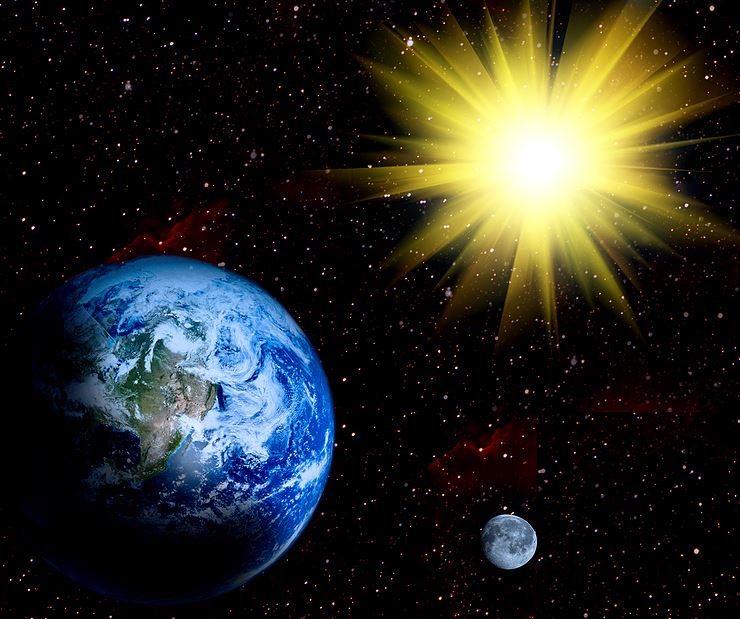
Have you ever wondered what it was like on the other side of the world as you were getting ready for bed? Perhaps you have wondered what season it was in Australia as you were sweating on a hot summer day. The first question can be answered by examining the constant spinning of Earth on its axis. The second answer comes from understanding the position of Earth during its revolution around the Sun and Earth’s tilt on its axis.
Earth rotates on its axis, taking about 24 hours to complete one entire spin. Thus, one complete rotation cycle results in 12 hours of daylight and 12 hours of night, as different parts of Earth are rotated into the Sun's light. Have you ever stood outside and watched as the Sun sink below the horizon? You have actually been witnessing Earth's rotation. The Sun is not moving, although it appears to be. Earth is moving! The rotating Earth also makes the other stars in the night sky seem to glide across the sky when, in fact, it is the rotation of Earth on its axis that makes them appear to move. At any given time during the 24-hour rotation, half of Earth is in sunlight and its other half is in darkness. This means as you get ready for bed, somewhere on the other side of Earth, someone is just getting up.
