Directions: Read each question below and choose the answer choice that best fits.
1 point
1
Question 1
1.
Define the concept Rule of Law. (SSCG1)
1 point
1
Question 2
2.
According to the writings of John Locke and Baron de Montesquieu (SSCG1)
1 point
1
Question 3
3.
The Magna Carta is also known as (SSCG1)
1 point
1
Question 4
4.
Read the following passage to answer question #4 (SSCG1)
“But constant experience shows us that every man invested with power is likely to abuse it…To prevent this abuse of power, it is necessary from the very beginning that power should be a check to power…in every government there are three sorts of power; the legislative in regards to making law, the executive, and the judicial…there is no liberty if the powers are not separate from one another.
The above quote reflects Montesquieu’s philosophy of government, how does this philosophy impact the United State’s concept of government?
1 point
1
Question 5
5.
What are the reasons why Life, Liberty, and Property are example of natural rights? (SSCG1)
1 point
1
Question 6
6.
Describe Thomas Hobbes view on the government’s power. (SSCG1)
1 point
1
Question 7
7.
Use the following passage to answer question #7
Rousseau: Man is born free, yet everywhere he is in chains. The government is created by a contract among the people and receives its powers from them.
Hobbes: Believed that people by nature are cruel, greedy, & selfish and only a powerful government could ensure an elderly society.
Locke: All men have certain natural rights: the right to life, liberty, and property. The purpose of government is to protect these rights. If it fails to do so, the people may set up a new government.
Montesquieu: There is no liberty if the judicial power is not separated from the legislative and executive branches.
Declaration of Independence
The Unanimous Declaration of the Thirteen United States of America
When is the course of human events, it becomes necessary for one people to dissolve the political bands which have connected them with another, and to assume, among the powers of the earth, the separate and equal station to which the laws of nature and of nature’s God entitle them, a decent respect to the opinions of mankind requires that they should declare the causes which impel them to the separation.
We hold these truths to be self-evident: That all men are created equal; that they are endowed by their Creator with certain unalienable rights; that among these are life, liberty, and the pursuit of happiness; that, to secure these rights, governments are instituted among men, deriving their just powers from the consent of the governed; that whenever any form of government becomes destructive of these ends, it is the right of the people to alter or to abolish it, and to institute new government, laying its foundation on such principles, and organizing its powers in such a from, as to them shall seem most likely to effect their safety and happiness.
Question 7 Which of these writers had a direct influence on the actual division of the Federal government’s powers?
1 point
1
Question 8
8.
Read the passage below and answer question #8 (SSCG1)
According to the English Bill of Rights, citizens are allowed “…freedom from cruel and unusual punishment, as well as excessive bail”
How does the above quote represent the concept of limited government?
1 point
1
Question 9
9.
Which of the following events DO NOT lead to the drafting of the Declaration of Independence? (SSCG2)
1 point
1
Question 10
10.
In what year was the Declaration of Independence signed? (SSCG2)
1 point
1
Question 11
11.
A major purpose of the Declaration of Independence was to (SSCG2)
1 point
1
Question 12
12.
Which one of the following is NOT a similarity between the Declaration of Independence and Social Contract Theory? (SSCG2)
1 point
1
Question 13
13.
Read the passage below and answer question #13
In the Declaration of Independence, when explaining why the 13 colonies should be freed from the rule of Great Britain, Thomas Jefferson wrote:
“We hold these truths to be self evident, that all men are created equal, that they are endowed by their creator with certain unalienable Rights, that among these are Life, Liberty and the pursuit of Happiness.”
Thomas Jefferson incorporates in the Declaration of Independence the idea of (SSCG2):
1 point
1
Question 14
14.
All of the following are key ideas included in the Declaration of Independence EXCEPT (SSCG2):
1 point
1
Question 15
15.
Which philosophy recognizes an implied agreement that entitles citizens their freedom and natural rights but also empowers government to maintain order? (SSCG2)
1 point
1
Question 16
16.
The Declaration of Independence was based largely on the ideas of (SSCG2)
1 point
1
Question 17
17.
Which of the following Enlightened philosophers had the greatest influence on the framing of the Declaration of Independence? (SSCG2)
1 point
1
Question 18
18.
The Declaration of Independence was a persuasive agreement directed at whom? (SSCG2)
1 point
1
Question 19
19.
The Connecticut Compromise recommended (SSCG3a):
1 point
1
Question 20
20.
People who were for the Constitution were known as (SSCG3a)
1 point
1
Question 21
21.
The principle of popular sovereignty states that (SSCG3c)
1 point
1
Question 22
22.
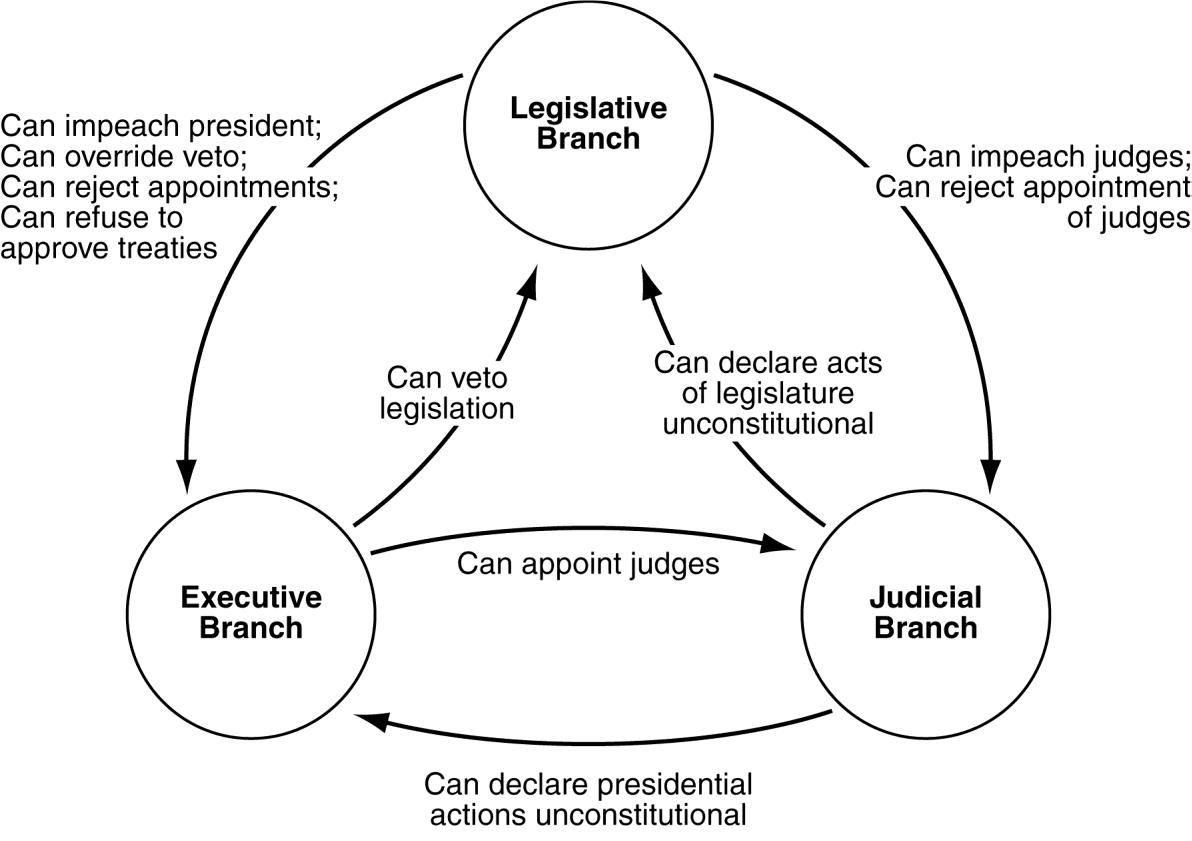
Use the diagram below to answer question #6 (SSCG3c)
What principle of the U.S. government is illustrated in the diagram above?
1 point
1
Question 23
23.
In the United States there is a national government as well a government in each state. What principle of the Constitution is this an example of? (SSCG3c)
1 point
1
Question 24
24.
Because of the Constitutional principle of __________________, the central government must share power with local and state governments (SSCG3c).
1 point
1
Question 25
25.
Use the quote below to answer question #27
"The accumulation of all powers legislative, executive and judiciary in the same hands [...] may justly be pronounced the very definition of tyranny."
-James Madison, Federalist Paper 47
SSCG3c
27. Which concept is James Madison discussing?
1 point
1
Question 26
26.
A major reason the Antifederalists opposed the ratification of the United States Constitution was because the Constitution (SSCG3a)
1 point
1
Question 27
27.
One of the issues facing the early nation was how to interpret the Constitution. Alexander Hamilton said that the Constitution gave Congress the power "to make all laws necessary and proper." Which statement best describes Hamilton's views on how the Constitution should be interpreted? (SSCG3a)