LHS General Biology PP Check - The Scientific Method
star
star
star
star
star
Last updated about 7 years ago
20 Nsɛmmisa
Hyɛ no nsow a efi ɔkyerɛwfo no hɔ:
scientific method
0
0
0
6
4
1
1
1
1
1
1
1
1
1
1
1
1
1
1
1
scientific method
Last Name First Name
Class Period.
Who is your biology teacher?
Place the statments with the correct step in the scientific method.
My coffeemaker works
If something is wrong with the outlet, my coffeemaker also won’t work when plugged into it.
Why doesn’t my toaster work?
I plug my coffee maker into the outlet
My toaster doesn’t toast my bread
There is something wrong with the electrical outlet.
1. Observation:
2. Question:
3. Hypothesis:
4. Prediction:
5. Experiment:
6. Result:
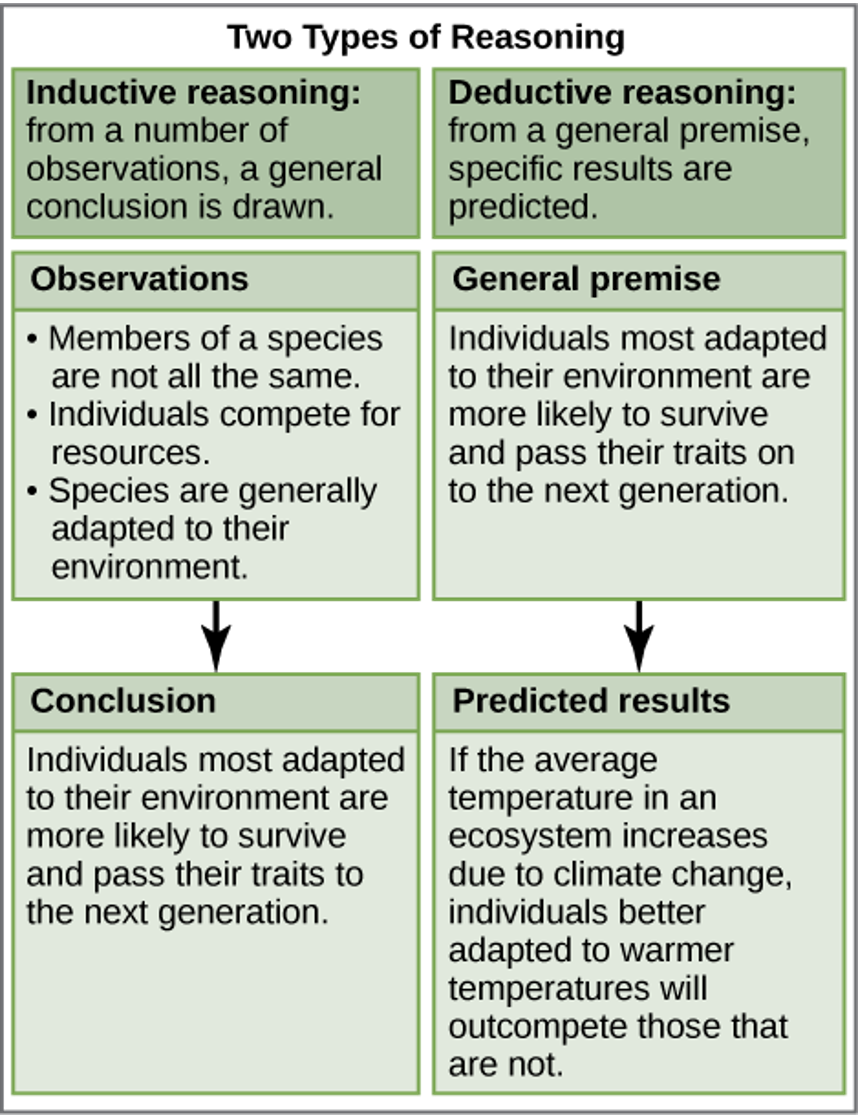
Classify the following as either deductive or inductive reasoning.
1. All flying birds and insects have wings. Birds and insects flap their wings as they move through the air. Therefore, wings enable flight.
2. Insects generally survive mild winters better than harsh ones. Therefore, insect pests will become more problematic if global temperatures increase.
3. Chromosomes, the carriers of DNA, separate into daughter cells during cell division. Therefore, DNA is the genetic material.
4. Animals as diverse as humans, insects, and wolves all exhibit social behavior. Therefore, social behavior must have an evolutionary advantage Answer
inductive
deductive
The first step in the scientific method is:
The basic unit of measurement for length is
The following is a list of steps involved in the Scientific Method which scientists use to solve problems. Choose the correct sequence (order) of the steps then choose the answer that corresponds to that sequence
Research
Form conclusions
Form a hypothesis
Perform a experiment
Identify a problem or ask a question
Collect or Analyze Data
Any factor that affects the results of an experiment is called a
The parts of the scientific method are: (check all that apply)
A student conducted an experiment to find out if air temperature affected the total number of seeds that germinate. Two groups of 100 identical seeds were used. One group was kept at an air temperature of 10°C and the other at an air temperature of 20°C. All other conditions were held constant. Observations made during the experiment are shown in the data table below.
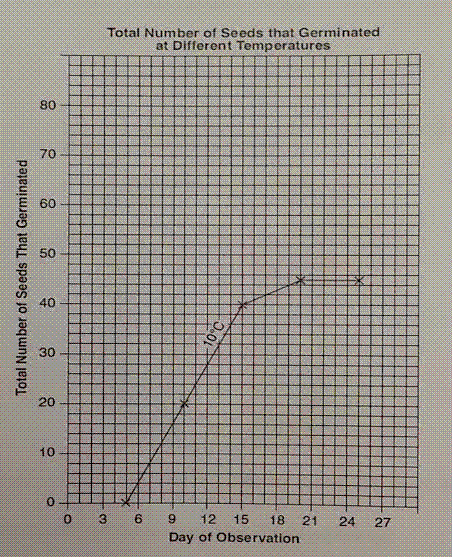
Using the graph below, determine how many seeds would have germinated at 10°C by day 12. (write the number only)
The scientific method is used to help scientists organize the process of solving problems.
Students perform an experiment testing whether light is required for plants to grow. The two students use the same materials to set up an experiment where seeds were exposed to light and no light. For seven days they observed the plants’ growth and recorded their measurements and observations. The seeds not exposed to light were less dense and pale yellowish in color.
Match the 7 bolded and underlined sets of words from the above text with the following terms in the questions 3 through 7. Terms are only used once for Questions 3 through 7.
Hypothesis: If....(insert the independent variable)...then...( insert the dependent variable)....
Independent variable (what you manipulate or change in the experiment):
[type the bolded term exactly from above that answers this question]
Dependent variable (what is measured in the experiment):
[type the bolded term exactly from above that answers this question]
Three constants (things that are the same in the experiment):
[type the 3 bolded terms exactly from above in the same order that answers this question; leave one space between each term]
Quantitative data (results that can be measured):
Qualitative data (results that are based on opinion, judgment, or interpretation):
Repeating your experiment can help verify that your results (data) are accurate.
Which of these questions can not be answered by the scientific method?