Algebra 2 4-9 Independent Practice: Quadratic Systems

Last updated almost 3 years ago
19 questions
10

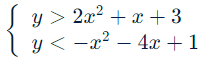
Solve the system by substitution.

10

Solve the system by substitution.

10

Solve the system by substitution.

10

Solve the system by graphing:
  1. Solve the system by graphing at desmos.com/calculator.
  2. Zoom and pan your graph to establish an appropriate viewing window.
  3. Capture a screenshot of your graph.
  4. Upload or paste your screenshot on the canvas.

10

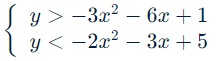
Solve the system by graphing:
  1. Solve the system by graphing at desmos.com/calculator.
  2. Zoom and pan your graph to establish an appropriate viewing window.
  3. Capture a screenshot of your graph.
  4. Upload or paste your screenshot on the canvas.

10

Compare and Contrast: How are solving systems of two linear equations or inequalities and solving systems of two quadratic equations or inequalities alike?

10

Reasoning: How many points of intersection can the graphs of a linear function and a quadratic function have? Select all that apply.

5

Graphing: Graph a linear function and a quadratic function that have no points of intersection.
Zoom and pan your graph to establish an appropriate viewing window.

  • Click the graph tab.
  • Click on the graph background to add a point. Add two points to create a graph. Drag a point or type in x and y coordinates to edit its position. Click on a point to delete it.
5

Graphing: Graph a linear function and a quadratic function that have exactly one point of intersection.
Zoom and pan your graph to establish an appropriate viewing window.

  • Click the graph tab.
  • Click on the graph background to add a point. Add two points to create a graph. Drag a point or type in x and y coordinates to edit its position. Click on a point to delete it.
5

Graphing: Graph a linear function and a quadratic function that have two points of intersection.
Zoom and pan your graph to establish an appropriate viewing window.

  • Click the graph tab.
  • Click on the graph background to add a point. Add two points to create a graph. Drag a point or type in x and y coordinates to edit its position. Click on a point to delete it.
5

Reasoning: How many points of intersection can the graphs of two quadratic functions have? Select all that apply.
Zoom and pan your graph to establish an appropriate viewing window.

5

Graphing: Graph two quadratic functions that have no points of intersection.
Zoom and pan your graph to establish an appropriate viewing window.

  • Click the graph tab.
  • Click on the graph background to add a point. Add two points to create a graph. Drag a point or type in x and y coordinates to edit its position. Click on a point to delete it.
5

Graphing: Graph two quadratic functions that have exactly one point of intersection. Zoom and pan your graph to establish an appropriate viewing window.

  • Click the graph tab.
  • Click on the graph background to add a point. Add two points to create a graph. Drag a point or type in x and y coordinates to edit its position. Click on a point to delete it.
5

Graphing: Graph two quadratic functions that have infinitely many points of intersection.
Zoom and pan your graph to establish an appropriate viewing window.

  • Click the graph tab.
  • Click on the graph background to add a point. Add two points to create a graph. Drag a point or type in x and y coordinates to edit its position. Click on a point to delete it.
10

Reasoning: How many points of intersection can the graphs of two absolute value functions have? Select all that apply.

5

Graphing: Sketch two absolute value functions that have no points of intersection on the canvas. Use bold lines and contrasting colors.

5

Graphing: Sketch two absolute value functions that have exactly one point of intersection on the canvas. Use bold lines and contrasting colors.

5

Graphing: Sketch two absolute value functions that have exactly two points of intersection on the canvas. Use bold lines and contrasting colors.

10

Reflection: Math Success