Algebra 2 5-1 Guided Practice: Polynomial Functions
star
star
star
star
star
Last updated over 3 years ago
30 Nsɛmmisa

3
10
3
6
6

3
10
3
10
A.SSE.1.a
F.IF.7.c
10
10
A.SSE.1.a
F.IF.7.c
10

3
3

Video Check: Select all that apply with regards to the video embedded directly above this item.
Solve It! The first column shows a sequence of numbers.
◆ For 1st differences, subtract consecutive numbers in the sequence: -6-(-4) = -2, 4-(-6) = 10, and so on.
◆ For 2nd differences, subtract consecutive 1st differences.
◆ For 3rd differences, subtract consecutive 2nd differences.
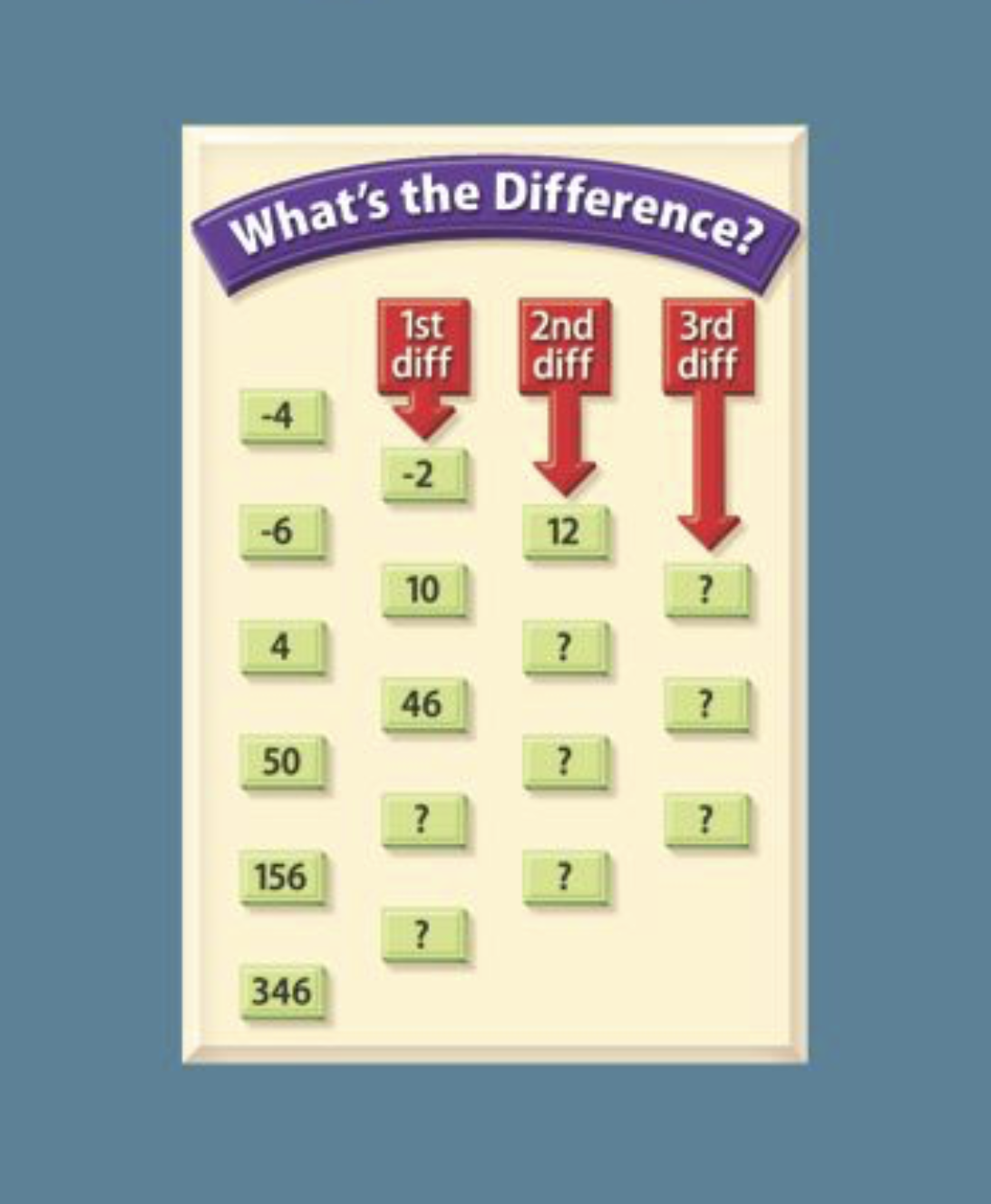
If the pattern continues, what is the 8th number in the first column (far left)?
⚠️HINT: Find the unknown values first and notice the pattern in the 3rd diff column. Use that to build the pattern down.
Video Check: Select all that apply with regards to the video embedded directly above this item.

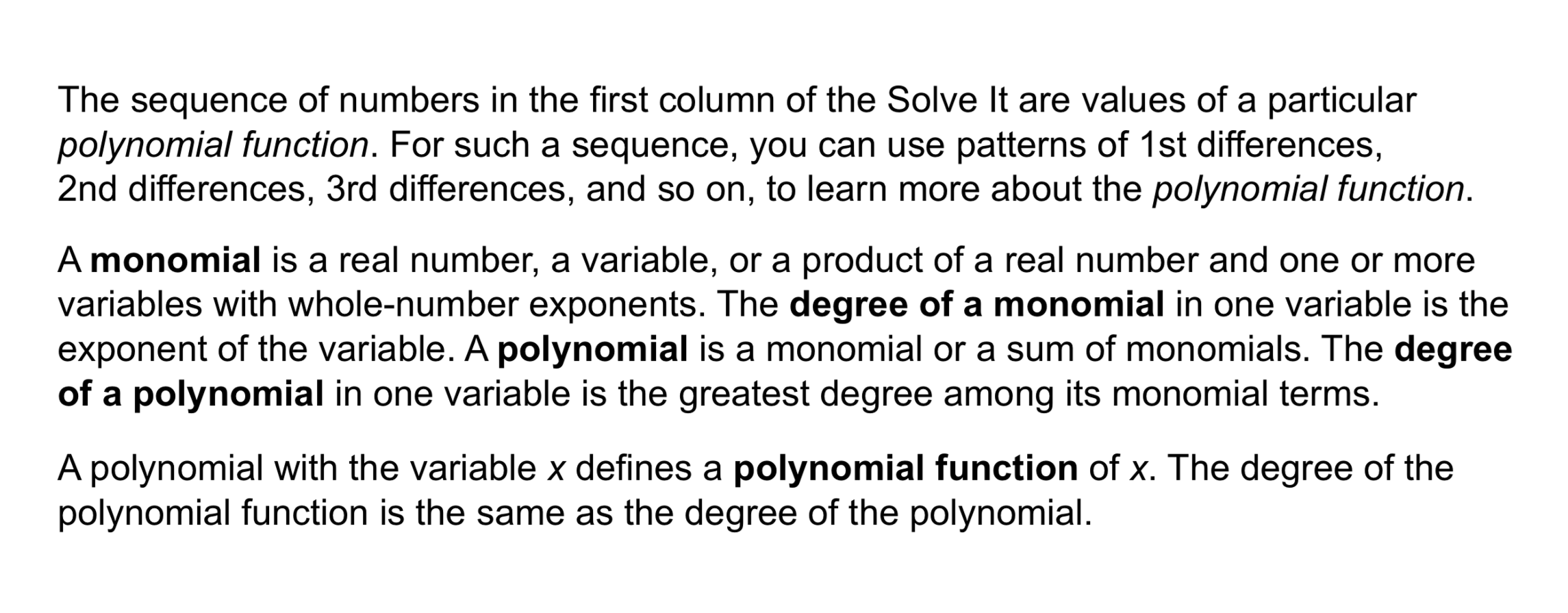
Take Note: Provide an example of a monomial.
Take Note: Define degree of a monomial.

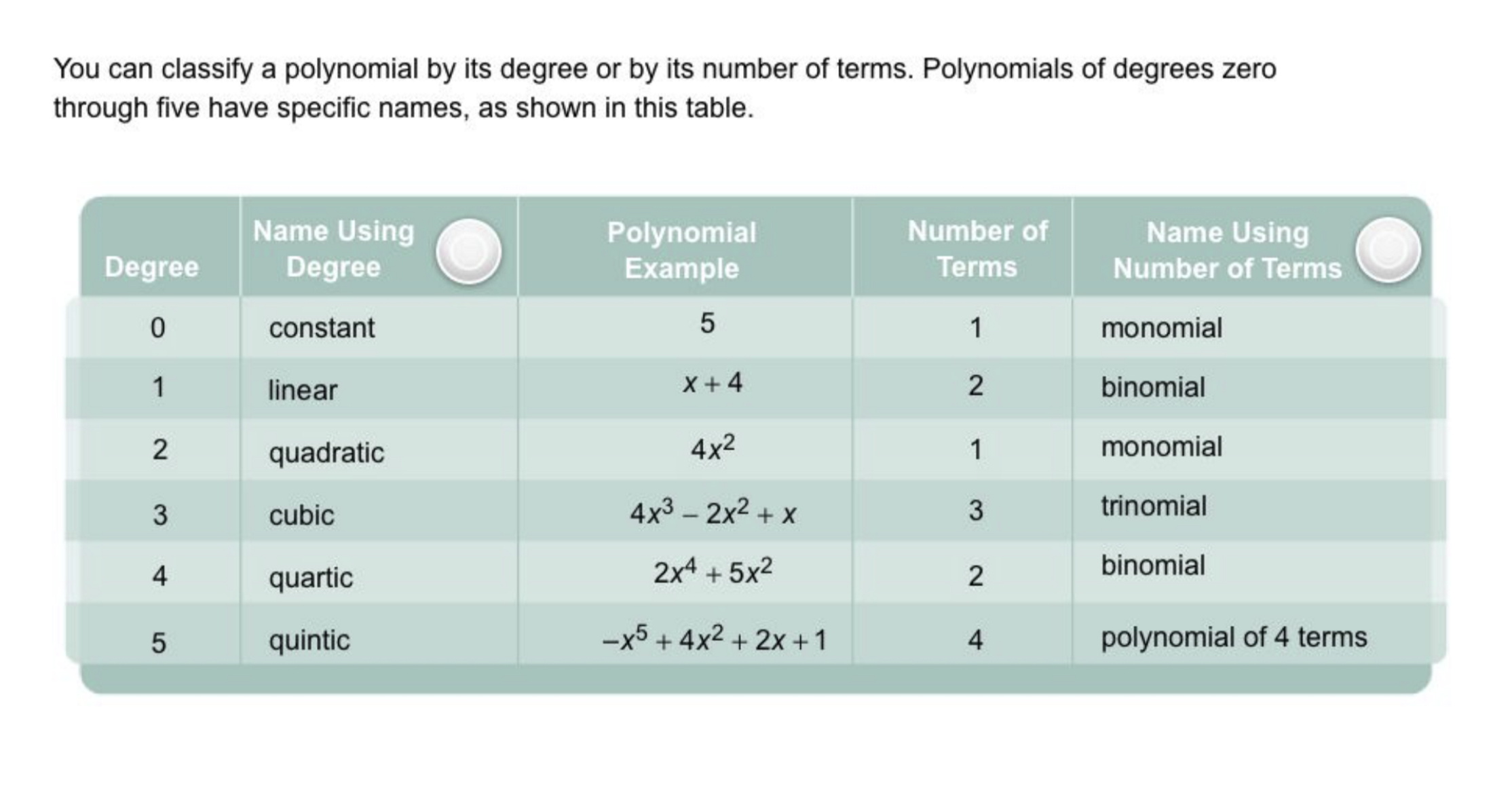
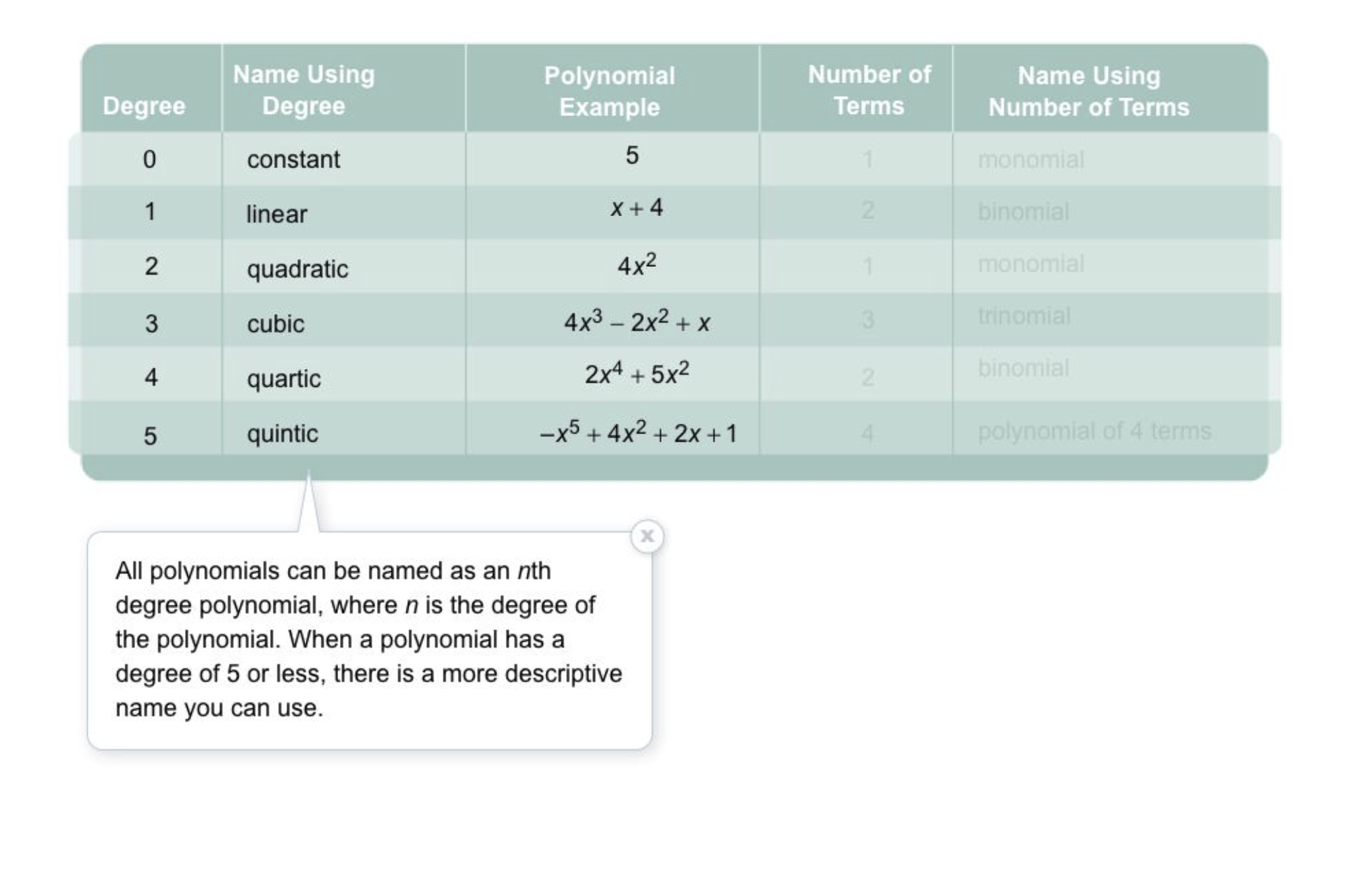
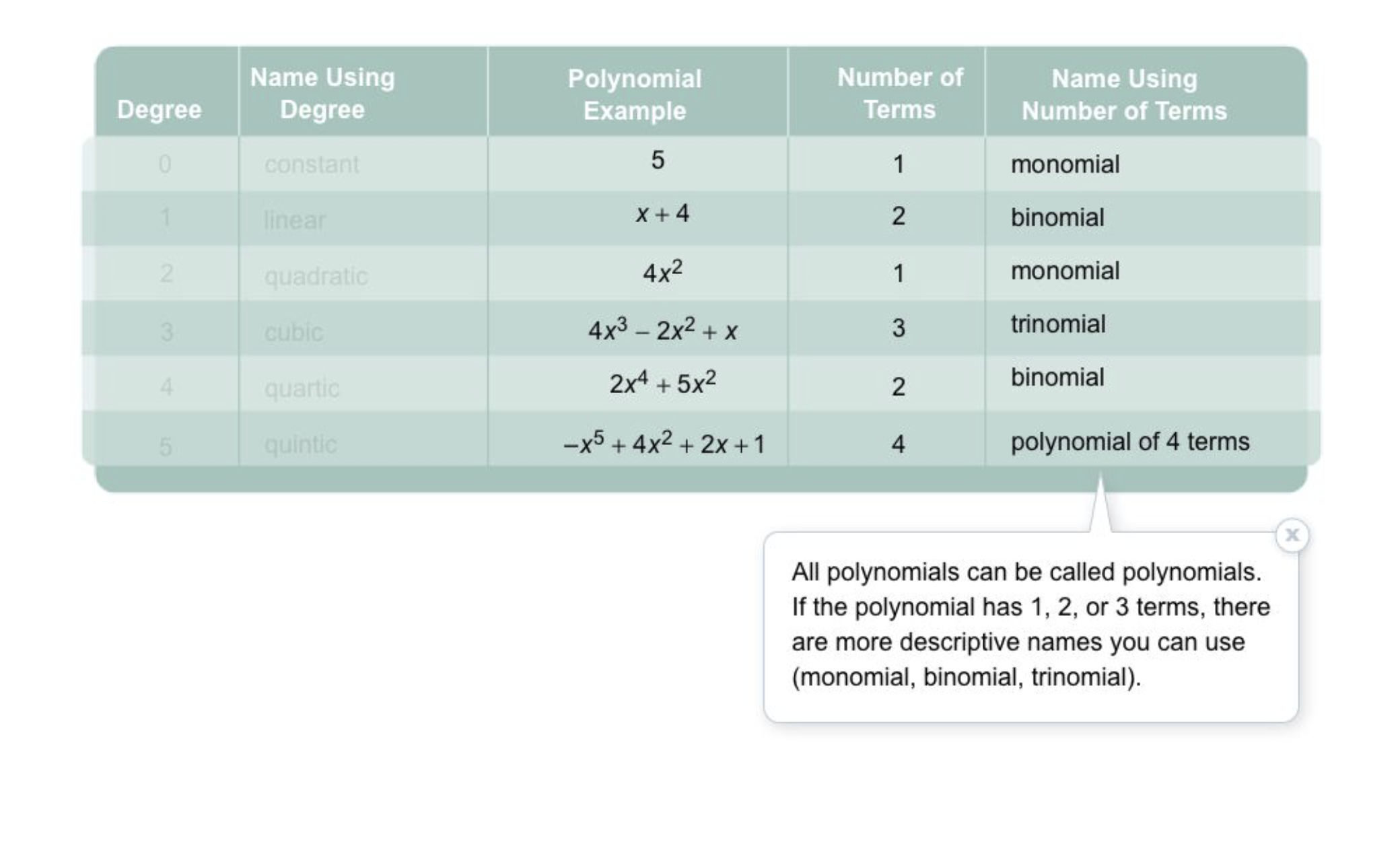
Take Note: Categorize each polynomial on the left based on its polynomial name (based on degree).
You may need to zoom out to see all of the items. You can also place each item from the left column by selecting it (click it) then selecting (clicking on) the category for it.
Constant (degree 0)
Linear (degree 1)
Quadratic (degree 2)
Cubic (degree 3)
Quartic (degree 4)
Quintic (degree 5)
Take Note: Categorize each polynomial on the left based on its polynomial name (by its number of terms).
You may need to zoom out to see all of the items. You can also place each item from the left column by selecting it (click it) then selecting (clicking on) the category for it.
Monomial (1 term)
Binomial (2 terms)
Trinomial (3 terms)
Polynomial of 4 terms
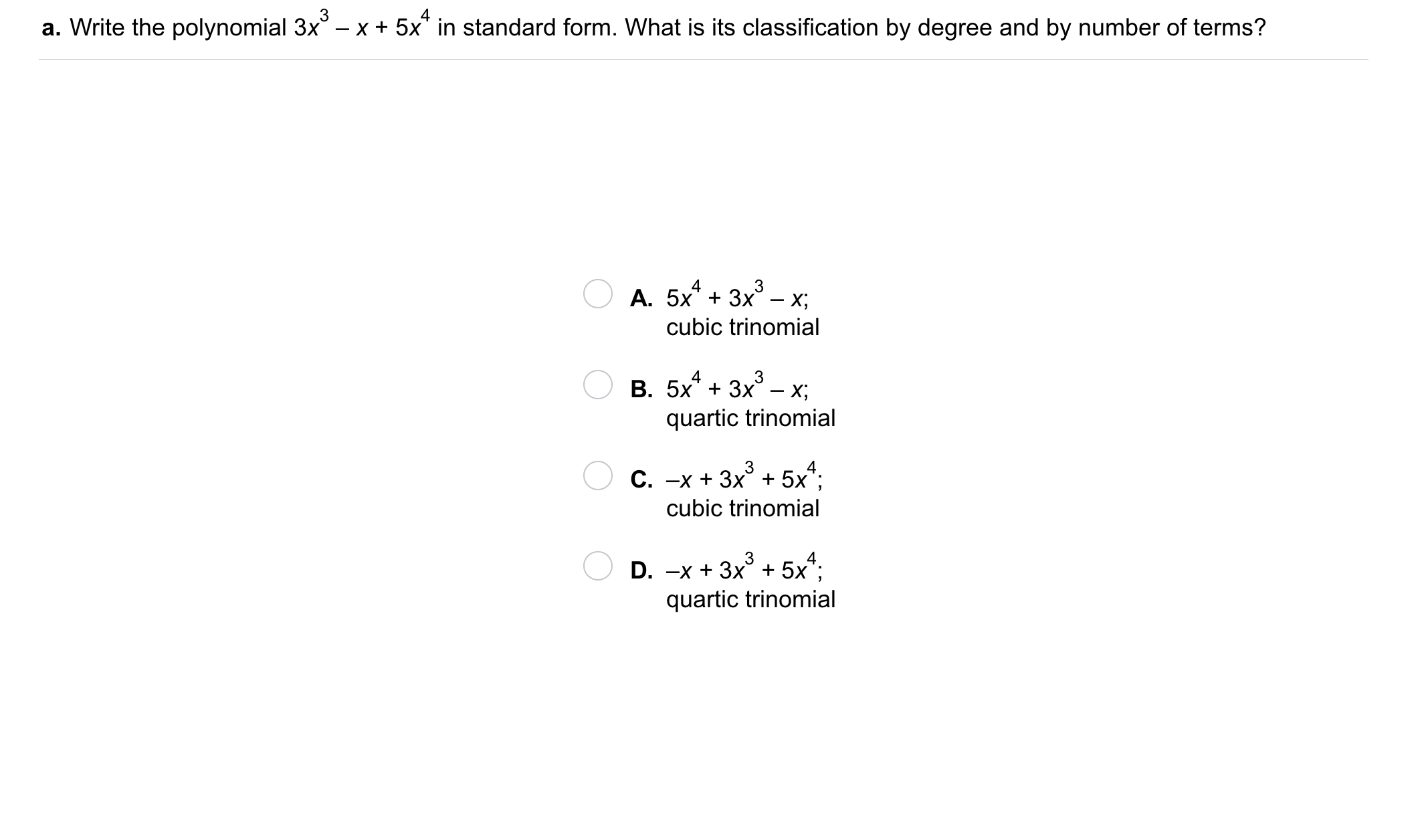
Problem 1 Got It?
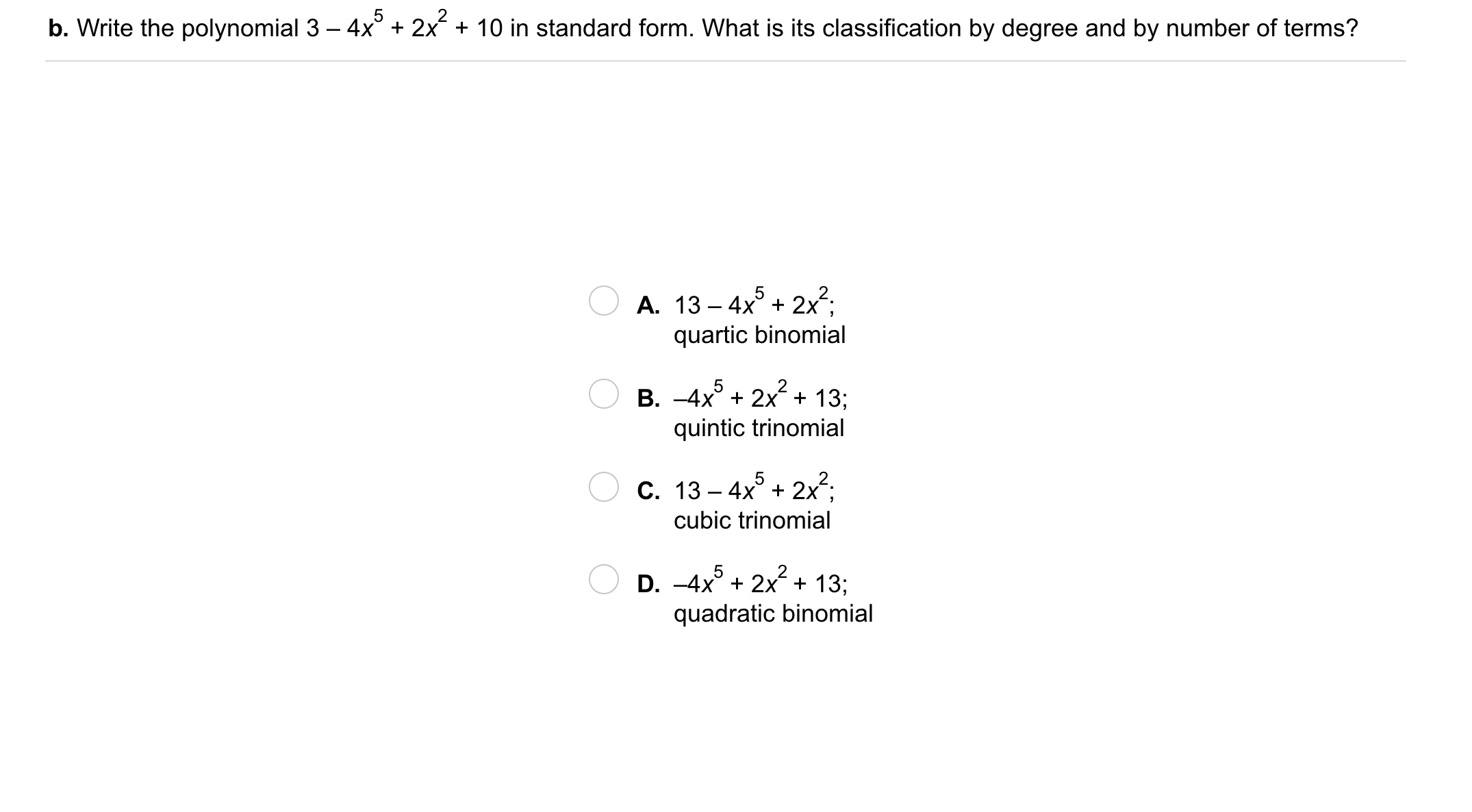
Problem 1 Got It?
Video Check: Select all that apply with regards to the video embedded directly above this item.
Take Note: Define turning point.
You may use the canvas to help illustrate your definition.
Take Note: Define end behavior (of the graph of a polynomial function).
You may use the canvas to help illustrate your definition.

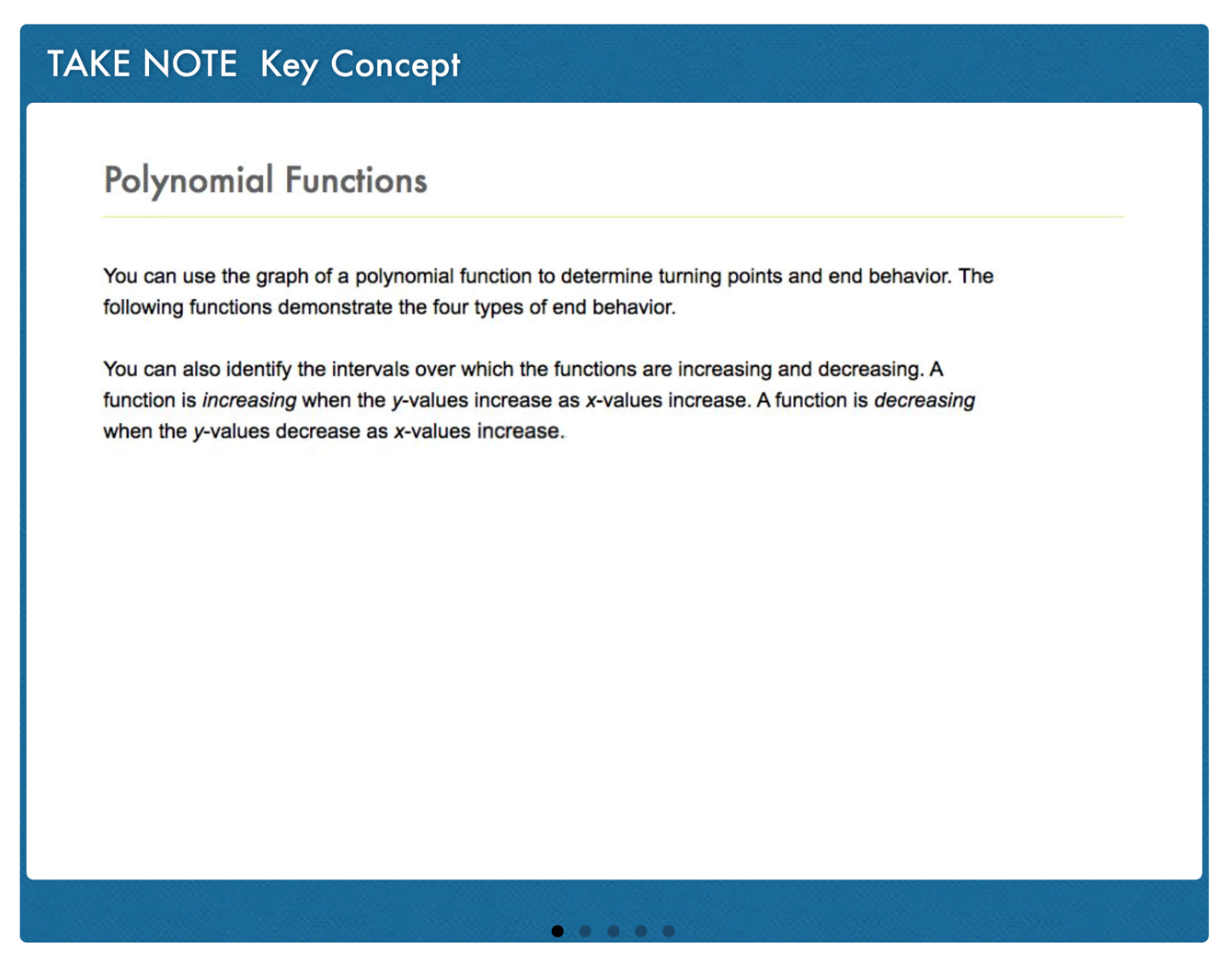
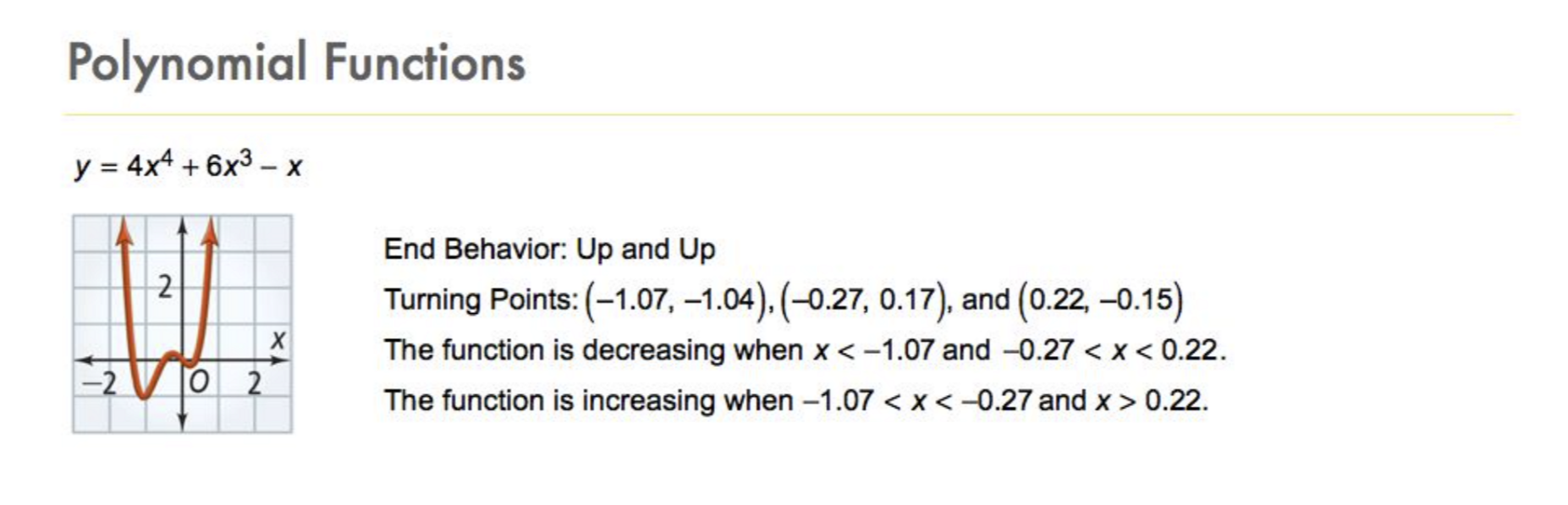
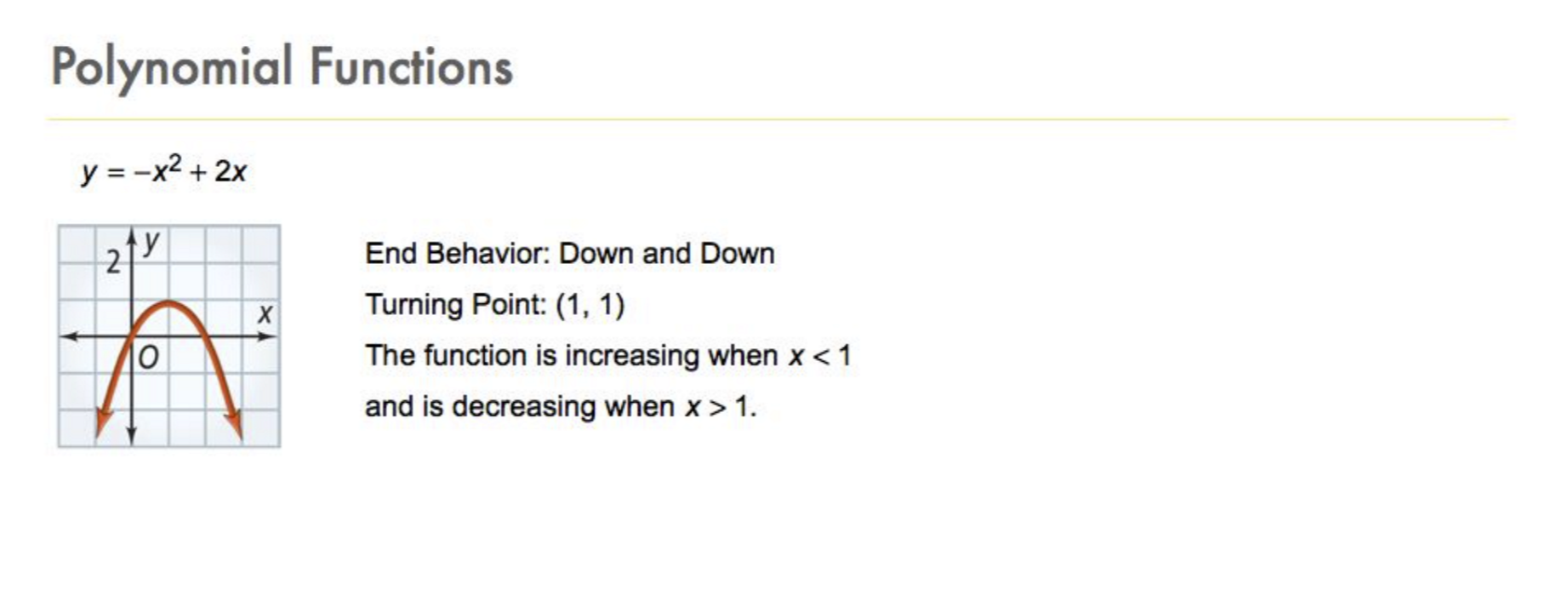
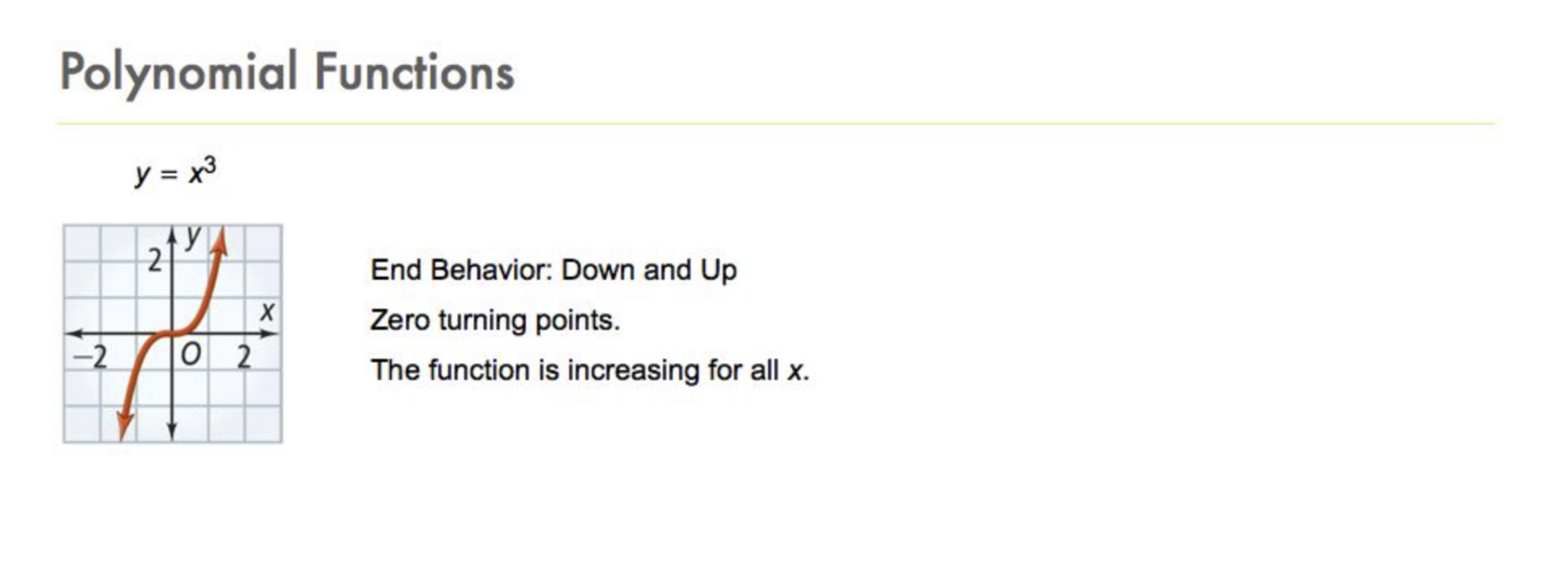
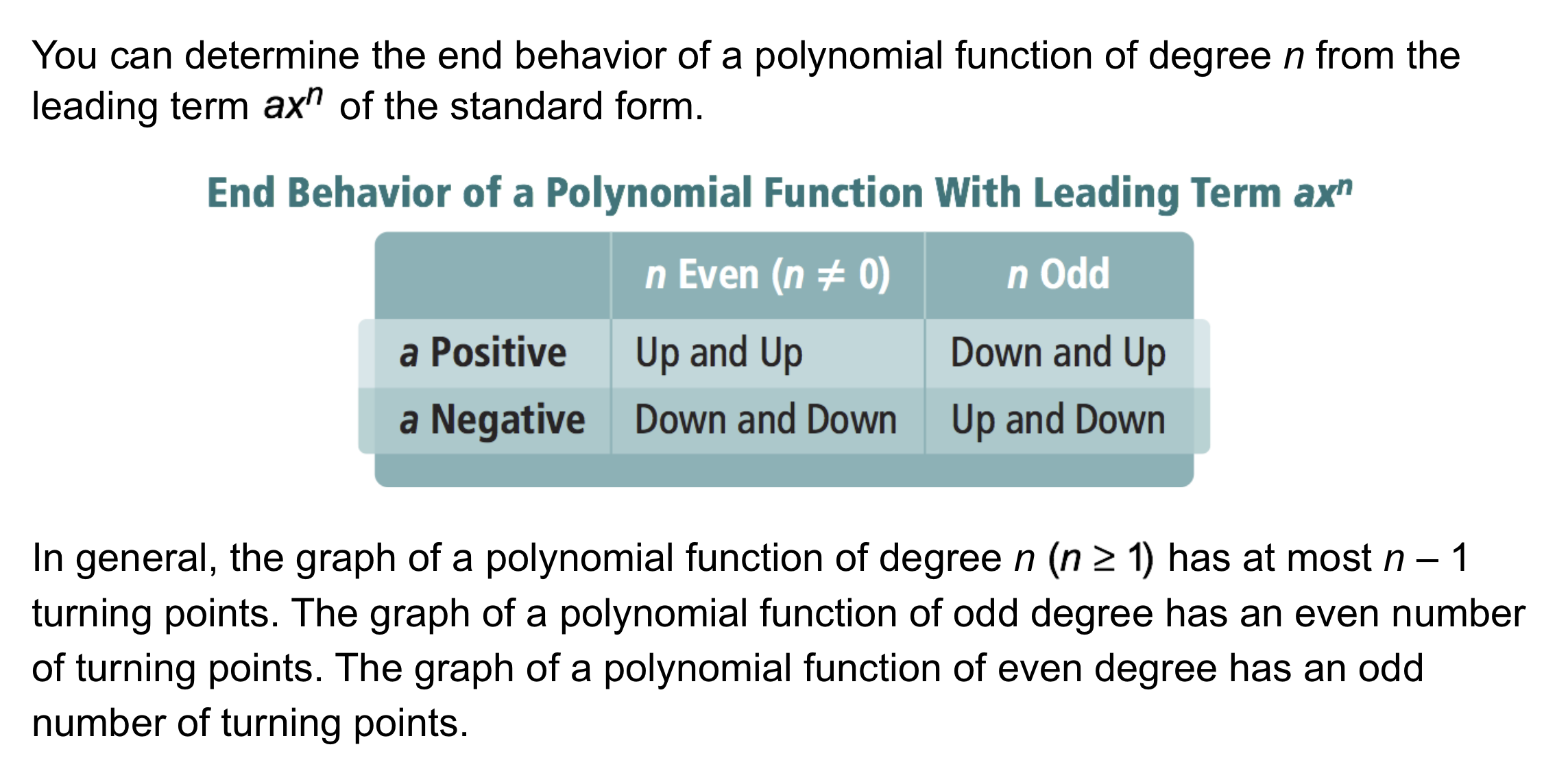
Take Note: Classify each polynomial function on the left based on the end behavior of its graph.
Remember that you only need to consider two things:
1. The polynomial's leading coefficient
2. Whether the polynomial's degree is even or odd
Up and Up
Down and Up
Down and Down
Up and Down
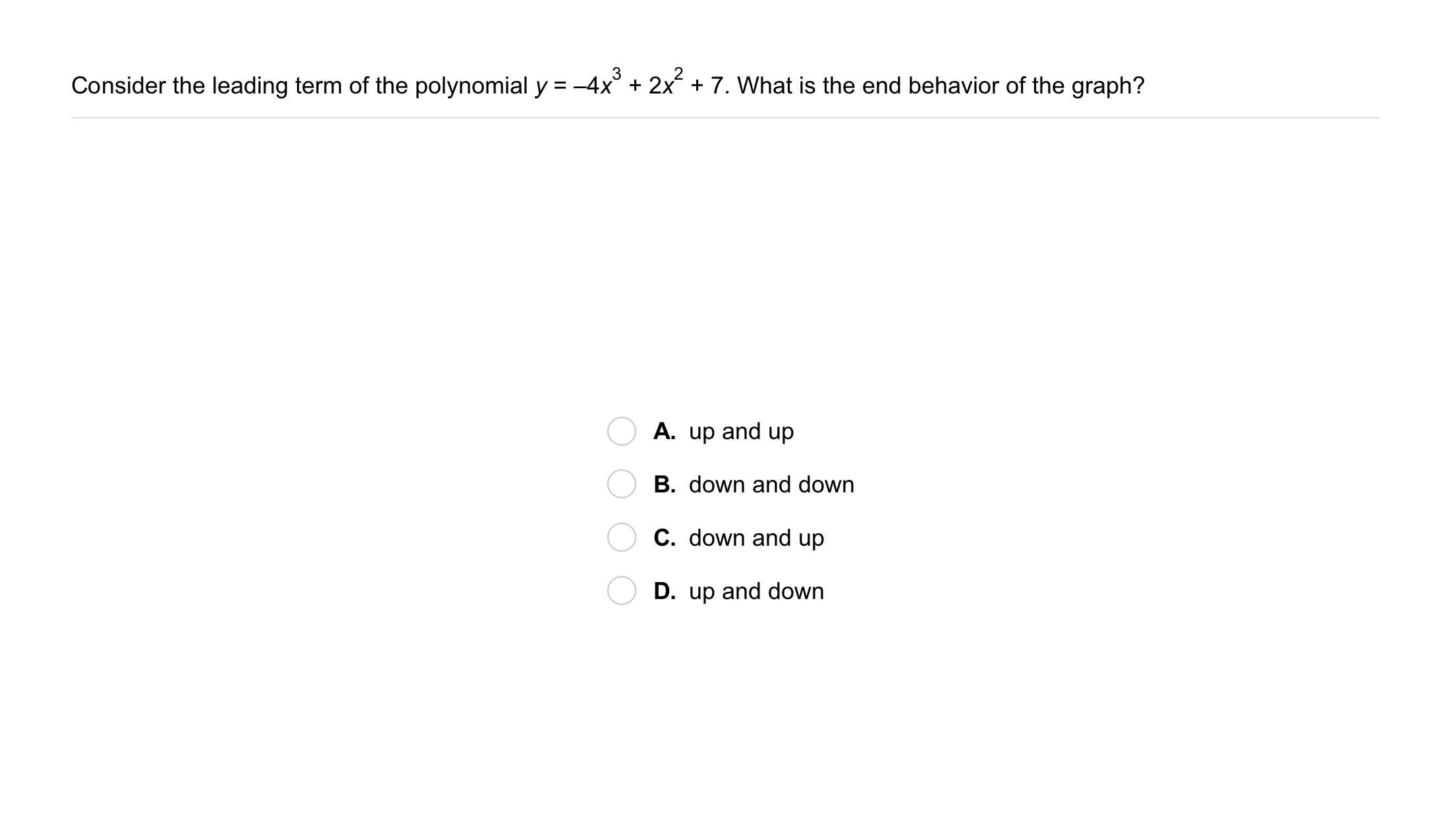
Problem 2 Got It?
Video Check: Select all that apply with regards to the video embedded directly above this item.
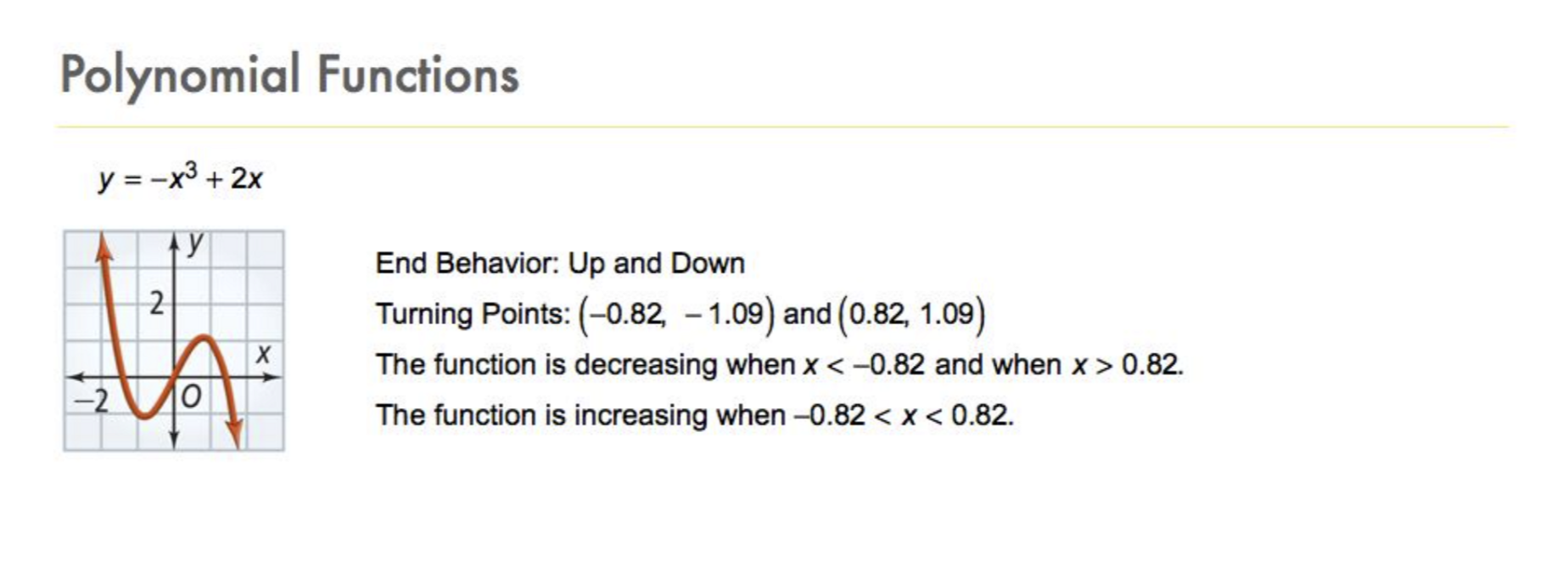
Problem 3 Got It? Identify the end behavior and turning points of the graph of the function as well as any intervals in which the graph is increasing or decreasing.
up and down
down and up
End behavior
Turning points
Increasing
Decreasing
Problem 3 Got It?
Graph the function at desmos.com.
Zoom and pan your graph to establish an appropriate viewing window.
Notice the end behavior and turning points of the graph and any intervals in which the graph is increasing or decreasing.
Take a screenshot of your graph.
Upload or paste your screenshot onto the canvas.
You may revise your responses to the previous item, as needed.
Problem 3 Got It? Identify the end behavior and turning points of the graph of the function as well as any intervals in which the graph is increasing and/or decreasing.
up and down
down and up
no turning points
End behavior
Turning points
Increasing
Problem 3 Got It?
Graph the function at desmos.com.
Zoom and pan your graph to establish an appropriate viewing window.
Notice the end behavior and turning points of the graph and any intervals in which the graph is increasing or decreasing.
Take a screenshot of your graph.
Upload or paste your screenshot onto the canvas.
You may revise your responses to the previous item, as needed.
Video Check: Select all that apply with regards to the video embedded directly above this item.

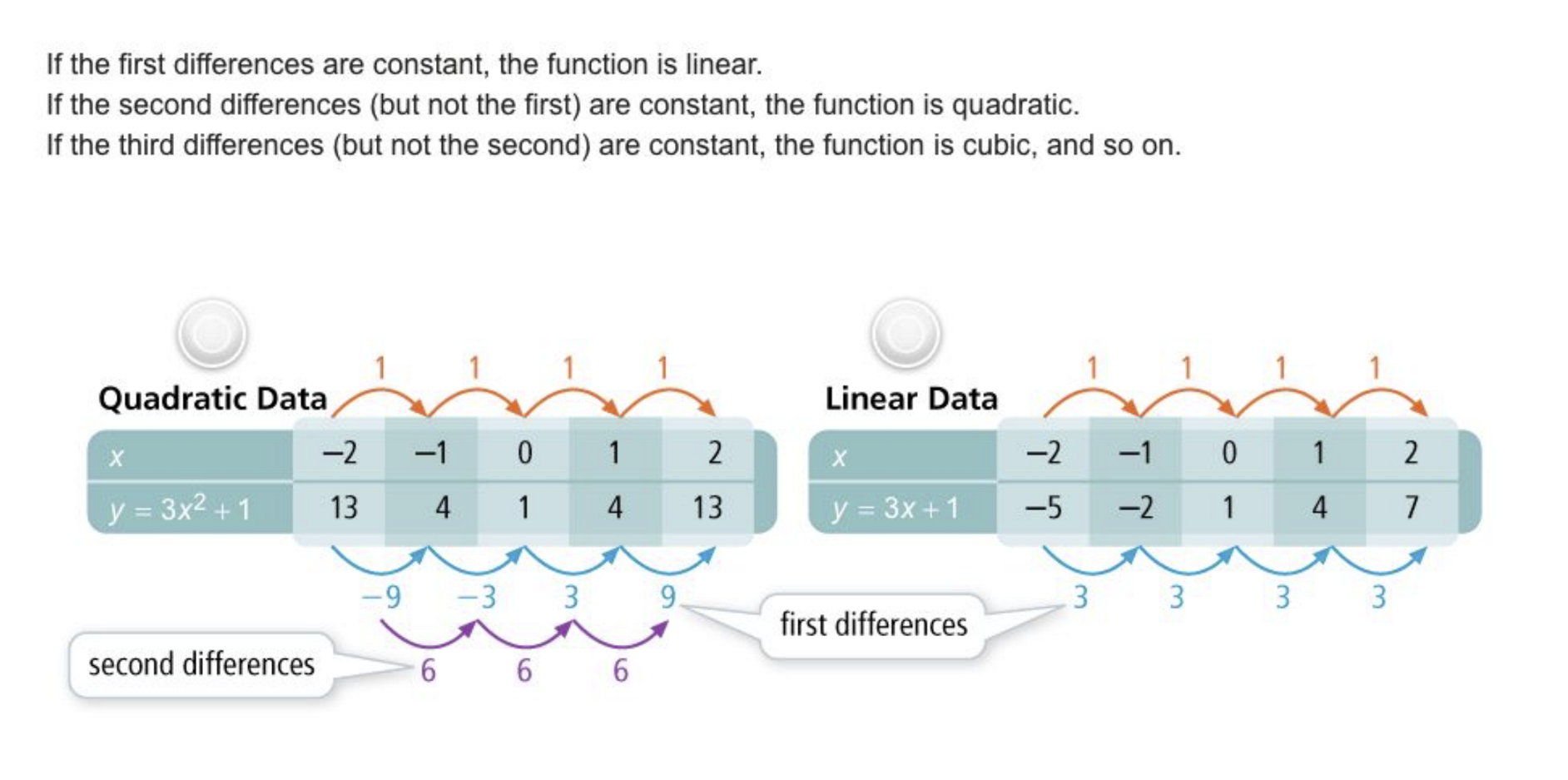
Take Note: Categorize each type of data on the left based on its differences.
First differences are not constant.
Second differences are constant.
First differences are constant.
Second differences are not constant.
Third differences are constant.
Linear data
Quadratic data
Cubic data
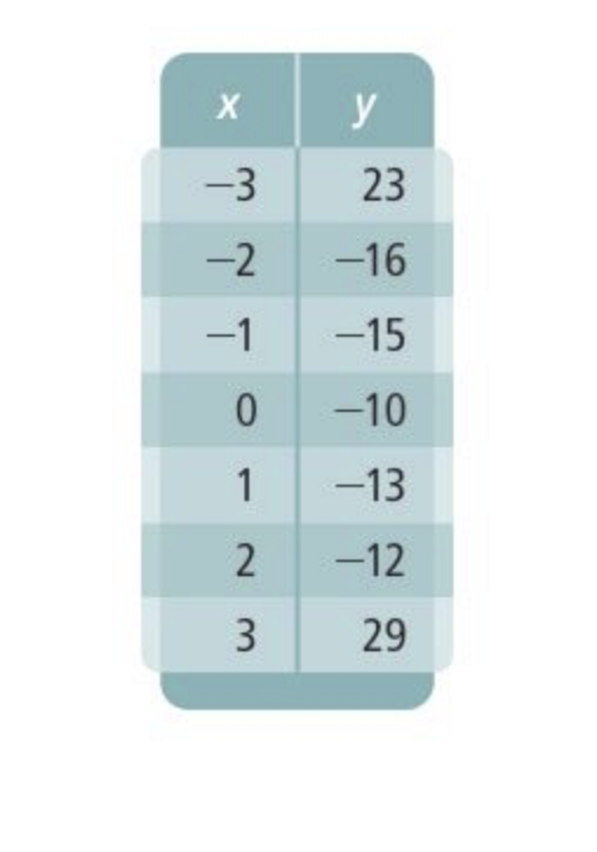
Problem 4 Got It? What is the degree of the polynomial function that generates the data in the table?

🧠 Retrieval Practice:
Summarize the mathematical content of this lesson. What topics, ideas, and vocabulary were introduced?
Take Note: Provide an example of a monomial of degree 3.
Take Note: Define polynomial.
Take Note: Provide an example polynomial of degree 4.
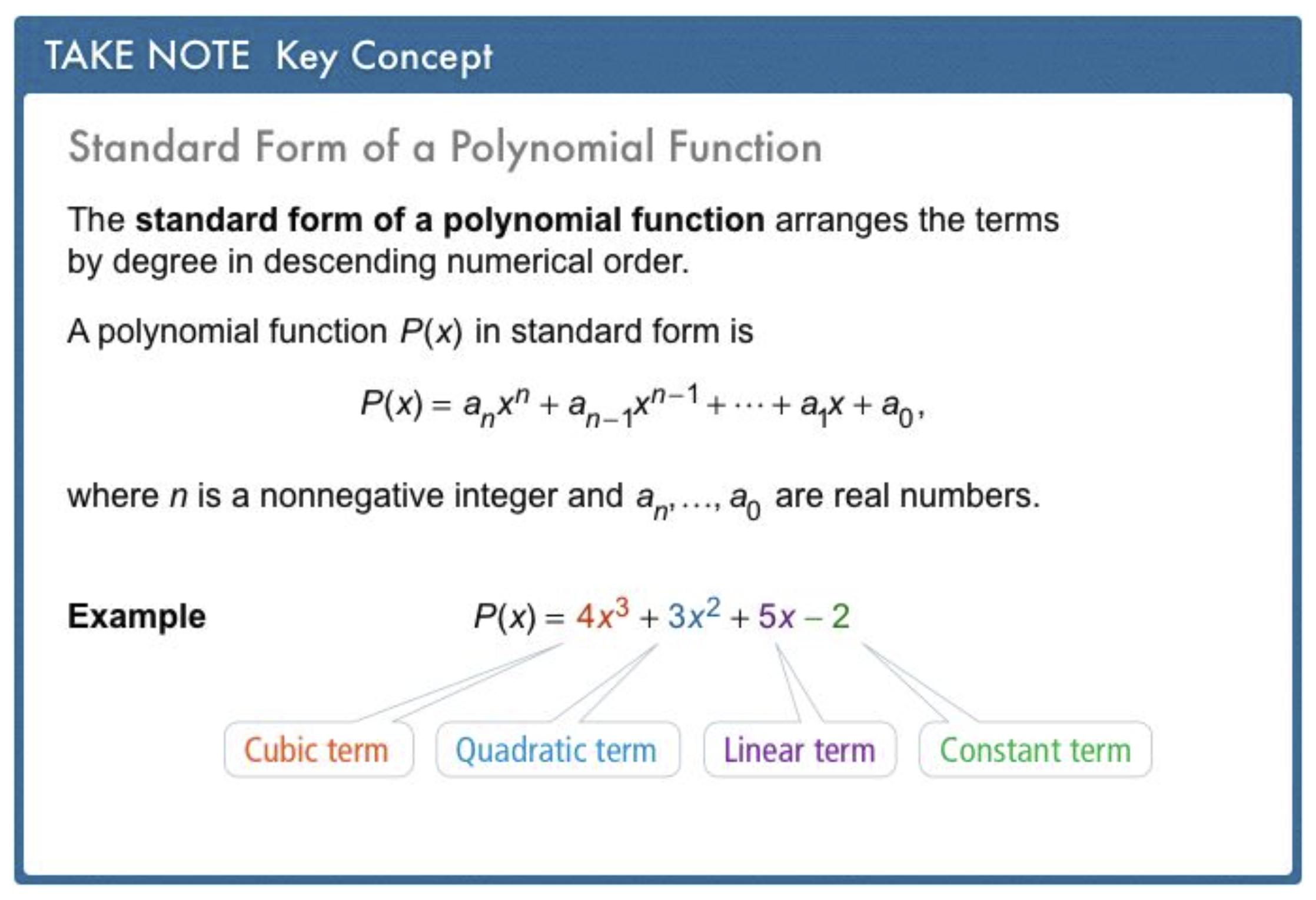
Take Note: Which polynomial functions are in standard form? Select all that apply.
Take Note: Sketch a graph that demonstrates Up and Up end behavior and has a turning point at (2, 3). Use a contrasting color.
Take Note: Sketch a graph that demonstrates Up and Down end behavior and has a turning point at (-2, 2). Use a contrasting color.
Problem 4 Got It? Reasoning: What is an example of a polynomial function whose fifth differences are constant, but whose fourth differences are not constant?