Algebra 2 7-1 Guided Practice: Exploring Exponential Models
star
star
star
star
star
Last updated almost 4 years ago
39 Nsɛmmisa

3
10
A.CED.2

3
30
F.IF.7.e
10
F.IF.7.e

3
3
20
3
10
A.CED.2
10
A.CED.2

3

Video Check: Select all that apply with regards to the video embedded directly above this item.
Embedded below is an online Tower of Hanoi puzzle that you may find helpful.
Solve It! You are to move the stack of 5 rings to another post.
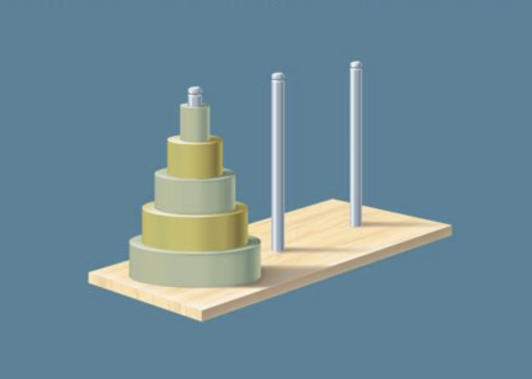
Here are the rules:
◆ A move must consist of taking the top ring from one post and placing it onto another post.
◆ You can move only one ring at a time.
◆ Do not place a ring on top of a smaller ring.
Consider the fewest number of moves needed to solve pyramids composed of 1, 2, 3... rings. Match the correct minimum number of moves on the left with each pyramid described on the right.
Hint: Consider modeling the scenario with an equation in the following format:
where m = number of moves, n = number of rings, and a is a constant.
1 move
2 moves
3 moves
5 moves
10 moves
31 moves
42 moves
1023 moves
1,048,575 moves
2,531,703 moves
Pyramid with 1 ring
Pyramid with 2 rings
Pyramid with 5 rings
Pyramid with 10 rings
Pyramid with 20 rings
Video Check: Select all that apply with regards to the video embedded directly above this item.

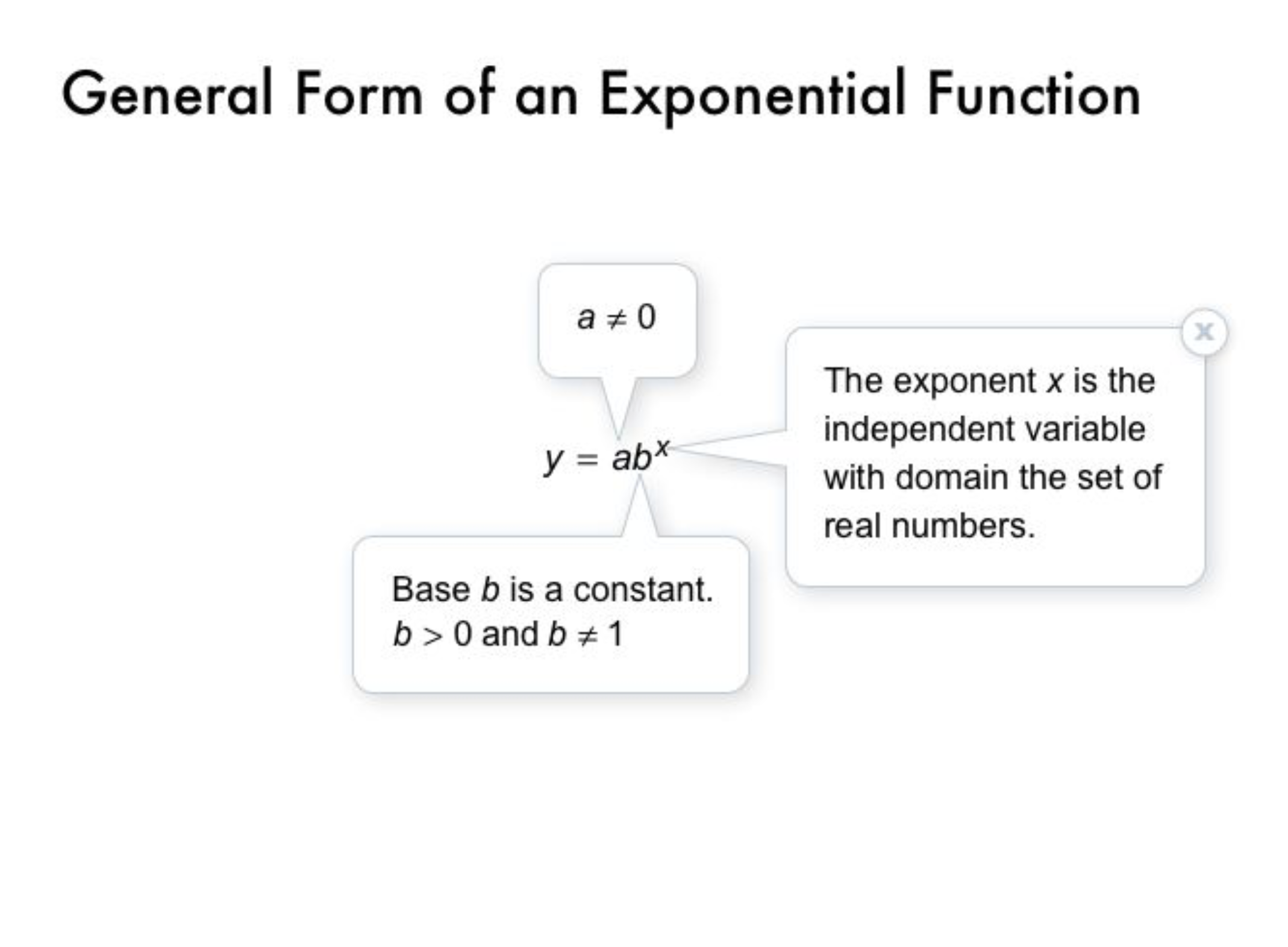
Take Note: What is the general form of an exponential function? Enter only the equation.
Problem 1 Got It? Graph the functions in the same coordinate plane using contrasting colors. Include all relevant graph detail and label the functions.
Graph the functions by hand first, but you may check your graphs with Desmos and make edits as needed.
You may also complete your work on paper or on a whiteboard and upload a clear picture of it to the canvas.
Problem 1 Got It? Reasoning: What generalization(s) can you make about the domain, range, and y-intercepts of these functions? Select all that apply.
Video Check: Select all that apply with regards to the video embedded directly above this item.

Take Note: What is an asymptote ?
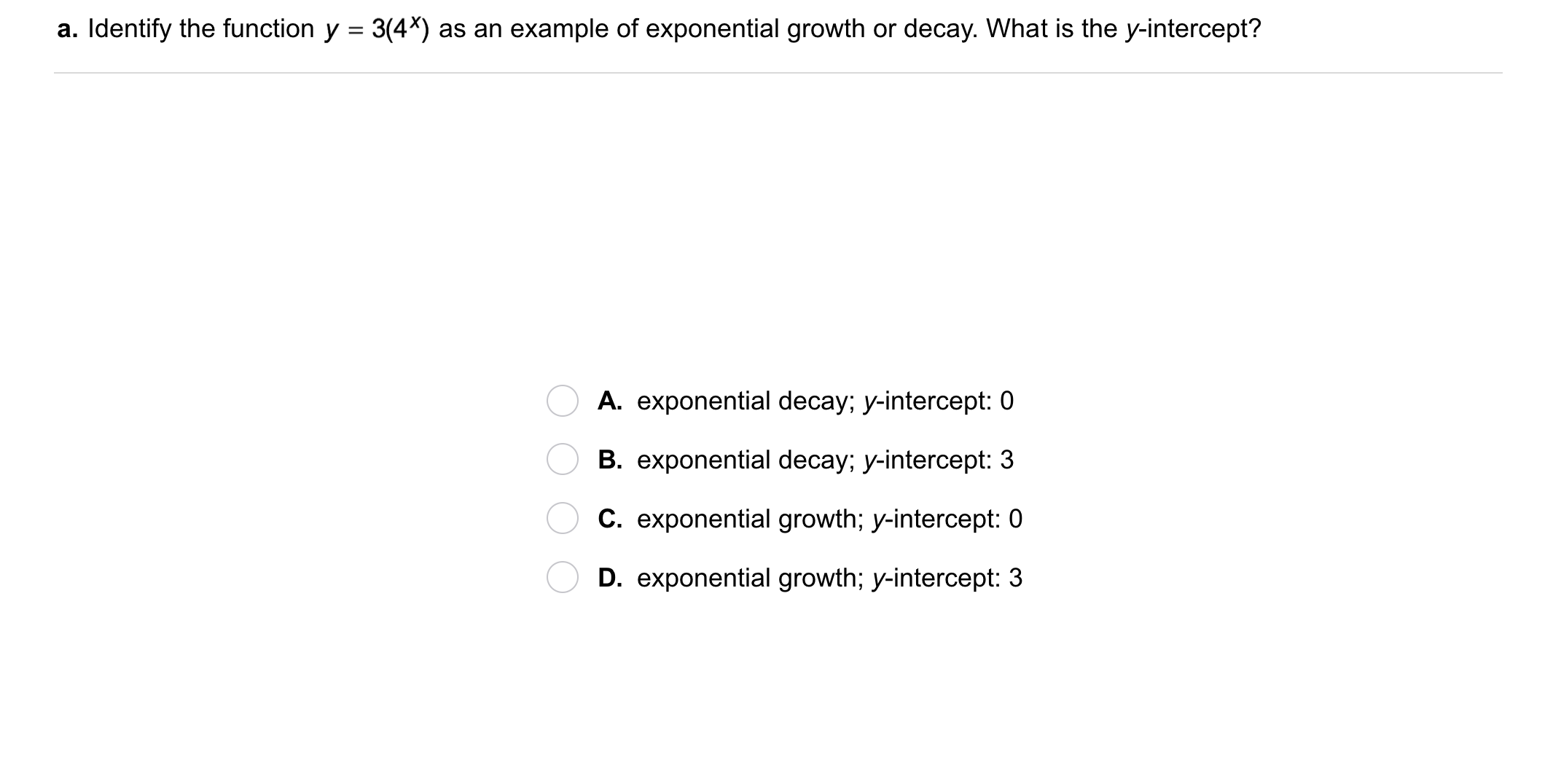
Problem 2 Got It?
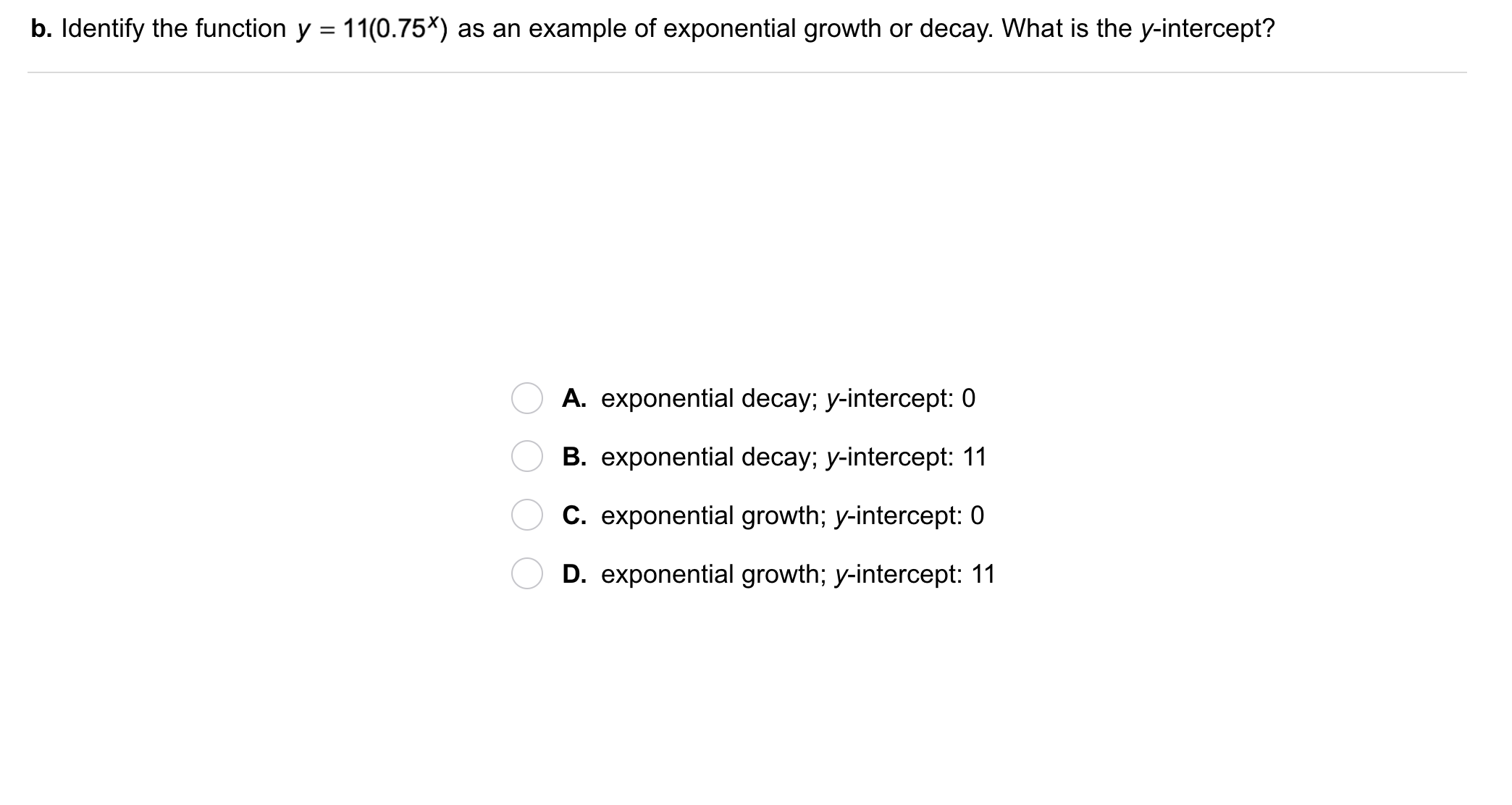
Problem 2 Got It?
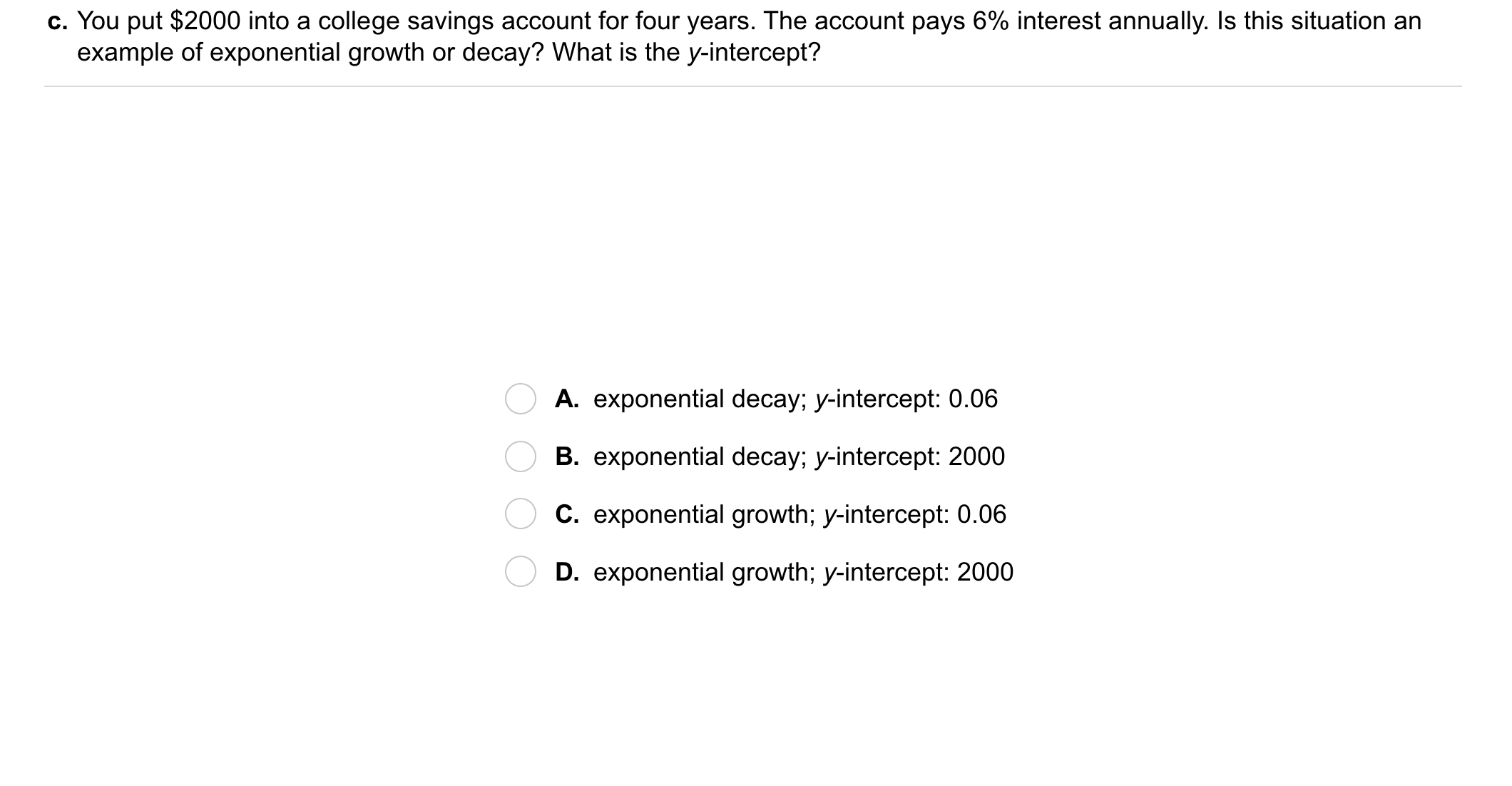
Problem 2 Got It? You put $2000 into a college savings account for four years. The account pays 6% interest annually. Is this situation an example of exponential growth or decay? What is the y-intercept?
Video Check: Select all that apply with regards to the video embedded directly above this item.

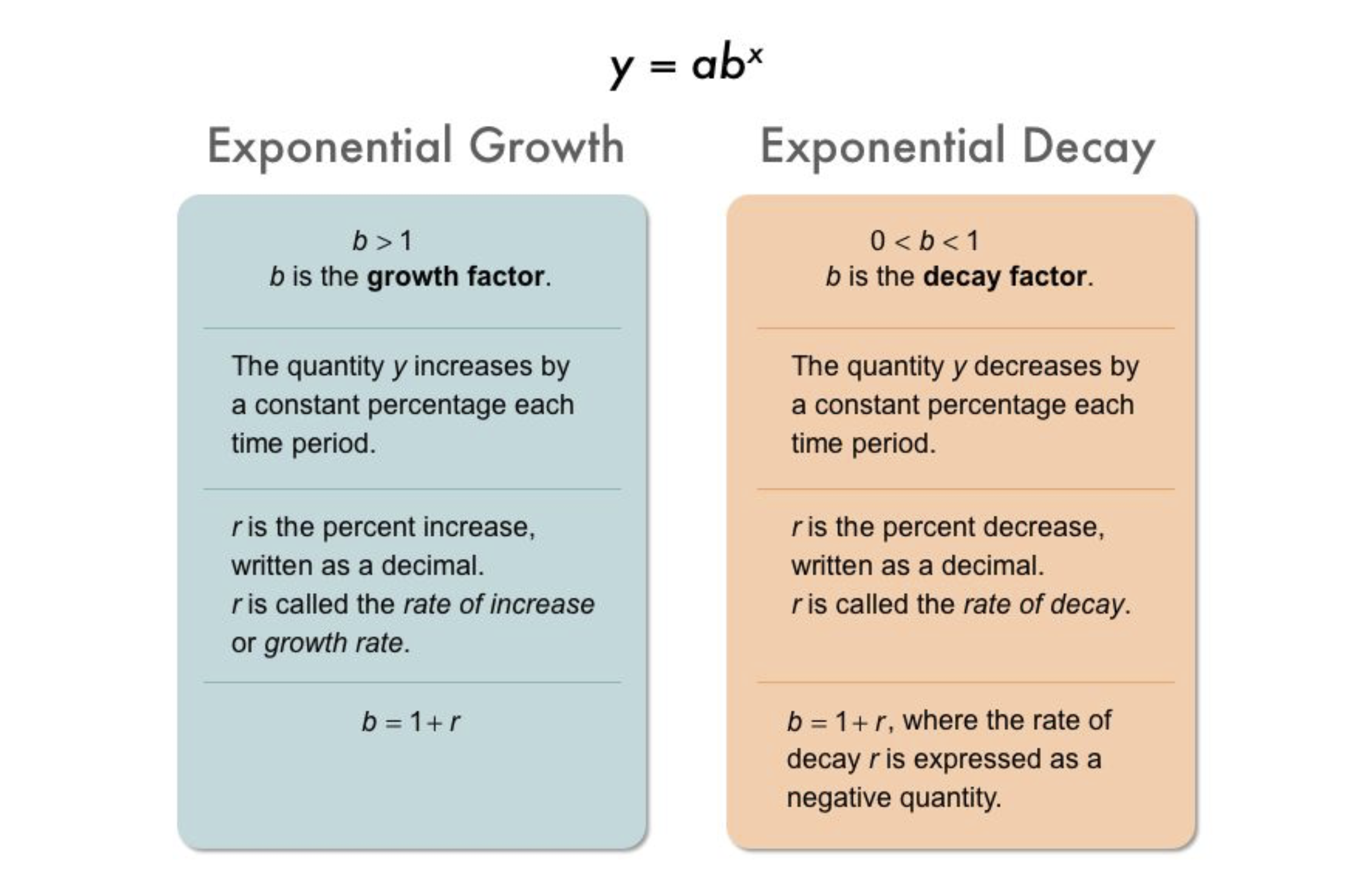
Take Note: Consider the general form of an exponential function.
Categorize each of the items on the left as representing either exponential growth or exponential decay.
y increases by a constant percentage each time period
b is the growth factor
r is the percent increase, written as a decimal & is called the rate of increase or growth rate
b > 1
b = 1 + r (r is a negative quantity)
y decreases by a constant percentage each time period
b = 1 + r (r is a positive quantity)
b is the decay factor
0 < b < 1
r is the percent decrease, written as a decimal & is called the rate of decay or decay rate
Exponential growth
Exponential decay

Take Note:
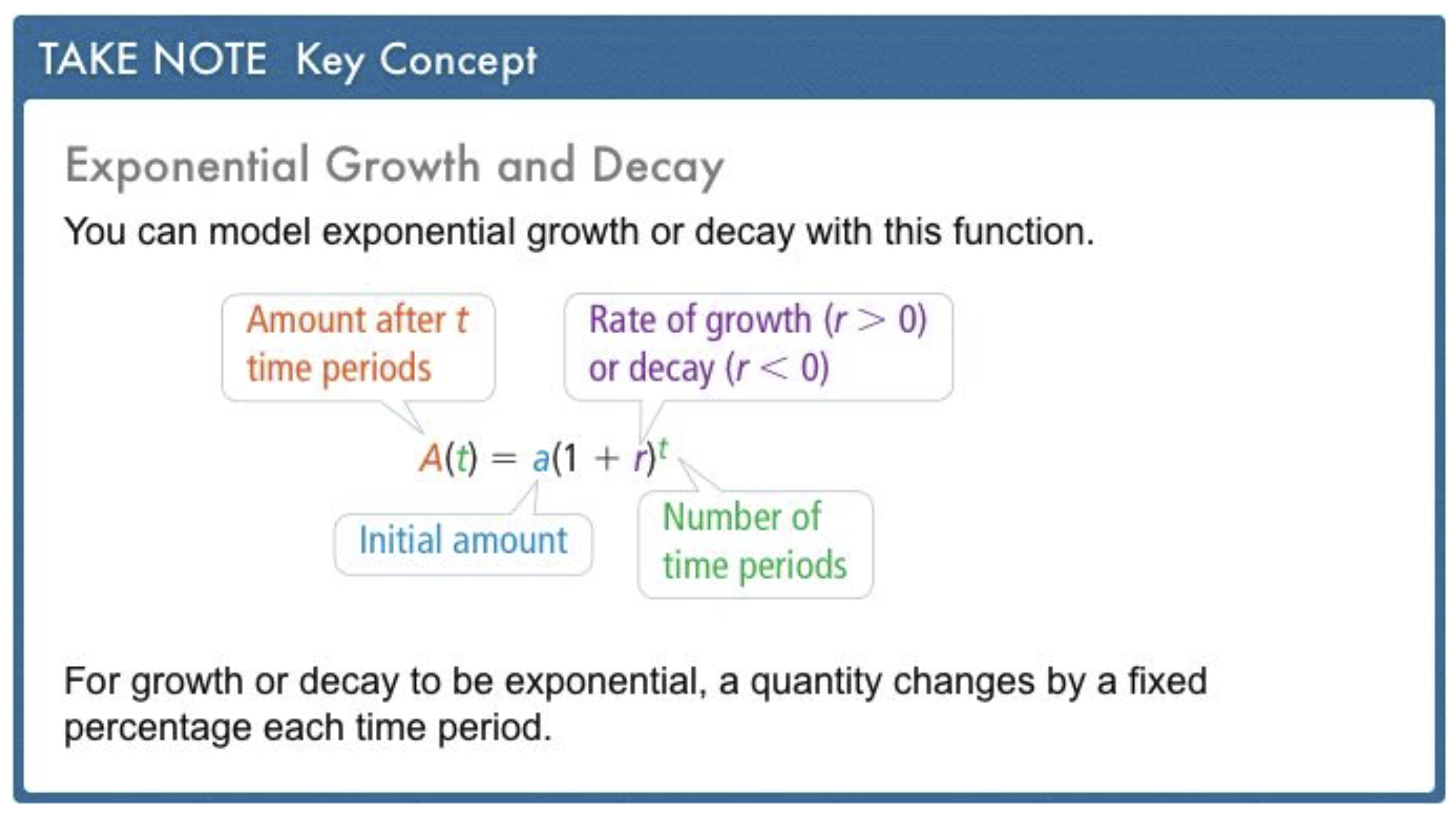
What does
Take Note:
What does t represent?
Take Note:
What does a represent?
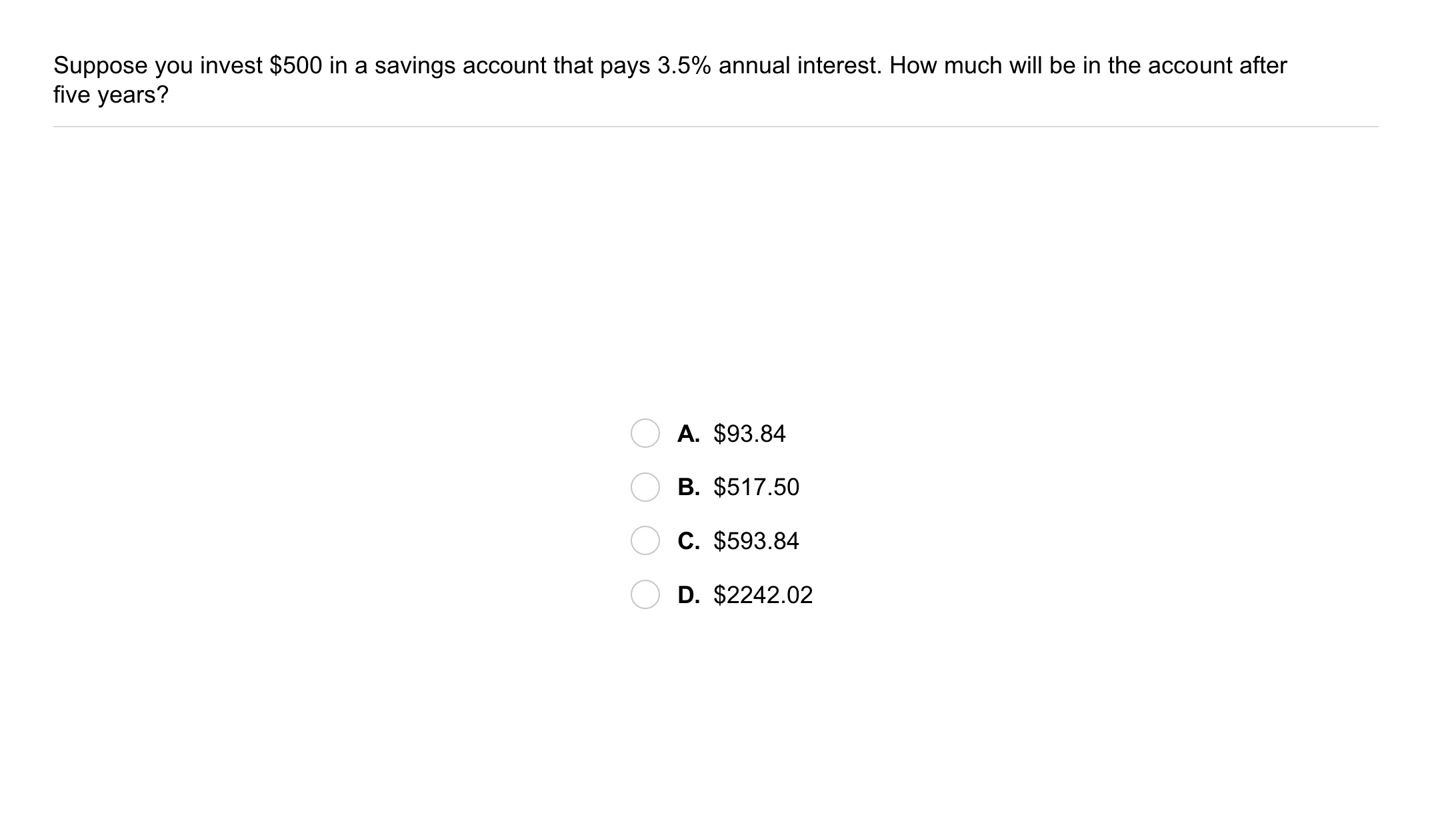
Problem 3 Got It? Suppose you invest $500 in a savings account that pays 3.5% annual interest. How much will be in the account after five years?
Video Check: Select all that apply with regards to the video embedded directly above this item.

Take Note: Summarize the process of using exponential growth and a table that was demonstrated in Problem 4.
Problem 4 Got It? Suppose you invest $500 in a savings account that pays 3.5% annual interest. When will the account contain at least $650?
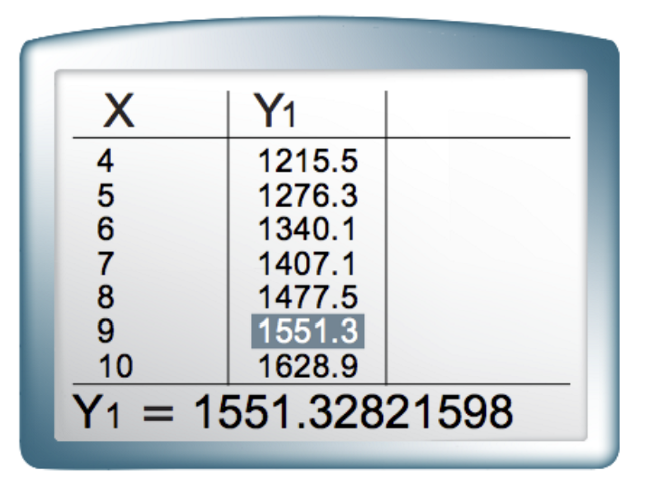
Problem 4 Got It? Reasoning: Use the table in Problem 4 (provided again below) to determine when that account will contain at least $1650. Explain.
Video Check: Select all that apply with regards to the video embedded directly above this item.

Take Note: What is the difference between discrete functions and continuous functions?
Take Note: Sketch a discrete function using orange and a continuous function using blue.
Take Note: How can you determine the growth factor or decay factor from discrete data?
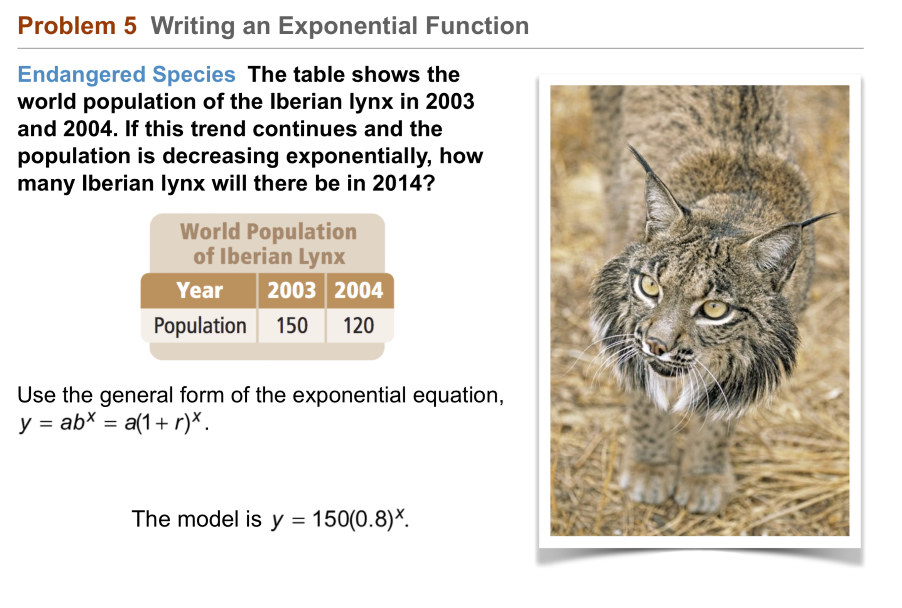
Problem 5 Got It? For the model in Problem 5, what will the world population of liberian lynx in 2020?

🧠 Retrieval Practice:
Summarize the mathematical content of this lesson. What topics, ideas, and vocabulary were introduced?
Take Note: In the general form of an exponential function,
Take Note: In the general form of an exponential function,
Take Note: In the general form of an exponential function,
Take Note: What is the domain of ALL exponential functions?
Take Note: Consider the general form of an exponential function.
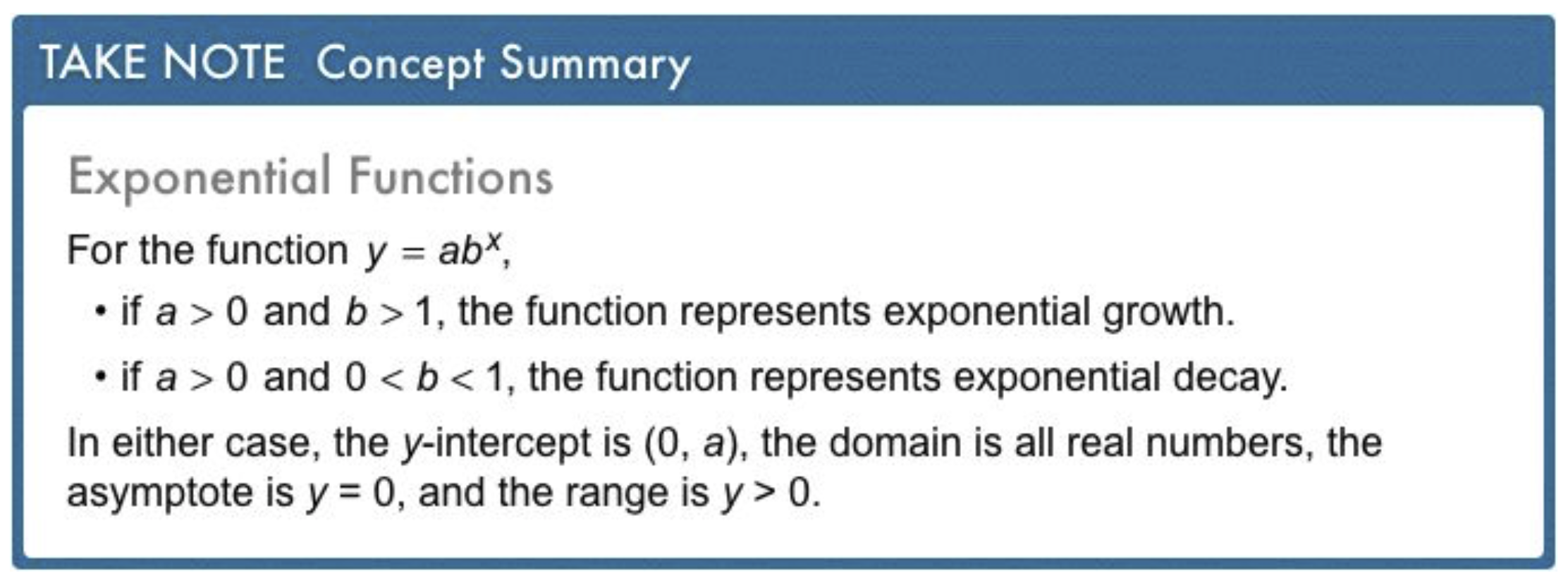
If the function represents exponential growth, what do you know about a and b ?
Select all that apply.
Take Note: Consider the general form of an exponential function.
If the function represents exponential decay, what do you know about a and b ?
Select all that apply.
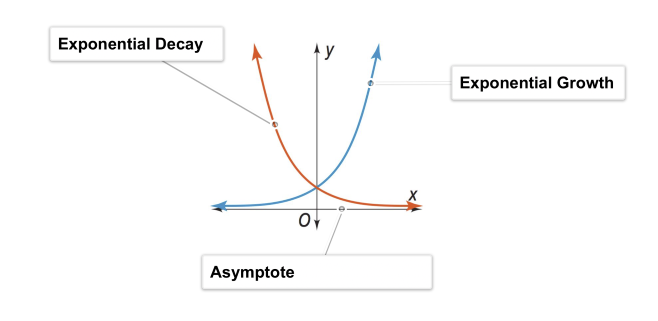
Take Note: Graph an example of an exponential growth function. Zoom and pan your graph to establish an appropriate viewing window.
Take Note: Graph an example of an exponential decay function. Zoom and pan your graph to establish an appropriate viewing window.
Take Note: Sketch the graph of an exponential growth function with a horizontal asymptote at
Take Note: What is the range of ALL exponential growth and exponential decay functions?
Take Note:
What does r represent?
Problem 5 Got It? Reasoning: If you graphed the model in Problem 5, would it ever cross the x-axis? Explain.