Prehistory*
star
star
star
star
star
Last updated almost 6 years ago
16 Nsɛmmisa
2
2
2
2
2
2
2
2
2
10
4
4
4
4
6
10
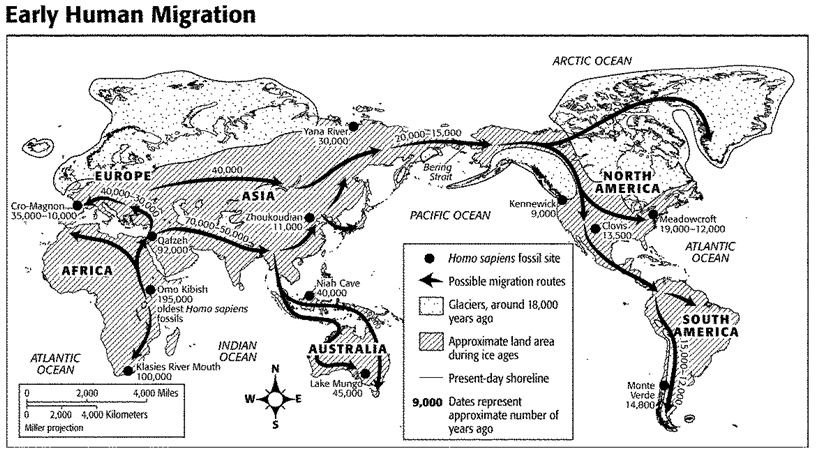
USE THE IMAGE ABOVE FOR QUESTIONS 1, 2, AND 3:
(DOK 1) Early humans migrated to the continent of Australia _____ years ago.
(DOK 1) Cro-Magnon fossils dating back to 35,000-10,000 years ago, were discovered on which continent?
(DOK 2) How many years passed between the discovery of Omo Kibish in Ethiopia and the discovery of fossils in Monte Verde, Chile?
(DOK 1) Which of the following statements most aptly describes Paleolithic society?
(DOK 1) Which of the following geologic changes most likely made the Earth's climate better suited to grow plants?
USE THIS TEXT FOR QUESTIONS 6, 7, AND 8:
In 1973, Donald Johanson was in the Afar, part of the Hadar region of Ethiopia, with the International Afar Research Expedition. He made a dramatic fossil find -- the leg bones of 3-million-year-old hominid. The bones' size and shape indicated that this individual walked upright, making it the oldest hominid on record to do so. This discovery helped Johanson raise enough money to continue the expedition in the Afar.
On November 30, 1974, Johanson and another member of the expedition discovered small bones from one individual -- it was a hominid, but looked different from any they were familiar with. Everyone at the site joined in the search for more of this specimen and collected hundreds of pieces. The pieces did appear to be from the same individual, and made up 40 percent of a skeleton. The pelvis showed it had been a female, and the team named her Lucy after the Beatles' song "Lucy in the Sky with Diamonds."
Lucy had a small brain and was only about one meter tall. Since bones from both left and right sides were found, mirror images could be constructed to put together 70 percent of her skeleton. More than one dating technique put her age at about 3.5 million years. (Johanson's earlier leg bone find was dated at 4 million years old.) The team kept working at the site and found other, more modern hominids together with stone tools. By 1976, however, Ethiopia's political situation was unstable, making further excavations unsafe or impossible.
In 1978, Mary Leakey discovered ancient footprints preserved in the ground around what was once a water hole at Laetoli, Tanzania. These prints showed clearly that small primates walked on two feet there. This put upright walking even further back in time.
Johanson and his colleague Tim White compared Leakey's finds at Laetoli with theirs from Afar, and felt that they were very similar, probably representing a stage between apes and humans. They categorized them both as Australopithecus afarensis. Leakey disagreed, but both of their finds broke a long-standing assumption: that humans developed big brains before walking upright. After 1974, scientists realized that this wasn't necessarily true, and that brain size overlaps between types of hominids, even as modern people's brains vary in size without relation to intelligence. This meant they had to look again at why hominids started walking upright. It had been thought that the big-brained creatures started using tools, and to free up their hands, they had to walk upright. But Lucy walked on two feet, and even had "modern" hands, yet showed no evidence of using tools. - PBS, Peoples and Discoveries
(DOK 1) How did Donald Johanson and other members of the expedition determine the skeletal remains were female?
(DOK 2) Donald Johanson is an American paleo-anthropologist. Based on the text above, which description BEST describes what an anthropologist does?
(DOK 2) Donald Johanson and Mary Leakey's discoveries disproved the long-standing assumption that early humans...
(DOK 2) Which Neolithic Revolution development led to the other three?
(DOK 2) Differentiate between the five species by placing each physical trait and/or achievement with the correct hominid.
First to use symbols and language for communication.
Body type resembled modern man's - strong musculature, straight forehead, and prominent chin.
Had opposable thumbs to pick up and hold objects.
Learned to make and use crude tools.
Engaged in religious activities such as burying their dead.
Began to walk with a upright posture, which allowed for endurance running.
Earliest hominid whose footprints date back to 3 million years ago.
These hominids are known as the archetypal “cavemen.”
Responsible for cave paintings throughout Europe, in particular France and Spain.
Jokingly referred to as the "handy man."
Australopithecines
Cro-Magnons
Homo erectus
Homo habilis
Neanderthals
(DOK 3) How would you determine the age of an artifact or a fossil using carbon dating?
(DOK 3) Differentiate between an artifact and a fossil.
(DOK 3) Elaborate as to why the Neolithic Age experienced more warfare than the Paleolithic Age?
(DOK 3) Why are historians unsure about the accuracy of the information in this unit/chapter?
(DOK 3) Explain how archaeologists can prove that hominids migrated across the continents.
(DOK 3) Differentiate between the Paleolithic Age and Neolithic Age (Include a minimum of four characteristics per paragraph).